


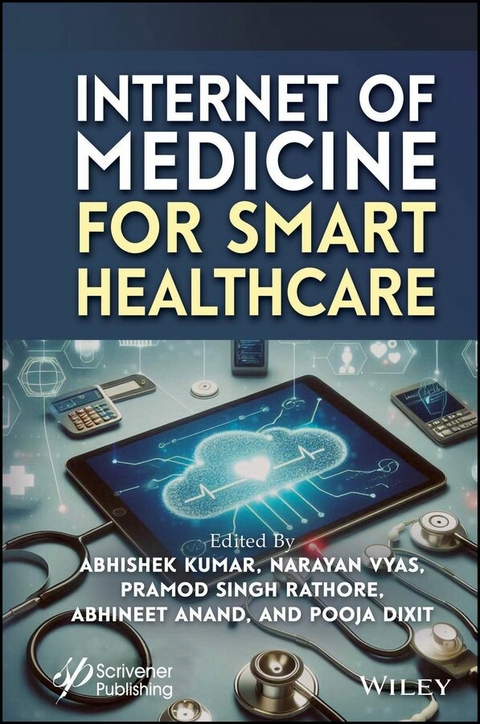
Internet of Medicine for Smart Healthcare (eBook)
837 Seiten
Wiley-Scrivener (Verlag)
978-1-394-27224-2 (ISBN)
This book provides in-depth explanations and discussions of the latest applications of Artificial Intelligence (AI), machine learning, and the Internet of Medicine, offering readers the cutting edge on this rapidly growing technology that has the potential to transform healthcare and improve patient outcomes.
Over the past five years, there have been significant advances in healthcare through the use of artificial intelligence (AI) and machine learning (ML) technologies. AI and machine learning in medical imaging has significantly improved the accuracy and speed of medical imaging analysis, accelerated the drug discovery process by identifying potential drug targets and predicting the efficacy and safety of new drugs, and enabled personalized medicine by analyzing large amounts of patient data to identify individualized treatment plans based on a patient's genetic makeup and medical history. Internet of Medicine (IoM) refers to the integration of the Internet of Things (IoT) and connected medical devices with healthcare systems and processes to enable remote monitoring, diagnosis, and treatment of patients. IoM is a subset of the larger Internet of Things concept, which involves the connection of everyday devices and appliances to the internet for various purposes. IoM has the potential to revolutionize healthcare by improving patient outcomes, reducing costs, and increasing efficiency. Some of the specific applications of IoM include remote patient monitoring, real-time data analysis, predictive analytics, smart hospitals, and personalized medicine.
Abhishek Kumar, PhD, is an assistant director and associate professor in the Computer Science and Engineering Department in Chandigarh University, Punjab, India. He has over 13 years of academic experience with more than 100 publications in reputed, peer-reviewed national and international journals, books, and conferences. Additionally, he has also authored six books and edited 25 books that have been internationally published. He is also a member of various national and international professional societies in the field of engineering and research, including the Institute of Electrical and Electronics Engineers, International Association of Engineers, and Institute of Research Engineers and Doctors.
Narayan Vyas is a principal research consultant at AVN Innovations, where he is actively involved in research and development in computer science and engineering. He qualified for the National Testing Agency's University Grants Commission National Eligibility Test and Junior Research Fellowship on his first attempt, showcasing his academic excellence. He has published many articles in reputed, peer-reviewed national and international Scopus journals and conferences. Additionally, he has served as a keynote speaker and resource person for several workshops and webinars conducted in India.
Pramod Singh Rathore is an assistant professor in the Department of Computer and Communication Engineering, Manipal University, Jaipur. With over 11 years of academic teaching experience, he has published more than 55 papers in reputable, peer-reviewed national and international journals, books, and conferences and co-authored and edited numerous books with well-known publishers. He serves on the editorial and advisory committees of the Global Journal Group and is a member of various national and international professional societies in the field of engineering and research, including the International Association of Engineers.
Abhineet Anand, PhD, is the Director in the department of Advanced Information Technology-Computer Science and Engineering, Chandigarh University with over 22 years of experience. He has published more than 40 Scopus-indexed papers, 25 papers in international conferences, eight international journals, three national journals, and three national conferences. He has been part of 20 special sessions at various international conferences as a session chair/co-chair and contributed at 20 different conferences as a Technical Program Committee member.
Pooja Dixit is visiting faculty in the Department of Computer Science and Engineering, Maharshi Dayanand Saraswati University, Ajmer, India with over eight years of experience. She has published many papers in reputable, peer-reviewed national and international journals, books, and conferences. Her research includes Artificial intelligence, Data Mining, Machine Learning, and Internet of Things.
This book provides in-depth explanations and discussions of the latest applications of Artificial Intelligence (AI), machine learning, and the Internet of Medicine, offering readers the cutting edge on this rapidly growing technology that has the potential to transform healthcare and improve patient outcomes. Over the past five years, there have been significant advances in healthcare through the use of artificial intelligence (AI) and machine learning (ML) technologies. AI and machine learning in medical imaging has significantly improved the accuracy and speed of medical imaging analysis, accelerated the drug discovery process by identifying potential drug targets and predicting the efficacy and safety of new drugs, and enabled personalized medicine by analyzing large amounts of patient data to identify individualized treatment plans based on a patient s genetic makeup and medical history. Internet of Medicine (IoM) refers to the integration of the Internet of Things (IoT) and connected medical devices with healthcare systems and processes to enable remote monitoring, diagnosis, and treatment of patients. IoM is a subset of the larger Internet of Things concept, which involves the connection of everyday devices and appliances to the internet for various purposes. IoM has the potential to revolutionize healthcare by improving patient outcomes, reducing costs, and increasing efficiency. Some of the specific applications of IoM include remote patient monitoring, real-time data analysis, predictive analytics, smart hospitals, and personalized medicine.
1
Omics Data Integration in AI System for Immediate and Carryover Effects of Neurodynamic Exercises on SLR Ranges Among Acute PIVD Patients
Durga Bahuguna, Vaibhav Agarwal* and Manish Kumar Jha
Department of Physiotherapy, Himalayan Institute of Medical Sciences, Swami Rama Himalayan University, Jolly Grant, Dehradun, India
Abstract
Prolapsed interverterbral disc (PIVD) is a disease that occurs when there is a rupture of annulus fibrosus, which further leads to an effusion of nucleus purposes. In order to obtain a more thorough knowledge of a biological system, data from several omics technologies—such as transcriptomics, proteomics, metabolomics, and genomics—are combined in a process known as “omics data integration.” Thus, different medical data of each patient are collected, which makes easy for their treatment. The aim of this study is to analyze the immediate and carryover effects of neurodynamic exercises on straight leg raise test ranges among acute PIVD patients using omics data integration in artificial intelligence (AI) system. There is no evidence-based study on neurodynamic exercises including static opener and four levels of sliders and tensioners to decrease the mechanosensitivity and nerve root irritation among acute PIVD patients, to promote more tolerance to exercises with less pain experience, and to decrease more reliability over electrotherapy, using omics data integration in AI system. This study can be further carried by comparing the age and gender by giving two different interventions, and their effectiveness can be seen in longer period of time, which becomes easy due to AI.
Keywords: AI, data integration, SLR, neurodynamics, omics, PIVD
1.1 Introduction
Prolapsed interverterbral disc (PIVD) is a disease that occurs when there is a rupture of annulus fibrosus, which further leads to an effusion of nucleus pulposus [1, 2]. Lumbar disc herniation is a frequent condition that affects 5% of individuals in adults [3]. In the world, the incidence of PIVD in males is from 1.9% to 7.6%, and, in females, it is between 2.2% and 5.0% [4]. It is one of the most common condition among low back ache (LBA) patients, which affects about 10% of the population [5, 6]. It consists of four stages that are nucleus degeneration, nucleus displacement, protusion, and extrusion [7, 8].
Studies have been conducted in usefulness of various physical examination results. They suggest that the straight leg raise (SLR) continues to remains the gold standard test for identifying the radicular symptoms [9]. Root irritation is typically thought to be present when the examiner elevates the affected limb and the pain reproduces or intensifies [10–15]. When the test reproduces pain in the gluteal or lower leg region as the examiner passively lifts the affected leg with the hip in flexion and knee in extension, it is said to be positive. The relevance given to the angle of elevation at which the pain is produced varies greatly. Brieg and Troups and others suggested that less than 70° is clinically relevant [16–19].
PIVD propulsion of disc leads to compression due to which there is compromised distal sliding of neural structures, which, in turn, possess challenges to physiotherapist in treatment of acute PIVD patients. There is no evidence-based study on neurodynamic exercises including static opener and four levels of sliders and tensioners to decrease the mechanosensitivity and nerve root irritation among acute PIVD patients. The purpose of this study was to analyze that neurodynamic exercise including static opener and four levels of sliders and tensioners can significantly alter neural mobility, SLR ranges, visual analog scale (VAS), and pain side code score [20–26].
The primary focus in gaining practical understanding of cellular processes is now on the examination of multi-omics data in conjunction with clinical informations. A methodical and thorough comprehension of complex biology seems to be possible through the integrations of multi-omics data relevant to biomolecule at several levels. They aid in evaluating the information transfer between omics levels and, hence, aid in closing the gap between genotype and phenotype. Integrative techniques can eventually contribute to better prevention and management because they can research biological phenomena holistically, which can enhance prognostics and the accuracy with which disease phenotypes are predicted [27–32].
The Omics Discovery Index (OmicsDI; https://www.omicsdi.org/) is a common data format that holds data sets from eleven repositories. Access, exploration, and integration of proteomics, transcriptomics, metabolomics, and genomics datasets are facilitated by this open-source platform. Human, model, and non-model organism datasets are all included. For each data collection that may be merged, OmicsDI includes an annotation as well as normalization stage in addition to indexing the data sets [33–36].
Numerous illnesses, including cancer, exhibit heterogeneity due to the notable variations in the extent of cancer growth across afflicted people. Furthermore, a variety of other variables, including lifestyle and environment, may contribute to illness heterogeneity. Therefore, in order to fully comprehend the etiology of the disorder and choose appropriate therapies for patient belonging to distinct subtype, it is essential to identify the underlying subcategories of diseases or categorize samples into recognized subgroups. A number of methods are available that use multi-omics data from sample to determine disease subtype or categorize different samples according to their omics profile. This section covers the instruments used to comprehend sample subgrouping according to underlying molecular patterns [35].
1.2 Literature Review
A systemic review to analyze the effectiveness of exercises program after lumbar discectomy surgery, by Nafsika Atsidakou et al., in Journal of Clinical Orthopaedics and Trauma (2021): The current systemic review found that the included studies’ methodologically quality, as measured by PEDro, is regarded moderate. Exercise programs are advised for patients who have undergone lumbar discectomy because the results indicated that they improved pain, disability, quality of life, muscle strength, and ability to return to work [1].
Prolapsed, herniated, or extruded intervertebral disc treatment by only stabilization, by Atul Goel et al., in Journal of Craniovertebral Junction and Spine (2018): This study suggests that only fixation is also effective and safe in the management of lumbar herniated disc [2].
A case report and literature review: Spontaneous regression of a large sequestrated lumbar disc herniation, by Chengxiang Hu et al., in Journal of International Medical Research, SAGE (2021): In this study, it was concluded, that compared to individuals with protruding or bulging disc, those with the disc herniation subtype known as sequestration are substantially more likely to experience spontaneous regression, and it also suggested that, in the absence of clear-cut surgical indication, conservative treatment is preferred for individuals with a large herniated lumbar discs, particularly if it is of the extrusions or sequestration subtype [3].
A case report: Prolapsed lumbar interverterbral disease treatment through acupuncture, by Dr. S. M. Shahidul Islam et al., in Journal of Sports and Physical Education (2022): In this study, it was found that the patients having prolapsed lumbar intervertebral disc prolapse disease have significantly showed improvement in low back pain after doing exercises including lumbar mobilization, manipulation, isometric back muscle strengthening exercises, and acupuncture treatment in lumbar area [4].
A systemic “Review and meta-analysis: Efficacy of physiotherapy intervention in management of lumbar prolapsed intervertebral disc,” by Varun Singh et al., in International Journal of Health Sciences (2021): This study reveals that interventions in physiotherapy are successful in reducing pain and disability. Mechanisms involving physiology, biomechanics, and spinal mobility can be increased as a result of procedures including disc replacement foramina opening and intervertebral space expansion. This meta-analysis did not find any significant effects of physiotherapy on brain mobility [5].
A double blind randomized controlled trial: Effect of neurodynamic technique on radiating symptom and mechanosensitivity of neural tissue in subjects with lumbosacral radiculopathy, by Mohit Bipin et al., in International Journal of Medical Science and Public Health (2021). This study revealed that patients with lumbosacral radiculopathy, neurodynamic treatments are useful in inducing centralization, lowering the mechanosensitivity of the neural tissues and decreasing the bothersomeness and frequency of radiating symptoms [6].
Randomized Control Trial: “Effect of Mckenzie approach and Mulligan’s mobilization (SNAGS) in lumbar disc prolapse with unilateral radiculopathy,” by Trupti Warude et al., in International Journal of Science and Research (2014): In this study, the results showed that, in PIVD with unilateral radiculopathy, Mulligan’s mobilization (SNAGS) technique showed more significant improvement than Mckenzie approach in response to...
| Erscheint lt. Verlag | 12.12.2024 |
|---|---|
| Sprache | englisch |
| Themenwelt | Mathematik / Informatik ► Informatik ► Theorie / Studium |
| ISBN-10 | 1-394-27224-3 / 1394272243 |
| ISBN-13 | 978-1-394-27224-2 / 9781394272242 |
| Informationen gemäß Produktsicherheitsverordnung (GPSR) | |
| Haben Sie eine Frage zum Produkt? |
 EPUB (Adobe DRM)
Kopierschutz: Adobe-DRM
Adobe-DRM ist ein Kopierschutz, der das eBook vor Mißbrauch schützen soll. Dabei wird das eBook bereits beim Download auf Ihre persönliche Adobe-ID autorisiert. Lesen können Sie das eBook dann nur auf den Geräten, welche ebenfalls auf Ihre Adobe-ID registriert sind.
Details zum Adobe-DRM
Dateiformat: EPUB (Electronic Publication)
EPUB ist ein offener Standard für eBooks und eignet sich besonders zur Darstellung von Belletristik und Sachbüchern. Der Fließtext wird dynamisch an die Display- und Schriftgröße angepasst. Auch für mobile Lesegeräte ist EPUB daher gut geeignet.
Systemvoraussetzungen:
PC/Mac: Mit einem PC oder Mac können Sie dieses eBook lesen. Sie benötigen eine
eReader: Dieses eBook kann mit (fast) allen eBook-Readern gelesen werden. Mit dem amazon-Kindle ist es aber nicht kompatibel.
Smartphone/Tablet: Egal ob Apple oder Android, dieses eBook können Sie lesen. Sie benötigen eine
Geräteliste und zusätzliche Hinweise
Buying eBooks from abroad
For tax law reasons we can sell eBooks just within Germany and Switzerland. Regrettably we cannot fulfill eBook-orders from other countries.
aus dem Bereich


