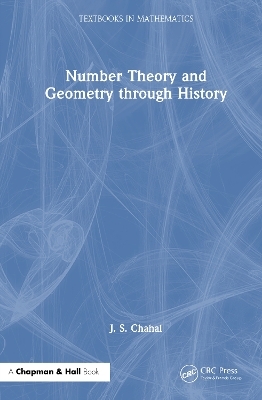
Number Theory and Geometry through History
CRC Press (Verlag)
978-1-041-01175-0 (ISBN)
This is a unique book that teaches mathematics and its history simultaneously. Developed from a course on the history of mathematics, this book is aimed at mathematics teachers who need to learn more about mathematics than its history, and in a way they can communicate it to middle and high school students. The author hopes to overcome, through the teachers using this book, math phobia among these students.
Number Theory and Geometry through History develops an appreciation of mathematics by not only looking at the work of individual, including Euclid, Euler, Gauss, and more, but also how mathematics developed from ancient civilizations. Brahmins (Hindu priests) devised our current decimal number system now adopted throughout the world. The concept of limit, which is what calculus is all about, was not alien to ancient civilizations as Archimedes used a method similar to the Riemann sums to compute the surface area and volume of the sphere.
No theorem here is cited in a proof that has not been proved earlier in the book. There are some exceptions when it comes to the frontier of current research.
Appreciating mathematics requires more than thoughtlessly reciting first the ten by ten, then twenty by twenty multiplication tables. Many find this approach fails to develop an appreciation for the subject. The author was once one of those students. Here he exposes how he found joy in studying mathematics, and how he developed a lifelong interest in it he hopes to share.
The book is suitable for high school teachers as a textbook for undergraduate students and their instructors. It is a fun text for advanced readership interested in mathematics.
Dr. J. S. Chahal is a professor of mathematics at Brigham Young University. He earned a PhD from Johns Hopkins University. After spending a couple of years at the University of Wisconsin as a postdoc, he joined Brigham Young University as an assistant professor and has been there ever since. He specializes in and has published several papers in number theory. For hobbies, he likes to travel and hike. His books, Fundamentals of Linear Algebra, and Algebraic Number Theory, are also published by CRC Press.
I Arithmetic
1 What is a Number?
1.1 Various Numerals to Represent
2 Arithmetic in Different Bases
3 Arithmetic in Euclid’s Elements
4 Gauss–Advent of Modern Number Theory
4.1 Number Theory of Gauss
4.2 Cryptography
4.3 Complex Numbers
4.4 Application of Number Theory – Construction of Septadecagon
4.5 How Did Gauss Do It?
4.6 Equations over Finite Fields*
4.7 Law of Quadratic Reciprocity*
4.8 Cubic Equations*
4.9 Riemann Hypothesis*
5 Numbers beyond Rationals
5.1 Arithmetic of Rational Numbers
5.2 Real Numbers
II Geometry
6 Basic Geometry
7 Greece: Beginning of Theoretical Mathematics
8 Euclid: The Founder of Pure Mathematics
8.1 Some Comments on Euclid’s Proof
9 Famous Problems from Greek Geometry
III Contributions of Some Prominent Mathematicians
10 Fibonacci’s Time and Legacy
10.1 Liber Abaci
10.2 Liber Quadratorum
10.3 Equivalent Formulations of the Problems
11 Solution of the Cubic
11.1 Introduction
11.2 History
12 Leibniz, Newton, and Calculus
12.1 Differential Calculus
12.2 Integral Calculus
12.3 Proof of FTC
12.4 Application of FTC
13 Euler and Modern Mathematics
13.1 Algebraic Number Theory
13.2 Analytical Number Theory
13.3 Euler’s Discovery of eπi + 1 = 0
13.4 Graph Theory and Topology
13.5 Traveling Salesman Problem
13.6 Planar Graphs
13.7 Euler-Poincaré Characteristic
13.8 Euler Characteristic Formula
14 Non-European Roots of Mathematics
15 Mathematics of the 20th Century*
15.1 Hilbert’s 23 Problems
1 Riemann Hypothesis
2 Poincaré Conjecture
3 Birch & Swinnerton-Dyer (B&S-D) Conjecture
15.2 Fermat’s Last Theorem
15.3 Miscellaneous
| Erscheinungsdatum | 01.05.2025 |
|---|---|
| Reihe/Serie | Textbooks in Mathematics |
| Zusatzinfo | 81 Line drawings, black and white; 81 Illustrations, black and white |
| Verlagsort | London |
| Sprache | englisch |
| Maße | 156 x 234 mm |
| Gewicht | 460 g |
| Themenwelt | Mathematik / Informatik ► Mathematik ► Allgemeines / Lexika |
| Mathematik / Informatik ► Mathematik ► Algebra | |
| Mathematik / Informatik ► Mathematik ► Arithmetik / Zahlentheorie | |
| Mathematik / Informatik ► Mathematik ► Geometrie / Topologie | |
| Mathematik / Informatik ► Mathematik ► Geschichte der Mathematik | |
| ISBN-10 | 1-041-01175-X / 104101175X |
| ISBN-13 | 978-1-041-01175-0 / 9781041011750 |
| Zustand | Neuware |
| Informationen gemäß Produktsicherheitsverordnung (GPSR) | |
| Haben Sie eine Frage zum Produkt? |
aus dem Bereich