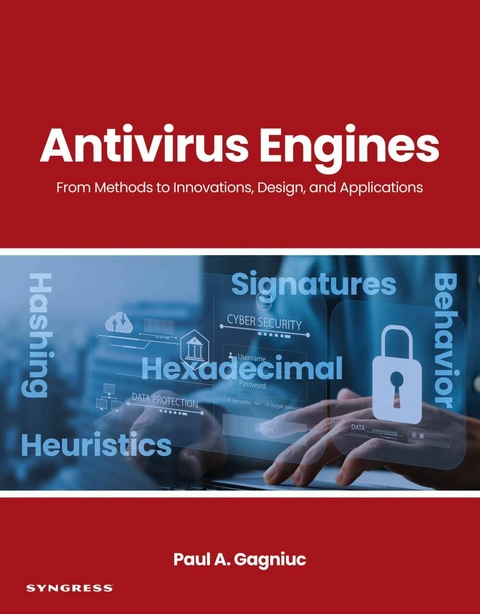
Antivirus Engines (eBook)
656 Seiten
Elsevier Science (Verlag)
9780443329531 (ISBN)
Dr. Paul A. Gagniuc is an associate professor of programming languages at University Politehnica of Bucharest (UPB) in Romania. Over a period of a decade, Dr. Gagniuc provided an original learning experience for many generations of students from many parts of the world. Dr. Gagniuc is the author of the most cited book in the history of University Politehnica of Bucharest. He has published numerous high-profile scientific research articles, patents, books and is the recipient of several awards for exceptional scientific results. He is also the creator of an antivirus project called Scut Antivirus, from which he brings his security expertise.
Antivirus Engines: From Methods to Innovations, Design, and Applications offers an in-depth exploration of the core techniques employed in modern antivirus software. It provides a thorough technical analysis of detection methods, algorithms, and integration strategies essential for the development and enhancement of antivirus solutions. The examples provided are written in Python, showcasing foundational, native implementations of key concepts, allowing readers to gain practical experience with the underlying mechanisms of antivirus technology.The text covers a wide array of scanning techniques, including heuristic and smart scanners, hexadecimal inspection, and cryptographic hash functions such as MD5 and SHA for file integrity verification. These implementations highlight the crucial role of various scanning engines, from signature-based detection to more advanced models like behavioral analysis and heuristic algorithms. Each chapter provides clear technical examples, demonstrating the integration of modules and methods required for a comprehensive antivirus system, addressing both common and evolving threats.Beyond simple virus detection, the content illustrates how polymorphic malware, ransomware, and state-sponsored attacks are tackled using multi-layered approaches. Through these examples, students, researchers, and security professionals gain practical insight into the operation of antivirus engines, enhancing their ability to design or improve security solutions in a rapidly changing threat environment. - Offers a thorough exploration of the mechanics behind antivirus detection methods, including signature-based detection, heuristic algorithms, and modern smart scanning techniques, with native source code examples to illustrate these core concepts- Provides fundamental native implementations of various antivirus engines, allowing readers to directly experiment with MD5, SHA, hexadecimal scanners, and heuristic models to expand their technical skills- Highlights practical case studies and examples of integrating antivirus software into real-world systems, helping cybersecurity professionals and developers design and implement robust protective measures adapted to evolving threats- Delivers actionable insights for business leaders, policymakers, and IT decision-makers, emphasizing the critical role antivirus software plays in safeguarding digital infrastructure, facilitating informed cybersecurity investments
| Erscheint lt. Verlag | 21.10.2024 |
|---|---|
| Sprache | englisch |
| Themenwelt | Mathematik / Informatik ► Informatik ► Grafik / Design |
| ISBN-13 | 9780443329531 / 9780443329531 |
| Informationen gemäß Produktsicherheitsverordnung (GPSR) | |
| Haben Sie eine Frage zum Produkt? |
 EPUB (Adobe DRM)
Kopierschutz: Adobe-DRM
Adobe-DRM ist ein Kopierschutz, der das eBook vor Mißbrauch schützen soll. Dabei wird das eBook bereits beim Download auf Ihre persönliche Adobe-ID autorisiert. Lesen können Sie das eBook dann nur auf den Geräten, welche ebenfalls auf Ihre Adobe-ID registriert sind.
Details zum Adobe-DRM
Dateiformat: EPUB (Electronic Publication)
EPUB ist ein offener Standard für eBooks und eignet sich besonders zur Darstellung von Belletristik und Sachbüchern. Der Fließtext wird dynamisch an die Display- und Schriftgröße angepasst. Auch für mobile Lesegeräte ist EPUB daher gut geeignet.
Systemvoraussetzungen:
PC/Mac: Mit einem PC oder Mac können Sie dieses eBook lesen. Sie benötigen eine
eReader: Dieses eBook kann mit (fast) allen eBook-Readern gelesen werden. Mit dem amazon-Kindle ist es aber nicht kompatibel.
Smartphone/Tablet: Egal ob Apple oder Android, dieses eBook können Sie lesen. Sie benötigen eine
Geräteliste und zusätzliche Hinweise
Buying eBooks from abroad
For tax law reasons we can sell eBooks just within Germany and Switzerland. Regrettably we cannot fulfill eBook-orders from other countries.
aus dem Bereich