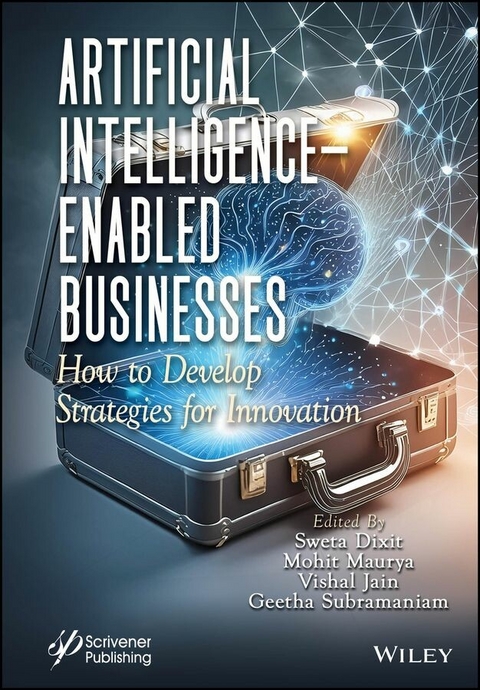
Artificial Intelligence-Enabled Businesses (eBook)
1011 Seiten
Wiley-Scrivener (Verlag)
978-1-394-23399-1 (ISBN)
This book has a multidimensional perspective on AI solutions for business innovation and real-life case studies to achieve competitive advantage and drive growth in the evolving digital landscape.
Artificial Intelligence-Enabled Businesses demonstrates how AI is a catalyst for change in business functional areas. Though still in the experimental phase, AI is instrumental in redefining the workforce, predicting consumer behavior, solving real-life marketing dynamics and modifications, recommending products and content, foreseeing demand, analyzing costs, strategizing, managing big data, enabling collaboration of cross-entities, and sparking new ethical, social and regulatory implications for business. Thus, AI can effectively guide the future of financial services, trading, mobile banking, last-mile delivery, logistics, and supply chain with a solution-oriented focus on discrete business problems. Furthermore, it is expected to educate leaders to act in an ever more accurate, complex, and sophisticated business environment with the combination of human and machine intelligence.
The book offers effective, efficient, and strategically competent suggestions for handling new challenges and responsibilities and is aimed at leaders who wish to be more innovative. It covers the early stages of AI adoption by organizations across their functional areas and provides insightful guidance for practitioners in the suitable and timely adoption of AI. This book will greatly help to scale up AI by leveraging interdisciplinary collaboration with cross-functional, skill-diverse teams and result in a competitive advantage.
Audience
This book is for marketing professionals, organizational leaders, and researchers to leverage AI and new technologies across various business functions. It also fits the needs of academics, students, and trainers, providing insights, case studies, and practical strategies for driving growth in the rapidly evolving digital landscape.
Sweta Dixit, PhD, is an associate professor in the Sharda School of Business Studies, Sharda University, Greater Noida, India. She has authored one book and published research articles and case studies on emotional intelligence, global mobility, performance management, and organizational culture. Dixit also conducts sessions on emotional intelligence, self-awareness, leadership, and negotiation skills.
Mohit Maurya, PhD, is an associate professor in the Sharda School of Business Studies, Sharda University, Greater Noida, India. He has published several research papers in national and international journals and delivered lectures on hyper-localization, digital marketing, branding, business ethics, etc. He has authored 3 books. His scholarly work won the Emerald - AUC School of Business Cast Writing Competition in 2020.
Vishal Jain, PhD, is an associate professor at Sharda University, Greater Noida, India. His research interests focus on information retrieval, the semantic web, ontology engineering, data mining, etc. He has edited 50 books for a variety of publishers and authored more than 100 research papers for reputed conferences and journals. Jain has several awards, which include the 2012 Young Active Member Award and the 2019 Best Researcher Award.
Geetha Subramaniam, PhD, is a professor at the Faculty of Education, Languages, Psychology, and Music, SEGI University, Kuala Lumpur, Malaysia. Her research focuses on labor economics, sustainable development issues, teaching & learning, and educational management issues. She has published more than 100 journals, co-authored two economics textbooks, and is the managing editor of the Malaysian Journal of Qualitative Research.
This book has a multidimensional perspective on AI solutions for business innovation and real-life case studies to achieve competitive advantage and drive growth in the evolving digital landscape. Artificial Intelligence-Enabled Businesses demonstrates how AI is a catalyst for change in business functional areas. Though still in the experimental phase, AI is instrumental in redefining the workforce, predicting consumer behavior, solving real-life marketing dynamics and modifications, recommending products and content, foreseeing demand, analyzing costs, strategizing, managing big data, enabling collaboration of cross-entities, and sparking new ethical, social and regulatory implications for business. Thus, AI can effectively guide the future of financial services, trading, mobile banking, last-mile delivery, logistics, and supply chain with a solution-oriented focus on discrete business problems. Furthermore, it is expected to educate leaders to act in an ever more accurate, complex, and sophisticated business environment with the combination of human and machine intelligence. The book offers effective, efficient, and strategically competent suggestions for handling new challenges and responsibilities and is aimed at leaders who wish to be more innovative. It covers the early stages of AI adoption by organizations across their functional areas and provides insightful guidance for practitioners in the suitable and timely adoption of AI. This book will greatly help to scale up AI by leveraging interdisciplinary collaboration with cross-functional, skill-diverse teams and result in a competitive advantage. Audience This book is for marketing professionals, organizational leaders, and researchers to leverage AI and new technologies across various business functions. It also fits the needs of academics, students, and trainers, providing insights, case studies, and practical strategies for driving growth in the rapidly evolving digital landscape.
1
Crafting Effective AI Adoption Strategies
Aarti Neema1 and Rashid Khan2*
1Department of Electronics & Communication Engineering, Galgotias University, Greater Noida, India
2Department of Mechanical Engineering, Galgotias University, Greater Noida, India
Abstract
In this chapter, we delve into vital aspects of constructing successful artificial intelligence (AI) adoption strategies for businesses. The integration of AI has immense potential to revolutionize industries and spur growth, necessitating a purposeful approach. We emphasize understanding business objectives and aligning AI initiatives with overall goals for cohesive implementation.
A readiness assessment is fundamental in evaluating technological maturity, data infrastructure, and AI expertise. Recognizing capabilities and limitations is crucial for setting expectations and allocating resources effectively. Data’s significance as AI’s foundation is explored. Acquiring, managing, and utilizing high-quality data is pivotal. Breaking data silos and ensuring data privacy are highlighted.
Building a proficient AI team is essential. A diverse team with AI, data science, and domain expertise identifies use cases and drives insights. Employee training ensures adaptability. Selecting suitable AI solutions requires a structured evaluation process. Pilot projects test feasibility before larger implementation.
Ethics and transparency are addressed through strong frameworks and clear communication about AI’s use. Managing change and resistance is vital. Involving employees, highlighting AI’s potential, and providing support to mitigate resistance. Measuring success via key performance indicators (KPIs) and metrics is critical. Regular evaluation informs data-driven decisions and strategy refinement.
In conclusion, businesses are equipped to craft effective AI adoption strategies. By aligning with objectives, fostering a data-driven culture, investing in talent and technology, and upholding ethics, AI’s power optimizes operations, enhances customer experiences, and secures a competitive edge. A well-crafted strategy empowers businesses to navigate evolving tech landscapes and unlock growth and innovation potentials.
Keywords: AI adoption, readiness assessment, data infrastructure, employee training, ethics, transparency, change management, data-driven decisions
1.1 Introduction
In today’s dynamic business realm, the integration of artificial intelligence (AI) signifies a pivotal shift [1]. This chapter navigates the realm of crafting potent AI adoption strategies, spotlighting the art of aligning AI’s power with organizational goals [2]. Artificial intelligence’s prowess in data analysis, trend prediction, and automation has vast implications, demanding a meticulous approach beyond technology implementation.
This journey commences with understanding business objectives and juxtaposing traditional seller-centric and customer-centric approaches with AI paradigms [3]. Evaluating technological readiness, data infrastructure, and workforce skills forms the core of the readiness assessment, underpinning successful AI adoption [4].
Data takes center stage as the fuel for AI engines, reinforcing the significance of robust data management and security [5]. Assembling a skilled AI dream team bridges expertise gaps and aids in recognizing AI use cases tailored to business goals [6].
Selecting fitting AI solutions is a calculated endeavor [7]. Ethical implications underscore transparency, while change management strategies combat resistance to AI adoption [8, 9]. Establishing key performance indicators (KPIs) and iterative improvement cycles ensures AI’s transformative impact is quantified and optimized [10].
This chapter’s exploration paves the way for a deeper dive into each element, equipping readers to orchestrate AI’s potential within the business terrain effectively.
1.2 Understanding Business Objectives
In the landscape of AI adoption, the compass guiding every strategic decision is a thorough understanding of the organization’s business objectives. With AI’s transformative potential, aligning AI initiatives with these objectives becomes the bedrock of a successful adoption strategy. Figure 1.1 shows a visual representation of the flow from overarching business goals to aligning AI initiatives, setting clear objectives, and involving stakeholders in the process [3].
1.2.1 Aligning AI with Business Goals
Artificial intelligence adoption must be an enabler of overarching business goals. Whether the aim is to enhance customer engagement, optimize operations, or innovate products, AI initiatives should seamlessly integrate with and contribute to these goals [7].
1.2.2 Defining Clear Objectives
Ambiguity in objectives can lead to inefficiencies and misaligned efforts. Each AI initiative should establish clear, specific, and measurable objectives. These objectives provide a yardstick for evaluating success and refining strategies [1].
1.2.3 Incorporating Stakeholder Input
An inclusive approach involves soliciting input from various stakeholders across departments. By involving key players in AI strategy development, a holistic perspective is gained, ensuring that AI efforts align with the collective vision of the organization [2].
Figure 1.1 Visual representation of business objectives.
As an example, consider a retail company aiming to improve customer retention. By aligning AI efforts with this objective, the company might implement AI-driven recommendation systems to personalize product offerings, enhancing the customer experience and fostering loyalty [4].
1.3 Seller-Centric and Customer-Centric Approaches
In the ever-evolving landscape of business strategies, two fundamental approaches have historically steered decision-making: the seller-centric approach and the customer-centric approach. These bedrock concepts illuminate how businesses position themselves in the market and engage with their target audience. As organizations embrace the transformative potential of AI adoption, it is crucial to navigate how these time-honored paradigms intersect with the strategic integration of AI.
As an example, imagine a manufacturing entity that adopts a seller-centric approach. This organization could employ AI to optimize its supply chain logistics, forecast equipment maintenance requirements, and enhance overall operational efficiency. Conversely, picture an e-commerce platform implementing a customer-centric approach. Such a platform might utilize AI algorithms to analyze users’ browsing patterns and purchase histories, thereby generating personalized product recommendations and tailoring the shopping journey.
The examples shed light on how AI applications align with each approach. In the manufacturing context, AI optimizes internal operations, boosting efficiency. In the e-commerce realm, AI drives personalized experiences, translating into improved customer satisfaction and loyalty.
1.3.1 Seller-Centric Approach
The seller-centric approach is a cornerstone of traditional business thinking, with a focal point on the products or solutions offered. This approach spotlights the offerings’ inherent qualities, functionalities, and attributes. In the context of AI adoption, the seller-centric approach involves leveraging AI technologies to amplify the capabilities of products and solutions. Artificial intelligence becomes a toolkit to optimize internal processes, bolster productivity, and unearth novel revenue streams through innovative applications [11].
1.3.2 Customer-Centric Approach
On the other side of the spectrum is the customer-centric approach, which hinges on delivering value and addressing the specific needs of customers. This approach necessitates an intimate comprehension of customer personas, preferences, and pain points. In the context of AI adoption, the customer-centric approach entails harnessing AI technologies to enrich customer experiences, offer tailor-made solutions, and streamline interactions [12]. Artificial intelligence becomes the conduit to gather and decipher customer data, enabling businesses to tailor offerings to individual preferences, predict customer behavior, and elevate engagement.
1.4 Comparison of Seller-Centric Approach and Customer-Centric Approach
Table 1.1 gives a comparison between the seller-centric approach and the customer-centric approach.
Table 1.1 Comparison of the seller-centric and customer-centric approaches.
| S. n. | Aspect | Seller-centric approach | Customer-centric approach |
|---|
| 1 | Focus | Product features | Customer value and needs |
| 2 | AI application | Internal process enhancement | Personalized customer experiences |
| 3 | Goal | Internal efficiency | Customer loyalty and satisfaction |
| 4 | Data utilization | Operational metrics | Customer behavior analysis |
| 5 | Strategic advantage | Product enhancement and innovation | Strong customer... |
| Erscheint lt. Verlag | 5.12.2024 |
|---|---|
| Sprache | englisch |
| Themenwelt | Mathematik / Informatik ► Informatik ► Theorie / Studium |
| Schlagworte | Artificial Intelligence • Blockchain • Business Functional Areas • Digital Adoption • E-Commerce • EduTech • Ethical Dilemma • exponential technologies • FinTech • Industry 4.0 • Intelligent Marketing • machine learning • Omni Channel • Pricing Analysis • Smart Distribution • Virtual Work Force |
| ISBN-10 | 1-394-23399-X / 139423399X |
| ISBN-13 | 978-1-394-23399-1 / 9781394233991 |
| Informationen gemäß Produktsicherheitsverordnung (GPSR) | |
| Haben Sie eine Frage zum Produkt? |
 EPUB (Adobe DRM)
Kopierschutz: Adobe-DRM
Adobe-DRM ist ein Kopierschutz, der das eBook vor Mißbrauch schützen soll. Dabei wird das eBook bereits beim Download auf Ihre persönliche Adobe-ID autorisiert. Lesen können Sie das eBook dann nur auf den Geräten, welche ebenfalls auf Ihre Adobe-ID registriert sind.
Details zum Adobe-DRM
Dateiformat: EPUB (Electronic Publication)
EPUB ist ein offener Standard für eBooks und eignet sich besonders zur Darstellung von Belletristik und Sachbüchern. Der Fließtext wird dynamisch an die Display- und Schriftgröße angepasst. Auch für mobile Lesegeräte ist EPUB daher gut geeignet.
Systemvoraussetzungen:
PC/Mac: Mit einem PC oder Mac können Sie dieses eBook lesen. Sie benötigen eine
eReader: Dieses eBook kann mit (fast) allen eBook-Readern gelesen werden. Mit dem amazon-Kindle ist es aber nicht kompatibel.
Smartphone/Tablet: Egal ob Apple oder Android, dieses eBook können Sie lesen. Sie benötigen eine
Geräteliste und zusätzliche Hinweise
Buying eBooks from abroad
For tax law reasons we can sell eBooks just within Germany and Switzerland. Regrettably we cannot fulfill eBook-orders from other countries.
aus dem Bereich