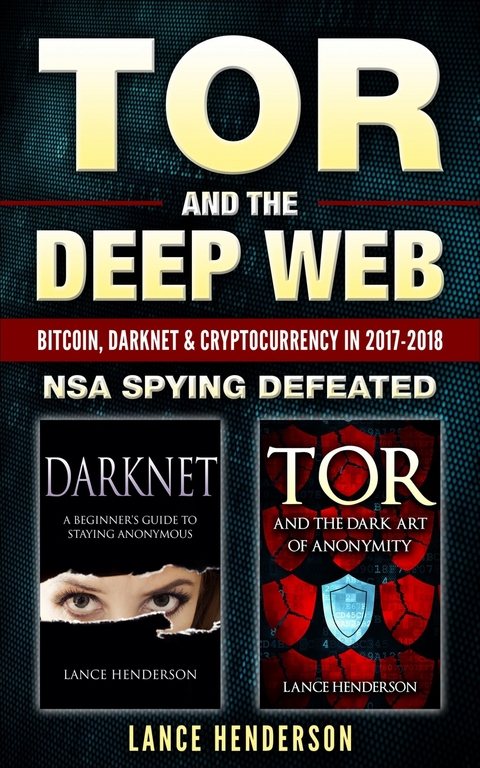
Tor and the Deep Web (eBook)
168 Seiten
Lance Henderson (Verlag)
978-0-00-027581-3 (ISBN)
THE ULTIMATE TOR BROWSER & DARKNET GUIDE. Just three questions you need to ask yourself: Do You Value Privacy? Do You Value Freedom? Do You Want to be Anonymous? If yes, then this is your book. Instant anonymity, right now, is yours for the taking. As science fiction author Hugh Howey once stated: When Pursuing a Dream, Don't Wait. This is the ultimate guide with easy instructions to teach you not only Tor but VPNs, Bitcoins, Anti-Hacking, Darknet personas and how to avoid Big Brother.
What's inside? Comment anonymously on ANY Website. Tor Browser strategies, Freenet, I2P, Cryptocurrency - How to Buy/Sell Anonymously. Encryption Guides: PGP. Veracrypt. Email. Linux. Windows. Mac. Kali Linux. Android. Burner phones. And much more. Master the Art of Invisibility TODAY!
Freenet
Freenet is unlike any other anonymizing beast on the entire internet. It takes quite a wizardly mind to crack its protection and to that, it is a bit like chess: easy to grasp the basics, long and difficult to become a master. Built in 2000, Freenet is a vast, encrypted datastore spanning thousands of connected computers across the globe, all distributing encrypted contents from one computer to another. To this end, it is somewhat similar to a P2P program like Emule. Except with eEule, every file, whether it mp3, rar or iso is out there in the open for weeks, months and years, along with the IP addresses, trumpeting who downloaded and uploaded every file. You know what you upload, and what you download, and so does everyone else.
Freenet is different in this regard.
While your IP address is visible, what you are uploading out of your datastore is not. You initially setup the size of the datastore for others to download from you. This datastore is encrypted. You have no idea what will eventually be inside, as the contents are encrypted. It is a bit like a postal worker delivering the mail. He has no idea what is in the package he is delivering. That is not his job. His job is to deliver the contents to its destination. Therein is the strength of Freenet.
While you can see your downloads merrily trickle their way down to your laptop, there is no way to decrypt your datastore’s content and see what it is you’re passing along to the nearest node. And to that, the bigger the datastore, the more efficiently Freenet runs. After one inserts a file into Freenet, the user is free to shutdown their pc. This is unlike torrents in that the stability of the torrent file is dependent on the length of online seeds. Thus, high reliability is a factor with Freenet files, as the file is spread between encrypted blocks residing in the Freenet system.
Freenet is slow. So slow in fact, that you may not see any measurable progress in download speed for a couple hours or so after install, and it may be a day before you can see extensive progress with old (unpopular) files. Don’t get discouraged because of this. It will speed up gradually over time.
Now, with your IP address out there in the open, you might be tempted to think it is not very anonymous. Nothing could be further from the truth. Whatever you download is encrypted from one end of Freenet to the other, and decrypted on your PC. No one looking in from the outside can see who requested which file or message. No one on the inside knows either, except you. For this reason alone, it is extremely censorship-resistant. This level of anonymity requires each node that requests data to operate in “hops”, from many intermediaries, similar to what you would see in Tor.
However, no node knows who requested which file, thus giving a high level of anonymity. This requirement carries a price in that downloads as well as uploads are initially extremely slow, especially for new data inserts.
Let’s say you want to share an iso dvd image on this network. You fire up Frost (a front-end addon for Freenet), then hit insert, then select the file. Then depending on how big your file is, you could be waiting for a long time, say several hours, for the file to finish. If this file had been inserted three months prior, and was very popular, with dozens of users trying to fetch said file, then that file would download very fast. However this is not usually the case with new files since every kernel of data on Freenet operates faster if and only if it is a popular file.
There are two types of security protocols that Freenet offers: Darknet and Openet. For Openet, you connect to other users, called “strangers”. There is nothing sinister about this, as this is what the Freenet developers envisioned that most beginners would use. The IP address of said strangers is visible, but the anonymity of Freenet isn’t nested in the security of the IP address like Tor, but rather it is nested in the encryption methods of the distributed datastore.
The other security option, which you are given at installation, is Darknet, where you will connect to “friends” rather than “strangers”. These will be Freenet users that you will have (presumably) previously exchanged node references, which are public security keys. With Darknet mode, it is assumed that you will have a higher level of trust, as your node reference is related to your online Freenet identity. Needless to say, this mode is not to be taken lightly. You really do have to TRUST those you add to this protocol. That is, the darknet protocol.
Within Freenet, there are no censors. Every kind of free speech is allowable and often encouraged. The very way in which Freenet is programmed makes it impossible to remove any message from the system by a censor. Individual users may opt to erase certain comments from the frost system, for instance, but this is only at the local level, on their machine, and not the Freenet network itself. Thus, no religious group for instance can force others in the network to conform to their belief and discussion system. No one on Freenet may deem information so offensive that it must be removed. Not even Freenet developers.
Needless to say, this has some negative consequences in that anyone may say anything to anyone at any time. Some Freesites on the Freenet network are plagued by spammers, identity thieves, terrorists, molesters, government anarchists and software pirates. The Freenet developers have stated this is a necessary evil of sorts in allowing 100% free speech to reign free. It could be argued that one should not allow illicit digital goods to be exchanged between users just so people could speak freely, however one of the stated purposes of Freenet is to preserve such a system in the even of societal collapse or oppression.
While there are no rules to govern Freenet by in the sense of censoring unsightly posts, a few guidelines have been posted in scattered parts of Freenet that should probably be heeded:
1. ) Never give anyone on Freenet your node-reference, as this contains information that could be exploited to correlate your Freenet identity with your IP address.
2.) Same rule as Usenet: Don’t give in to trolling activity. Trolling by its very nature flourishes with the more responses it receives. Ignore them.
3.) Never give out any personal info: your location, where you grew up, which restaurants you like most, what kinds of clothing stores you shop at, as these could zero-in on your location
4.) Take notice of different regionally spelled words (labor vs. labour, color vs. colour: these could reveal your home country).
5.) Never use any nickname that is the very same unique nickname you use for opennet forums. Use popular nicknames like Shadow, John, Peter and the like.
The highest security setting can be a bit foreboding, but perhaps necessary in countries where criticizing the government could land you a lifetime in a work camp. It has an encrypted password option to encrypt Freenet usage. This setting is in the security configuration, along with a host of other options of varying system requirements. The higher the security setting, the slower Freenet will run as it will use more resources to cover your footsteps.
When first installing Freenet, it will likely take no more than a few minutes, while asking you which security level you would like to operate at (normal up to maximum). After that and a bit of time allowed for Freenet to find nodes to connect to, you’ll be presented with a previously hidden world where a Freenet index lists every possible combination of Freesites available. Everything from anarchy sites to Iranian news, to pirated copies of books, films and game roms and even a few political how to documents describing how to protest a corrupt government without getting caught will be indexed.
These are the types of things typically either censored by Google in China, or deindexed altogether. The only thing missing is a disclaimer at the bottom of the screen welcoming you to the deepest, darkest depths of the internet, known as Darknet.
Optionally, you may run Freenet from an encrypted Truecrypt container file. You will need to create a Truecrypt volume that is sufficiently large enough to hold whatever files you intend on downloading from Freenet. Remember to keep in mind that when Freenet asks you how large you want the datastore to be, the size you choose could be a benefit to other Freenet users. The larger the datastore, the more efficient the Freenet network operates.
That is not to say that downloads will always come down faster, but rather encrypted data will last longer on the network. This is similar to the retention times that Usenet providers talk about when they try to sell their servers to you. The higher the data retention, the longer the files on the network will last. There is also another bonus to having a large datastore, say fifty gigabytes or so. Files that you may request may already be in your datastore after having run Freenet for some time, thereby shortening the time to retrieve them.
With your Truecrypt container you can run Freenet with the volume mounted and not worry about your Freenet activities being used against you in case of your computer being confiscated. You can also do the same for your Tor browser as well. Install Tor browser bundle to a mounted Truecrypt container and only run the...
| Erscheint lt. Verlag | 3.10.2020 |
|---|---|
| Sprache | englisch |
| Themenwelt | Mathematik / Informatik ► Informatik ► Programmiersprachen / -werkzeuge |
| ISBN-10 | 0-00-027581-6 / 0000275816 |
| ISBN-13 | 978-0-00-027581-3 / 9780000275813 |
| Informationen gemäß Produktsicherheitsverordnung (GPSR) | |
| Haben Sie eine Frage zum Produkt? |
 EPUB (Adobe DRM)
Größe: 1,8 MB
Kopierschutz: Adobe-DRM
Adobe-DRM ist ein Kopierschutz, der das eBook vor Mißbrauch schützen soll. Dabei wird das eBook bereits beim Download auf Ihre persönliche Adobe-ID autorisiert. Lesen können Sie das eBook dann nur auf den Geräten, welche ebenfalls auf Ihre Adobe-ID registriert sind.
Details zum Adobe-DRM
Dateiformat: EPUB (Electronic Publication)
EPUB ist ein offener Standard für eBooks und eignet sich besonders zur Darstellung von Belletristik und Sachbüchern. Der Fließtext wird dynamisch an die Display- und Schriftgröße angepasst. Auch für mobile Lesegeräte ist EPUB daher gut geeignet.
Systemvoraussetzungen:
PC/Mac: Mit einem PC oder Mac können Sie dieses eBook lesen. Sie benötigen eine
eReader: Dieses eBook kann mit (fast) allen eBook-Readern gelesen werden. Mit dem amazon-Kindle ist es aber nicht kompatibel.
Smartphone/Tablet: Egal ob Apple oder Android, dieses eBook können Sie lesen. Sie benötigen eine
Geräteliste und zusätzliche Hinweise
Buying eBooks from abroad
For tax law reasons we can sell eBooks just within Germany and Switzerland. Regrettably we cannot fulfill eBook-orders from other countries.
aus dem Bereich