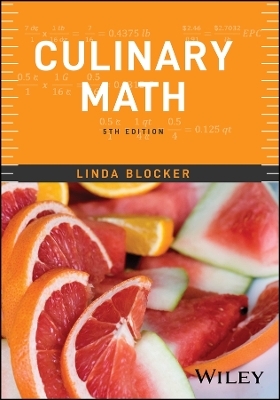
Culinary Math
John Wiley & Sons Inc (Verlag)
978-1-394-26586-2 (ISBN)
Culinary Math provides the explanations and steps necessary to learn and utilize the math concepts at the heart of successful foodservice operations. This edition includes newly-added introductory-level practice and homework problems. The new practice problems support learners with guidance at various difficulty levels. Student Success Tips have been added to the beginning of every chapter homework section. These tips come from the author’s many years of experience supporting students learning Culinary Math topics.
A companion website hosts instructor resources, including PowerPoint slides, a test bank formatted for Respondus, and best practices for using each chapter in the classroom.
Culinary Math has been designed to help current and future foodservice professionals learn the concepts necessary to manage a successful foodservice business, including:
Basic math concepts with a focus on the specific calculations of the foodservice industry
Common culinary units of measure and their equivalents
Step-by-step method for converting units of measure
Yield Percent calculations for ordering, using, and calculating the cost of ingredients
Determining the food cost of a single recipe serving and its selling price
How to calculate quantities when using kitchen ratios
Culinary Math is an essential textbook for instructors and students enrolled in hospitality management courses. It is also a valuable reference for professionals seeking clear guidance for the applied math of the foodservice industry.
Linda Blocker is an Associate Professor at the State University of New York at Delhi. She teaches mostly math-intensive classes in the Hospitality Management and Business departments. Prior to teaching at SUNY Delhi, she was an Associate Professor at the Culinary Institute of America, where she taught Culinary Math. She had been a middle school and high school math teacher when she found her way to the world of applied mathematics at the CIA as a result of her involvement in her family’s gourmet food business, Meredith Mountain Farms. She co-authored the four previous editions of Culinary Math with her friend and former colleague, Julia Hill.
Acknowledgments ix
Preface xi
1 Basic Math Concepts 1
2 Customary Units of Measure 21
3 Metric Measures 37
4 Measurement Conversion Part 1—Basic Conversion of Units of Measure 45
5 Measurement Conversion Part 2—Converting Weight and Volume Mixed Measures 56
6 Advanced Conversions between Weight and Volume 64
7 Yield Percent 82
8 Applying Yield Percent 101
9 Finding Cost 112
10 Edible Portion Cost 128
11 Recipe Costing 145
12 Yield Percent: When to Ignore It 169
13 Recipe Size Conversion 178
14 Kitchen Ratios 199
Appendix-A: Formula Reference Review 212
Appendix-B: Units of Measure and Equivalency Charts 215
Appendix-C: Approximate Volume to Weight Chart and Approximate Yield of Fruits and Vegetables Chart 218
Appendix-D: Rounding Realities 224
Appendix-E: Blank Food Cost Form 225
Answers to Chapter Practice Problems 227
Culinary Math Glossary of Terms 232
Index 235
| Erscheinungsdatum | 15.05.2025 |
|---|---|
| Verlagsort | New York |
| Sprache | englisch |
| Maße | 175 x 252 mm |
| Gewicht | 522 g |
| Themenwelt | Sachbuch/Ratgeber ► Essen / Trinken |
| Mathematik / Informatik ► Mathematik | |
| Weitere Fachgebiete ► Handwerk | |
| ISBN-10 | 1-394-26586-7 / 1394265867 |
| ISBN-13 | 978-1-394-26586-2 / 9781394265862 |
| Zustand | Neuware |
| Informationen gemäß Produktsicherheitsverordnung (GPSR) | |
| Haben Sie eine Frage zum Produkt? |
aus dem Bereich