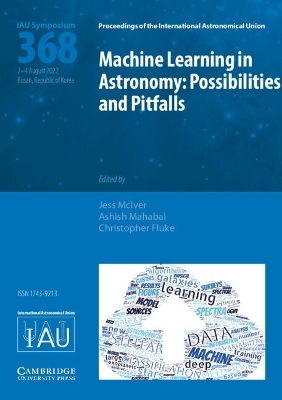
Machine Learning in Astronomy (IAU S368)
Cambridge University Press (Verlag)
978-1-009-34519-4 (ISBN)
Today's astronomical observatories are generating more data than ever, from surveys to deep images. Machine learning methods can be a powerful tool to harness the full potential of these new observatories, as well as large archives that have accumulated. However, users should beware of common pitfalls, including bias in data sets and overfitting. IAU Symposium 368 addresses graduate students, teachers and professional astronomers who would like to leverage machine learning to unlock these huge volumes of data. Researchers pushing the frontiers of these methods share best practices in applied machine learning. While this volume is focused on astronomy applications, the methodological insights provided are relevant to all data-rich fields. Machine learning novices and expert users will find and benefit from these fresh new insights.
Enhancing exoplanet surveys via physics-informed machine earning Eric Ford; How do we design data sets for machine learning in astronomy? Renee Hlozek; Deep machine learning in cosmology: Evolution or revolution? Ofer Lahav; An astronomers guide to machine learning Sara Webb; Panel discussion: practical problem solving for machine learning David Parkinson; Panel discussion: methodology for fusion of large datasets Kai Polsterer; The entropy of galaxy spectra Ignacio Ferreras; Unsupervised classification: a necessary step for deep learning? Didier Fraix-Burnet; Spectral identification and classification of dusty stellar sources using spectroscopic and multiwavelength observations through machine learning Sepideh Ghaziasgar; Simulating transient burst noise with gengli Melissa Lopez; Detecting complex sources in large surveys using an apparent complexity measure David Parkinson; Machine learning in the study of star clusters with Gaia EDR3 Priya Shah; Assessing the quality of massive spectroscopic surveys with unsupervised machine learning John Suárez-Pérez; Neural networks for meteorite and meteor recognition Aisha Alowais; Unsupervised clustering visualisation tool for Gaia DR3 Marco Alvarez Gonzalez; Kinematic Planetary Signature Finder (KPSFinder): Convolutional neural network-based tool to search for exoplanets in ALMA data Jaehan Bae; Predicting physical parameters of Cepheid and RR Lyrae variables in an instant with machine learning Anupam Bhardwaj; Bayesian deconvolution of a rotating spectral line profile to a non-rotating one Michel Curé; A short study on the representation of gravitational waves data for convolutional neural network Margherita Grespan; Search for microlensing signature in gravitational waves from binary black hole events Kyungmin Kim; Deep learning and numerical simulations to infer the evolution of MaNGA galaxies Johan Knapen; Data pre-extraction for better classification of galaxy mergers William Pearson; Stellar spectra classification and clustering using deep learning Tomasz Różański; Is GMM effective in membership determination of open clusters? Priya Shah; Deep radio image segmentation Hattie Stewart; Computational techniques for high energy astrophysics and medical image processing Nicolás Vásquez; Deep learning proves to be an effective tool for detecting previously undiscovered exoplanets in Kepler data Amelia Yu.
| Erscheinungsdatum | 16.10.2025 |
|---|---|
| Reihe/Serie | Proceedings of the International Astronomical Union Symposia and Colloquia |
| Zusatzinfo | Worked examples or Exercises |
| Verlagsort | Cambridge |
| Sprache | englisch |
| Maße | 178 x 254 mm |
| Gewicht | 400 g |
| Themenwelt | Informatik ► Theorie / Studium ► Künstliche Intelligenz / Robotik |
| Naturwissenschaften ► Physik / Astronomie ► Astronomie / Astrophysik | |
| ISBN-10 | 1-009-34519-2 / 1009345192 |
| ISBN-13 | 978-1-009-34519-4 / 9781009345194 |
| Zustand | Neuware |
| Informationen gemäß Produktsicherheitsverordnung (GPSR) | |
| Haben Sie eine Frage zum Produkt? |
aus dem Bereich