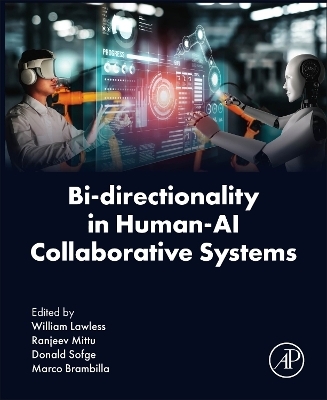
Bi-directionality in Human-AI Collaborative Systems
Academic Press Inc (Verlag)
978-0-443-40553-2 (ISBN)
It will also be useful for government scientists, business leaders, social scientists, philosophers, regulators and legal experts interested in the impact of autonomous human-machine teams and systems.
William Lawless is professor of mathematics and psychology at Paine College, GA. For his PhD topic on group dynamics, he theorized about the causes of tragic mistakes made by large organizations with world-class scientists and engineers. After his PhD in 1992, DOE invited him to join its citizens advisory board (CAB) at DOE’s Savannah River Site (SRS), Aiken, SC. As a founding member, he coauthored numerous recommendations on environmental remediation from radioactive wastes (e.g., the regulated closure in 1997 of the first two high-level radioactive waste tanks in the USA). He is a member of INCOSE, IEEE, AAAI and AAAS. His research today is on autonomous human-machine teams (A-HMT). He is the lead editor of seven published books on artificial intelligence. He was lead organizer of a special issue on “human-machine teams and explainable AI by AI Magazine (2019). He has authored over 85 articles and book chapters, and over 175 peer-reviewed proceedings. He was the lead organizer of twelve AAAI symposia at Stanford (2020). Since 2018, he has also been serving on the Office of Naval Research's Advisory Boards for the Science of Artificial Intelligence and Command Decision Making. Ranjeev Mittu is the Branch Head for the Information and Decision Sciences Branch within the Information Technology Division at the U.S. Naval Research Laboratory (NRL). He leads a multidisciplinary group of scientists and engineers conducting research and advanced development in visual analytics, human performance assessment, decision support systems, and enterprise systems. Mr. Mittu’s research expertise is in multi-agent systems, human-systems integration, artificial intelligence (AI), machine learning, data mining and pattern recognition; and he has authored and/or coedited eleven books on the topic of AI in collaboration with the national and international scientific communities spanning academia and defense. Mr. Mittu received a Master of Science Degree in Electrical Engineering in 1995 from The Johns Hopkins University in Baltimore, MD. The views expressed in this Work do not necessarily represent the views of the Department of the Navy, the Department of Defense, or the United States. Don Sofge is a computer scientist and roboticist at the Naval Research Laboratory (NRL) with 36 years of experience in artificial intelligence, machine learning, and control systems R&D, the last 23 years at NRL. He leads the Distributed Autonomous Systems Section in the Navy Center for Applied Research in Artificial Intelligence (NCARAI), where he develops nature-inspired computing paradigms to challenging problems in sensing, artificial intelligence, and control of autonomous robotic systems. He has more than 200 refereed publications including 12 edited books in robotics, artificial intelligence, machine learning, planning, sensing, control, and related disciplines. The views expressed in this Work do not necessarily represent the views of the Department of the Navy, the Department of Defense, or the United States. Marco Brambilla is full professor at Politecnico di Milano. He is active in research and innovation, both at industrial and academic level. His research interests include data science, software modeling languages and design patterns, crowdsourcing, social media monitoring, and big data analysis. He has been visiting researcher at CISCO, San Josè, and University of California, San Diego. He has been visiting professor at Dauphine University, Paris. He is founder of various startups and spinoffs, including WebRatio, Fluxedo, and Quantia, focusing on social media analysis, software modeling, Mobile and Business Process based software applications, and data science projects. He is author of various international books including Model Driven Software Development in Practice (II edizione, Morgan-Claypool, 2017, adopted in 100+ universities worldwide), Web Information Retrieval (Springer, 2013), Interaction Flow Modeling Language (Morgan-Kauffman, 2014), Designing Data-Intensive Web Applications (Morgan-Kauffman, 2002). He also authored more than 250 research articles in top research journals and conferences. He was awarded various best paper awards and gave keynotes and speeches at many conferences and organisations. He is the main author of the OMG (Object Management Group) standard IFML (Interaction Flow Modeling Language). He participated in several European and international research projects. He has been reviewer of FP7 projects and evaluator of EU FP7 proposals, as well as of national and local government funding programmes throughout Europe. He has been PC chair of ICWE 2008 and ICWE 2021, as well as co-chair of various tracks, conferences and workshops. He is associate editor of various journals and PC member of several conferences and workshops.
Chapter 1 Introduction to bidirectionality in human–AI collaborative systems
Chapter 2 Foundational approaches to post-hoc explainability for image classification
Chapter 3 Explaining poisoned AI models
Chapter 4 Desirability vs. feasibility: a research through design inquiry of explainable AI
Chapter 5 Credition, uncertainty, consciousness, and communication
Chapter 6 On the principles and effectiveness of gamification in bidirectional artificial intelligence and explainable AI
Chapter 7 Employing Kolmogorov–Arnold network for man–machine collaboration
Chapter 8 Collaborative communication for unnamable risks: a creative writing approach to aligning human–machine situation models in an open world
Chapter 9 Not all explanations are created equal: investigating the pitfalls of current XAI evaluation
Chapter 10 A mixture-of-experts flock: examining expert influence
Chapter 11 On replacing humans with human simulators in human-in-the-loop systems built to interact with humans
Chapter 12 Addressing procrastination and improving task completion efficiency through agent-based interventions
Chapter 13 Navigating the sociotechnical labyrinth: dynamic certification for responsible embodied AI
Chapter 14 Searching XAI collaborating with manager: bidirectional learning for human-tech applications
Chapter 15 Natural perception-based control types for human/machine systems
Chapter 16 Hybrid forums as a means to perceive bidirectional risks
Chapter 17 Credit assignment: challenges and opportunities in developing human-like learning agents
Chapter 18 Human–machine teams: advantages afforded by the quantum-likeness of interdependence
| Erscheinungsdatum | 14.06.2025 |
|---|---|
| Verlagsort | San Diego |
| Sprache | englisch |
| Maße | 191 x 235 mm |
| Gewicht | 1040 g |
| Themenwelt | Informatik ► Software Entwicklung ► User Interfaces (HCI) |
| ISBN-10 | 0-443-40553-0 / 0443405530 |
| ISBN-13 | 978-0-443-40553-2 / 9780443405532 |
| Zustand | Neuware |
| Informationen gemäß Produktsicherheitsverordnung (GPSR) | |
| Haben Sie eine Frage zum Produkt? |
aus dem Bereich