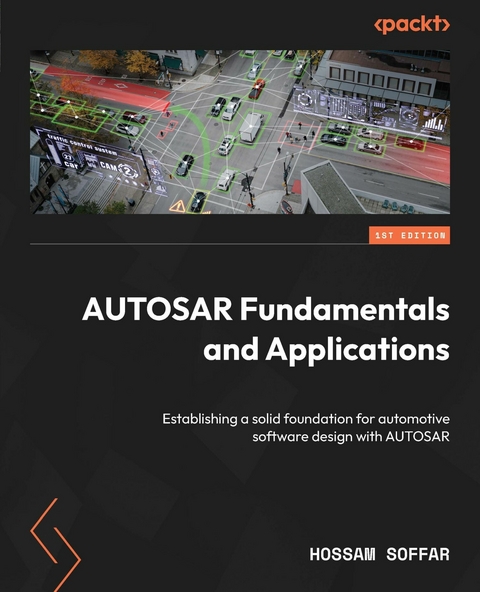
AUTOSAR Fundamentals and Applications (eBook)
254 Seiten
Packt Publishing (Verlag)
978-1-80512-280-7 (ISBN)
AUTOSAR has become the standard for developing automotive ECUs, driven by the demand for increasingly sophisticated features that require a robust, safe, secure, and scalable framework for efficient development for automotive software. For those new to AUTOSAR, its complexity, intricate architecture, and extensive standards can be daunting. With twelve years of experience in the automotive software industry, Hossam Soffar brings his unparalleled expertise to this essential AUTOSAR guide, addressing these challenges by explaining AUTOSAR's framework, architecture, and their application through best practices and real-world use cases.
This book comprehensively explores AUTOSAR's objectives, guiding you through its layered architecture and various stacks, components, and communication mechanisms. You'll learn how to design, configure, and integrate AUTOSAR Basic Software (BSW) components, understand the real-time-environment (RTE), and master the principles of communications, diagnostics, security, and operating systems, all of which is essential for developing high-quality, safety-critical, and efficient ECUs. With a clear understanding of how these elements work together, you'll be equipped to navigate the complexities of modern automotive software development to build, implement, and manage automotive systems with enhanced efficiency.
No detailed description available for "e;AUTOSAR Fundamentals and Applications"e;.
1
Exploring the Genesis and Objectives of AUTOSAR
AUTomotive Open System ARchitecture (AUTOSAR) is a standard for the development of automotive electronic systems. It provides a common software architecture for electronic control units (ECUs) in vehicles, allowing for the easier integration and development of new features. It is a partnership of major automotive manufacturers and suppliers, and its goal is to improve the overall efficiency and flexibility of the automotive software development process.
In this first chapter, we will discuss the motivation behind the development of AUTOSAR, the organization of the partnership, and its aims and objectives. In this chapter, we will cover the following main topics:
- Evolution of the automotive industry
- Introducing the AUTOSAR framework
- Understanding the AUTOSAR standards
- Software architecture and design
Evolution of the automotive industry
Over the past few decades, the automobile industry has evolved from a simple means of transportation to a complex machine that resembles a smartphone on wheels. This transformation is due to the integration of advanced technologies and the adoption of a more sophisticated approach to design and development.
The evolution of the car can be traced back to the early 20th century when the first automobiles were developed. These vehicles were simple and utilitarian, designed primarily for transportation from point A to point B. However, as technology advanced, so did the car. In the 1950s and 1960s, we saw the emergence of advanced safety features such as seat belts, airbags, and anti-lock brakes. By the 1980s, we began to see the introduction of onboard computers, which enabled more advanced engine management and diagnostics. In the 1990s, vehicles saw the integration of more sophisticated electronic systems, such as electronic stability control (ESC) and advanced driver assistance systems (ADAS).
In the 21st century, the car has undergone a massive transformation. Today’s vehicles are equipped with advanced features that were once reserved for high-end luxury cars.
The percentage of car production costs attributed to electronic control systems and automotive software has been consistently rising over the years. This upward trend is clearly depicted in the Statista data (https://www.statista.com/statistics/277931/automotive-electronics-cost-as-a-share-of-total-car-cost-worldwide/) shown in the following figure, which has been monitoring this development since 1970:
Figure 1.1 – Electronics system as percent of total car cost
This increasing complexity of automotive systems has presented a challenge for the industry in terms of software development.
The evolution of the car into a smart, connected, and autonomous machine is driven by several factors, which include the following:
- The growing demand for advanced safety features
- The need for more efficient and environmentally friendly transportation
- The desire for a more convenient and connected driving experience
The adoption of advanced technologies such as sensors, software systems, and connectivity has enabled car manufacturers to deliver on these demands, creating a new era of smart, autonomous, and connected vehicles.
With the integration of new technologies such as ADAS and connected car features, the amount of software that needs to be developed and integrated into vehicles has grown significantly.
The comparison to the Apollo mission highlights the significant increase in complexity of modern cars. While the Apollo spacecraft had only a limited number of systems that needed to be managed, modern cars can contain up to 100 or more ECUs, sensors, and actuators, all of which need to communicate seamlessly within very tight time constraints with one another to ensure proper functioning. Additionally, modern cars are highly connected devices that require sophisticated software and networking capabilities, further adding to their complexity. This increased complexity allows modern cars to offer advanced features and functionality but also requires more sophisticated maintenance and repair processes.
Having discussed the evolution and complexity of automotive software, let’s shift our focus to one of the essential components that enable modern cars to function effectively – the ECU.
What is an ECU?
Before we move any further, we need to understand what an automotive ECU is. This is a computer – comprising a printed circuit board (PCB) with a microcontroller and various electronic components – that controls various functions in a vehicle. These functions may include engine management, transmission control, climate control, power steering, and brakes. Here are some examples of automotive ECUs:
- Engine control module (ECM): The ECM is responsible for managing the engine’s performance, including fuel injection, ignition timing, and emissions control.
- Transmission control module (TCM): The TCM manages the operation of the transmission, including gear selection, shift timing, and torque converter lock-up.
- Body control module (BCM): The BCM controls various functions related to the vehicle’s body and interior, such as lighting, climate control, door locks, and audio systems.
- Anti-lock braking system (ABS) control module: The ABS control module manages the operation of the ABS, which helps to prevent skidding and maintain control of the vehicle during braking.
- Battery management system (BMS): The BMS’s primary function is to monitor, control, and optimize the performance of the vehicle’s battery pack. It also ensures all battery cells within the pack are charged and discharged uniformly, preventing the overcharging of certain cells and maximizing the overall battery capacity.
Some examples of these components are shown in the following figure:
Figure 1.2 – Examples of ECUs in a vehicle
Overall, automotive ECUs play a critical role in the operation of modern vehicles, providing precise control over various systems and ensuring optimal performance, efficiency, and safety. As automotive ECUs rely heavily on complex software to perform their functions, we first need to understand the software development aspect to comprehend the nuances of ECU operation and design.
Introducing automotive software development
Automotive software development is a critical component of the continued innovation and success of the automotive industry. It involves creating and maintaining software systems used in various types of automobiles, cars, trucks, buses, and other automobiles. These software systems are responsible for multiple tasks, such as engine management, navigation, entertainment, and safety features. Therefore, engineers in this field must have expertise in embedded systems, real-time programming, control systems, and communication protocols to create reliable and safe software systems.
It is a highly specialized field that requires close collaboration with other members of the automotive development team, such as electrical and mechanical engineers and quality assurance specialists, to ensure seamless integration of the software systems into the vehicle and meet the end users’ needs. Clean software architecture principles can help address the challenges of this complex field by creating a system that is easy to maintain, modify, and evolve while being resilient to change.
Note
Clean architecture in software design refers to a structured approach that prioritizes clarity, separation of concerns, and maintainability. It emphasizes the organization of code in a way that minimizes dependencies, allowing for easy modifications and testing. Clean architecture fosters systems that are adaptable, scalable, and easy to comprehend.
It’s a challenging field but plays a critical role in the continuous success and innovation of the automotive industry. Before we discuss advancements in this field, let’s first understand traditional automotive software development.
Understanding traditional software development
Traditional automotive software development involves a wide variety of ECUs with different hardware and software, which can make it difficult to ensure that all components work together efficiently. Each supplier has its own software architecture definitions, development methodology, and interfaces for ECUs, resulting in fragmented and non-standardized...
| Erscheint lt. Verlag | 31.12.2024 |
|---|---|
| Sprache | englisch |
| Themenwelt | Mathematik / Informatik ► Informatik ► Theorie / Studium |
| Technik ► Fahrzeugbau / Schiffbau | |
| ISBN-10 | 1-80512-280-0 / 1805122800 |
| ISBN-13 | 978-1-80512-280-7 / 9781805122807 |
| Informationen gemäß Produktsicherheitsverordnung (GPSR) | |
| Haben Sie eine Frage zum Produkt? |
 EPUB (Ohne DRM)
Digital Rights Management: ohne DRM
Dieses eBook enthält kein DRM oder Kopierschutz. Eine Weitergabe an Dritte ist jedoch rechtlich nicht zulässig, weil Sie beim Kauf nur die Rechte an der persönlichen Nutzung erwerben.
Dateiformat: EPUB (Electronic Publication)
EPUB ist ein offener Standard für eBooks und eignet sich besonders zur Darstellung von Belletristik und Sachbüchern. Der Fließtext wird dynamisch an die Display- und Schriftgröße angepasst. Auch für mobile Lesegeräte ist EPUB daher gut geeignet.
Systemvoraussetzungen:
PC/Mac: Mit einem PC oder Mac können Sie dieses eBook lesen. Sie benötigen dafür die kostenlose Software Adobe Digital Editions.
eReader: Dieses eBook kann mit (fast) allen eBook-Readern gelesen werden. Mit dem amazon-Kindle ist es aber nicht kompatibel.
Smartphone/Tablet: Egal ob Apple oder Android, dieses eBook können Sie lesen. Sie benötigen dafür eine kostenlose App.
Geräteliste und zusätzliche Hinweise
Buying eBooks from abroad
For tax law reasons we can sell eBooks just within Germany and Switzerland. Regrettably we cannot fulfill eBook-orders from other countries.
aus dem Bereich