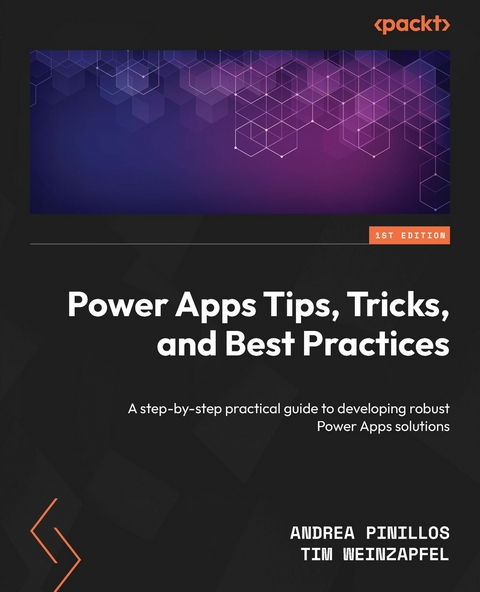
Power Apps Tips, Tricks, and Best Practices (eBook)
430 Seiten
Packt Publishing (Verlag)
978-1-83508-964-4 (ISBN)
Microsoft Power Apps is ideal for businesses seeking to digitally transform their operations by developing custom applications quickly and efficiently, without the heavy investment required for software development. This book leverages the authors' combined experience in Power Platform, among others, to lay down the foundation for successful app development, focusing on defining project scope and understanding requirements.
In this book, you'll go through several key development areas, including solution creation and Power Platform environments, both critical areas for effective app development and deployment. You'll also discover best practices for choosing when to build a canvas app or a model-driven app based on project requirements and data connections. The chapters will take you through advanced development techniques and show you how to integrate Power Apps with other applications. You'll get a clear understanding of the key aspects of governance, security, app maintenance, and error handling, ensuring that your Power Apps solutions are not only effective but also secure and sustainable.
By the end, you'll confidently create scalable, secure, and maintainable Power Apps for your business needs.
No detailed description available for "e;Power Apps Tips, Tricks, and Best Practices"e;.
Preface
The Microsoft Power Apps platform has become a key tool for modern businesses, offering a highly flexible and efficient way to develop custom applications. By simplifying the development process with its drag-and-drop interface and low-code/no-code capabilities, Power Apps allows users—regardless of technical expertise—to quickly build apps tailored to their business needs. Pre-built templates and seamless integration with Microsoft services and external data sources further enhance its utility, promoting a cohesive and optimized business environment. For companies seeking to innovate, streamline operations, and drive digital transformation, Power Apps serves as an essential tool that enables agility, cost-efficiency, and scalability.
Although Power Apps excels in providing an accessible low-code/no-code environment, fully unlocking its potential requires looking beyond these fundamentals. This guide will walk you through every phase of the app development lifecycle. From identifying initial concepts to applying advanced development techniques and maintaining your applications, we’ll explore how to maximize the capabilities of Power Apps. No matter the project—whether building apps, websites, or new products—the first critical step is understanding the underlying business need, ensuring a strong foundation for success.
We have designed this book to focus on key areas of overall Power App development. We begin with key foundational aspects including project planning, using Power Platform environments and solutions, understanding canvas apps versus model-driven apps, as well as data sources.
We then move into more advanced development areas to help you build more complex apps. In addition, we cover integrating Power Apps with other applications such as Power Automate, Teams, Outlook, SharePoint, and Power BI. Finally, we touch down on governance and development strategies.
Power Apps provides you the ability to develop robust low code/no code applications. However, as you move beyond basic apps, there are many areas to need to be considered. Our goal is to strengthen your expertise to go beyond just the basics.
Who this book is for
This book is designed for developers who have some familiarity with building out applications within Power Apps and want to expand their knowledge across a variety of areas. If you are brand new to Power Apps, this book is not the best area to start with and there are other books out there that provide a more introductory use of Power Apps.
However, if you have begun using Power Apps and want to expand your knowledge then this book is for you. Building Power Apps goes well beyond the actual development. From initial project planning to using Power Platform environments and solutions all the way to overall governance, there is much to consider.
What this book covers
Chapter 1, Understanding Requirements and Project Planning, introduces the overall concept of planning your overall Power App development. Proper planning is an integral part of ensuring a successful outcome.
Chapter 2, Working with Solutions, discusses the concept of creating and using solutions within the Power Platform. Solutions are crucial for managing, packaging, and deploying changes across different environments.
Chapter 3, Power Platform Environments, explores Power Platform environments, how they are created, and how they can be effectively deployed. Understanding how environments are used is also important in overall app governance and security which are covered in Chapter 13.
Chapter 4, Choosing the Right Tool – Navigating Canvas Apps, Power Pages, and Model-Driven Apps, discusses the different types of apps within Power Apps including canvas apps, model-driven apps, and Power Pages. In this chapter, we explore the different uses of each type.
Chapter 5, Data Connections, explores different data connections that be used as you build out your Power Apps. We cover three of the most popular data connections including Excel, SharePoint, and Dataverse.
Chapter 6, Variables, Collections, and Data Filtering, discusses three fundamental areas within Power Apps. Variables and collections are used to temporarily store data and are essential in building more complex apps. Furthermore, we’ll discuss data filtering to refine the data.
Chapter 7, Canvas App Formulas, continues discussing key functions within Power Apps. In this chapter, we cover important functions around form submission and app navigation. In addition, we cover how to connect a form to a Dataverse table.
Chapter 8, Conditional Formatting and URL Deep Linking, discusses two common capabilities that enrich user interaction. First, we cover how to use and apply conditional formatting within your app. We then cover URL deep linking which allows you to create hyperlinks taking users directly to your app. Both concepts can enhance the overall user experience and the user interface.
Chapter 9, Integration with Power Automate/Teams/Outlook, shows how Power Apps can be integrated with Power Automate, Teams, and Outlook to add additional functionality. We cover sending Outlook emails and calendar invites using Power Automate. In addition, we show how you can also use Power Automate to send Teams notifications using adaptive cards.
Chapter 10, Integration with Power BI, shows how you can integrate Power BI dashboards and reports into your Power Apps. In addition, we show how you can integrate a Power App into a Power BI report.
Chapter 11, Integrating Power Apps with SharePoint, shows how you can integrate Power BI with SharePoint. This includes embedding Power Apps into a SharePoint site, creating custom SharePoint list forms, and also covering the SharePointIntegration component.
Chapter 12, Integration with Power Virtual Agents/CoPilot, introduces Microsoft Copilot Studio and Copilot which allows you to integrate AI. Microsoft Copilot Studio allows you to create virtual chatbots while Copilot leverages AI to assist in app creation.
Chapter 13, Governance, Security, and Application Life Cycle Management, covers key areas important to the Power Apps area. We discuss how to establish a Power Platform environment strategy, discuss the use of service accounts, and how to set up data policies to support Data Loss Prevention (DLP). Finally, we will introduce the concept of Application Lifecycle Management (ALM).
Chapter 14, Error Handling, discusses approaches to handling errors within your app. This includes understanding an overview of error handling, using built-in functions in your app, using the OnError app property, and creating custom error messages.
Chapter 15, Registering a Power App in Azure, closes out the book by showing how you register an app in Azure. This includes understanding the importance of registering an app in Azure, how to register your app, and finally when to add the Azure app ID, client ID, and secret ID within Power Apps.
To get the most out of this book
The following software are needed for this book:
- Power Apps
- Power Automate
- SharePoint
- PowerBI
- Azure
Download the example code files
You can download the example code files for this book from GitHub at https://github.com/PacktPublishing/Power-Apps-Tips-Tricks-and-Best-Practices. If there’s an update to the code, it will be updated in the GitHub repository.
We also have other code bundles from our rich catalog of books and videos available at https://github.com/PacktPublishing/. Check them out!
Conventions used
There are a number of text conventions used throughout this book.
Code in text: Indicates code words in text, database table names, folder names, filenames, file extensions, pathnames, dummy URLs, user input, and Twitter handles. Here is an example: “Locate the formula that defines the Items property of the copied Gallery1.”
A block of code is set as follows:
If(IsBlank(CurrentVendor), BrowseGallery1.Selected, LookUp('Preferred Vendor List', ID = CurrentVendor) )When we wish to draw your attention to a particular part of a code block, the relevant lines or items are set in bold:
Param("VendorID") Param("Screen")Bold: Indicates a new term, an important word, or words that you see onscreen. For instance, words in menus or dialog boxes appear in bold. Here is an example:...
| Erscheint lt. Verlag | 29.11.2024 |
|---|---|
| Sprache | englisch |
| Themenwelt | Mathematik / Informatik ► Informatik ► Web / Internet |
| ISBN-10 | 1-83508-964-X / 183508964X |
| ISBN-13 | 978-1-83508-964-4 / 9781835089644 |
| Informationen gemäß Produktsicherheitsverordnung (GPSR) | |
| Haben Sie eine Frage zum Produkt? |
 EPUB (Ohne DRM)
Digital Rights Management: ohne DRM
Dieses eBook enthält kein DRM oder Kopierschutz. Eine Weitergabe an Dritte ist jedoch rechtlich nicht zulässig, weil Sie beim Kauf nur die Rechte an der persönlichen Nutzung erwerben.
Dateiformat: EPUB (Electronic Publication)
EPUB ist ein offener Standard für eBooks und eignet sich besonders zur Darstellung von Belletristik und Sachbüchern. Der Fließtext wird dynamisch an die Display- und Schriftgröße angepasst. Auch für mobile Lesegeräte ist EPUB daher gut geeignet.
Systemvoraussetzungen:
PC/Mac: Mit einem PC oder Mac können Sie dieses eBook lesen. Sie benötigen dafür die kostenlose Software Adobe Digital Editions.
eReader: Dieses eBook kann mit (fast) allen eBook-Readern gelesen werden. Mit dem amazon-Kindle ist es aber nicht kompatibel.
Smartphone/Tablet: Egal ob Apple oder Android, dieses eBook können Sie lesen. Sie benötigen dafür eine kostenlose App.
Geräteliste und zusätzliche Hinweise
Buying eBooks from abroad
For tax law reasons we can sell eBooks just within Germany and Switzerland. Regrettably we cannot fulfill eBook-orders from other countries.
aus dem Bereich