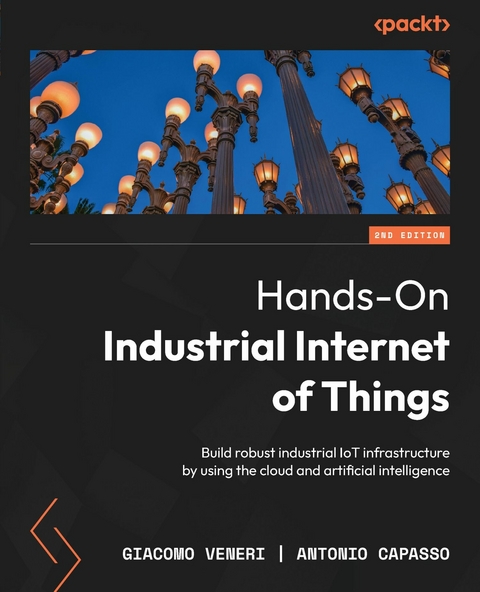
Hands-On Industrial Internet of Things (eBook)
532 Seiten
Packt Publishing (Verlag)
978-1-83588-747-9 (ISBN)
In today's automation-driven era, precision is crucial, and the Industrial Internet of Things (IIoT) has made a remarkable impact. This updated second edition explores the technologies fueling the IIoT revolution and shares essential knowledge to enable you to establish remote-access networks.
Written by IIoT and AI experts, as well as renowned authors, this book helps you enhance your skills in emerging technologies by introducing new techniques from Azure and AWS and keeping you up to date with the latest advancements. You'll find out how Artificial Intelligence of Things (AIoT) and MLOps apply to IIoT and learn how to handle complex projects confidently. The book covers identifying and connecting industrial data sources from various sensors, advancing from foundational concepts to professional skills. You'll discover how to connect these sensors to cloud networks such as AWS IoT, Azure IoT, and open source IoT platforms, and extract data from the cloud to your devices. Through hands-on experience with tools such as Node-RED, OPC UA, MQTT, NoSQL, defense in depth, and Python, you'll develop streaming and batch-based AI algorithms.
By the end of this book, you'll have achieved a professional level of expertise in the cloud, IoT, and AI, and be able to build more robust, efficient, and reliable IoT infrastructure for your industry.
No detailed description available for "e;Hands-On Industrial Internet of Things"e;.
Preface
In today’s automation-driven era, precision is crucial, and the Industrial Internet of Things (IIoT) has a remarkable impact. This updated guide offers essential knowledge for establishing remote-access networks and explores the technologies fueling the IIoT revolution.
Written by an IIoT and AI expert, this book serves as a comprehensive resource for enhancing skills in emerging technologies, introducing new techniques from Azure and AWS, and allowing you to stay up to date with the latest advancements in the field. You’ll dive into AIoT and MLOps applied to IIoT, equipping yourself to handle complex projects confidently. The book covers identifying and connecting industrial data sources from various sensors, advancing from foundational concepts to professional skills. You’ll learn how to connect these sensors to cloud networks such as AWS IoT, Azure IoT, and open source IoT platforms, and extract data from the cloud to your devices. Through hands-on experience with tools such as Node-RED, OPC-UA, MQTT, NoSQL, defense in depth, and Python, you’ll develop streaming and batch-based AI algorithms.
By the end, you’ll have achieved a professional level of expertise in the cloud, IoT, and AI, enabling you to build more robust, efficient, and reliable IoT infrastructure in your industry.
Who this book is for
If you are an IoT architect, developer, AI engineer, or a stakeholder involved in the architectural aspects of the IIoT, this book is tailored for you. The only prerequisites are a solid understanding of programming languages and networking concepts.
What this book covers
Chapter 1, Introduction to Industrial IOT, provides some background to industrial IoT, the story, use cases, and the contrast with the home internet of things. It helps you understand the Industrial IoT Process
Chapter 2, Understanding the Industrial Process and Devices, helps you understand the industrial process and devices and defines the factory processes. This chapter describes the concept of a distributed control system (DCS), programmable logic controllers (PLCs), supervisory control and data acquisition (SCADA), Historian, manufacturing execution system (MES), enterprise resource planning (ERP), and fieldbus. It introduces the International Electrotechnical Commission (IEC)-61131 and the CIM pyramid. Finally, it designs a big picture, from equipment through to the cloud.
Chapter 3, Industrial Data Flow and Devices, details which equipment, devices, network protocols, and software layers manage the industrial IoT data flow along its path, from the sensors on the factory floor to the edge that is the external boundary of the industrial IoT data flow inside the factory.
Chapter 4, Implementing the Industrial IoT Data Flow, explains how to implement the industrial IoT data flow in a complex industrial plant. This journey starts with an understanding of how to select the industrial data source to connect to for the purpose of gathering the data and ends by providing five network scenarios for edge deployment in industrial plants.
Chapter 5, Applying Cybersecurity, explores the industrial IoT data flow from the cybersecurity perspective, outlining the goals of the DiD strategy, and the most common network architecture to secure industrial control systems, including the five network scenarios for edge deployment discussed in the previous chapter.
Chapter 6, Performing an Exercise Based on Industrial Protocols and Standards, explores how to implement a basic data flow from the edge to the cloud by means of OPC UA and Node-RED.
Chapter 7, Developing Industrial IoT and Architecture, outlines the basic concepts regarding industrial IoT data processing, providing the key principles for storing time series data, handling the asset data model, processing the data with analytics, and building digital twins.
Chapter 8, Implementing a Custom Industrial IoT Platform, shows how to implement a custom platform leveraging the most popular open source technologies: Node.js, Docker, InfluxDB, Neo4J, Apache Airflow, Mosquitto, and Docker.
Chapter 9, Building an AWS Industrial IOT Solution, explores the solutions proposed by Amazon Web Services (AWS) and the capabilities of the AWS IoT platform. This chapter introduces the Edge IoT of AWS (Greengrass), the IoT Core, and AWS SiteWise and builds the first part of the proposed architecture. We will learn about these technologies by performing a practical exercise.
Chapter 10, Implementing an Industrial IOT Data Flow with AWS, concludes the proposed architecture by implementing a data flow using DynamoDB, AWS analytics, and Grafana to display data. We will gain practical experience with these technologies through hands-on exercise.
Chapter 11, Performing a Practical Industrial IoT Solution with Azure, develops a wing-to-wing industrial IoT solution leveraging Azure, Azure Edge, and the Azure IoT platform. We will learn about these technologies by performing a practical exercise.
Chapter 12, Implementing an Industrial IoT Data Flow with Azure, finalizes the proposed architecture, implementing the data flow with Azure Cosmos DB, Stream Analytics, and Synapse. We will learn about these technologies by performing a practical exercise.
Chapter 13, Performing Diagnostic, Maintenance, and Predictive Analytics, introduces the basic concepts of analytics and data consumption. It also develops basic analytics for anomaly detection and prediction. The chapter also introduces new concepts of generative AI.
Chapter 14, Implementing a Digital Twin – Advanced Analytics, develops a physics-based and data-driven digital equipment model to monitor assets and systems.
Chapter 15, Deploying an Analytics Model, shows how to develop analytics on Azure ML and AWS SageMaker. Finally, the chapter explores other common technologies.
To get the most out of this book
You will need a version of Python, Docker, and Git installed on your computer. All code has been tested on Python 3.11, Node.js 20, Docker 4.34, Linux, and Windows.
| Software/hardware covered in the book | Operating system requirements |
| Python 3.11+ | Windows or Linux |
| Node.js 20+ | Docker or Docker Community Edition |
| Git |
If you are using the digital version of this book, we advise you to type the code yourself or access the code from the book’s GitHub repository (a link is available in the next section). Doing so will help you avoid any potential errors related to the copying and pasting of code.
Download the example code files
You can download the example code files for this book from GitHub athttps://github.com/PacktPublishing/Hands-On-Industrial-Internet-of-Things-Second-EditionIf there’s an update to the code, it will be updated in the GitHub repository.
We also have other code bundles from our rich catalog of books and videos available at https://github.com/PacktPublishing/. Check them out!
Conventions used
There are a number of text conventions used throughout this book.
Code in text: Indicates code words in text, database table names, folder names, filenames, file extensions, pathnames, dummy URLs, user input, and Twitter handles. Here is an example: “Create a new file called docker-compose-python.yml and add the following two services.”
A block of code is set as follows:
if __name__ == '__main__': asyncio.run(main())When we wish to draw your attention to a particular part of a code block, the relevant lines or items are set in bold:
if __name__ == '__main__': asyncio.run(main())Any command-line input or output is written as follows:
pip install opcua crypto...| Erscheint lt. Verlag | 29.11.2024 |
|---|---|
| Sprache | englisch |
| Themenwelt | Informatik ► Theorie / Studium ► Künstliche Intelligenz / Robotik |
| Technik ► Bauwesen | |
| ISBN-10 | 1-83588-747-3 / 1835887473 |
| ISBN-13 | 978-1-83588-747-9 / 9781835887479 |
| Informationen gemäß Produktsicherheitsverordnung (GPSR) | |
| Haben Sie eine Frage zum Produkt? |
 EPUB (Ohne DRM)
Digital Rights Management: ohne DRM
Dieses eBook enthält kein DRM oder Kopierschutz. Eine Weitergabe an Dritte ist jedoch rechtlich nicht zulässig, weil Sie beim Kauf nur die Rechte an der persönlichen Nutzung erwerben.
Dateiformat: EPUB (Electronic Publication)
EPUB ist ein offener Standard für eBooks und eignet sich besonders zur Darstellung von Belletristik und Sachbüchern. Der Fließtext wird dynamisch an die Display- und Schriftgröße angepasst. Auch für mobile Lesegeräte ist EPUB daher gut geeignet.
Systemvoraussetzungen:
PC/Mac: Mit einem PC oder Mac können Sie dieses eBook lesen. Sie benötigen dafür die kostenlose Software Adobe Digital Editions.
eReader: Dieses eBook kann mit (fast) allen eBook-Readern gelesen werden. Mit dem amazon-Kindle ist es aber nicht kompatibel.
Smartphone/Tablet: Egal ob Apple oder Android, dieses eBook können Sie lesen. Sie benötigen dafür eine kostenlose App.
Geräteliste und zusätzliche Hinweise
Buying eBooks from abroad
For tax law reasons we can sell eBooks just within Germany and Switzerland. Regrettably we cannot fulfill eBook-orders from other countries.
aus dem Bereich