


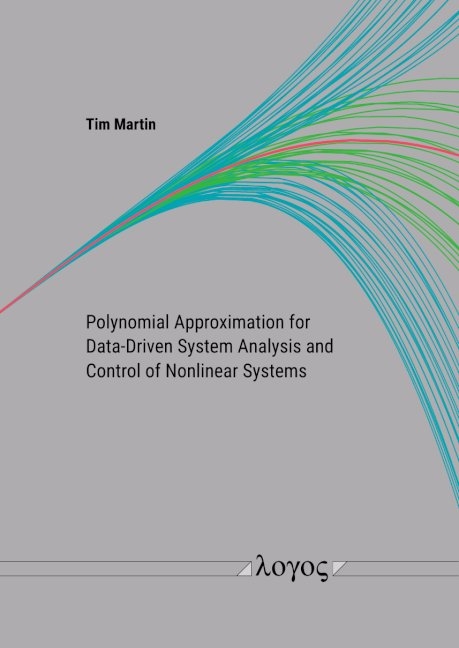
Polynomial Approximation for Data-Driven System Analysis and Control of Nonlinear Systems
Seiten
This thesis presents data-driven methods for nonlinear systems, enabling the verification of system-theoretical properties and the design of state feedbacks based on measured trajectories. Despite noisy data, the developed methods provide rigorous guarantees and leverage convex optimization.
Classical control techniques require a mathematical model of the system dynamics, which derivation from first principles often demands expert knowledge or is time-consuming. In contrast, data-based control methods determine system properties and controllers from system trajectories. Whereas recent developments address linear systems, dynamical systems are generally nonlinear in practice. Therefore, this thesis first introduces a data-based system representation for unknown polynomial systems to determine dissipativity and integral quadratic constraints via sum-of-squares optimization. The second part of the thesis establishes a polynomial representation of nonlinear systems based on polynomial interpolation. Due to the unknown interpolation polynomial, a set of polynomials containing the actual interpolation polynomial is deduced from noisy data. This set, along with a polynomial bound on the approximation error, forms the basis for determining dissipativity properties and designing state feedbacks with stability guarantees utilizing robust control techniques and sum-of-squares relaxation.
Classical control techniques require a mathematical model of the system dynamics, which derivation from first principles often demands expert knowledge or is time-consuming. In contrast, data-based control methods determine system properties and controllers from system trajectories. Whereas recent developments address linear systems, dynamical systems are generally nonlinear in practice. Therefore, this thesis first introduces a data-based system representation for unknown polynomial systems to determine dissipativity and integral quadratic constraints via sum-of-squares optimization. The second part of the thesis establishes a polynomial representation of nonlinear systems based on polynomial interpolation. Due to the unknown interpolation polynomial, a set of polynomials containing the actual interpolation polynomial is deduced from noisy data. This set, along with a polynomial bound on the approximation error, forms the basis for determining dissipativity properties and designing state feedbacks with stability guarantees utilizing robust control techniques and sum-of-squares relaxation.
| Erscheinungsdatum | 15.12.2024 |
|---|---|
| Sprache | englisch |
| Maße | 145 x 210 mm |
| Einbandart | Paperback |
| Themenwelt | Mathematik / Informatik ► Informatik ► Theorie / Studium |
| Technik ► Elektrotechnik / Energietechnik | |
| Schlagworte | Dissipativity • Robust Control • Sum-of-Squares Optimization • System Identification |
| ISBN-10 | 3-8325-5886-1 / 3832558861 |
| ISBN-13 | 978-3-8325-5886-4 / 9783832558864 |
| Zustand | Neuware |
| Informationen gemäß Produktsicherheitsverordnung (GPSR) | |
| Haben Sie eine Frage zum Produkt? |
Mehr entdecken
aus dem Bereich



aus dem Bereich
Teil 2 der gestreckten Abschlussprüfung Fachinformatiker/-in …
Buch | Softcover (2025)
Europa-Lehrmittel (Verlag)
CHF 37,90


