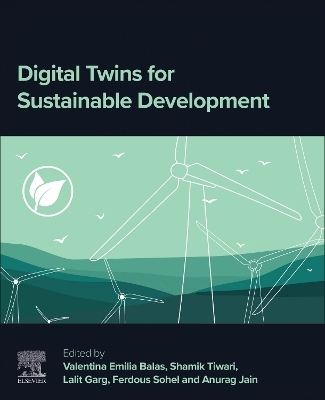
Digital Twins for Sustainable Development
Elsevier - Health Sciences Division (Verlag)
978-0-443-27388-9 (ISBN)
- Noch nicht erschienen (ca. April 2026)
- Versandkostenfrei
- Auch auf Rechnung
- Artikel merken
Valentina Emilia Balas is currently a Full Professor in the Department of Automatics and Applied Software at the Faculty of Engineering, “Aurel Vlaicu University of Arad, Romania. She holds a PhD cum Laude in Applied Electronics and Telecommunications from the Polytechnic University of Timisoara. Dr. Balas is the author of more than 350 research papers. She is the Editor-in-Chief of the 'International Journal of Advanced Intelligence Paradigms' and the 'International Journal of Computational Systems Engineering', an editorial board member for several other national and international publications, and an expert evaluator for national and international projects and PhD theses. Dr. Shamik Tiwari is the Founding Dean of the School of Computer Science & Engineering at IILM University, Gurugram, and is recognized among the World’s Top 2% Scientists (Elsevier & Stanford University, 2023–2025) in Artificial Intelligence. With over 23 years of experience, he has led transformative initiatives in AI-driven education, research, and industry collaboration. His innovations include a non-invasive diagnostic tool for diabetic retinopathy funded by BIRAC–DBT, Government of India. A prolific researcher with 100+ publications, and a Fellow at CPRG, Dr. Tiwari continues to advance global AI research, policy, and innovation in computer science education. Lalit Garg is a Senior Lecturer in Computer Information Systems at the University of Malta, Malta, and an honorary lecturer at the University of Liverpool, UK. He has been a researcher at the Nanyang Technological University, Singapore, and Ulster University, UK. He has supervised 200+ Master's dissertations, 2 DBA and 4 PhD theses and published 125+ high-impact publications in refereed journals/conferences/books, eight edited books and 22 patents. He has delivered several keynote speeches, organized/chaired international conferences, and consulted numerous public and private organizations for information systems implementation and management. His research interests are business intelligence, machine learning, data science, deep learning, cloud computing, mobile computing, the Internet of Things (IoT), information systems, management science and their applications, mainly in healthcare and medical domains. He participates in many EU and locally funded projects, including a one million euro Erasmus+ Capacity-Building project in Higher Education (CBHE), titled Training for Medical education via innovative eTechnology (MediTec), and Malta Council of science and technology's Space Research Funds. The University of Malta has awarded him the 2021-22 Research Excellence Award for exploring Novel Intelligent Computing Methods for healthcare requirements forecasting, allocation and management (NICE-Healthcare). Ferdous Sohel received PhD degree from Monash University, Australia. He is currently a Professor in Information Technology at Murdoch University, Australia. Prior to joining Murdoch University in 2015, he was a Research Assistant Professor/Research Fellow at the School of Computer Science and Software Engineering, The University of Western Australia. His research interests include artificial intelligence and machine learning, computer vision, digital agriculture, image processing, pattern recognition, scene understanding, and video coding. Prof Sohel is a recipient of several research grants worth more than $4.5million. Notably, he is a recipient of the prestigious Discovery Project and Discovery Early Career Research Award (DECRA) funded by the Australian Research Council. He is a recipient of the Learning and Teaching grant on Work Integrated Learning and a Community grant for Invasive Ants detection and tracking from Australia’s national competitive pools. He has also won two WA State Govt. funded competitive grants on shark hazard mitigation and digital pathology to improve cancer diagnosis. He is a recipient of the VC’s Early Career Investigators award (UWA) and the best PhD thesis medal from Monash University. He has won several best paper awards. He is serving IEEE Transactions on Multimedia and IEEE Signal Processing Letters as an Associate Editor. He is a Fellow of the Higher Education Academy, a member of the Australian Computer Society and a senior member of the IEEE. Dr. Anurag Jain is Professor of Computer Science and Engineering at IILM University, Gurugram. He holds a Ph.D. in Computer Science & Engineering and has over 22 years of academic experience across leading Indian universities, including UPES. His research focuses on machine learning, deep learning, and applied AI. He has authored over 80 publications with more than 1,900 citations (h-index 23). Dr. Jain led a BIRAC-funded project on non-invasive diabetic retinopathy diagnostics, supervised multiple Ph.D. and M.Tech students, and served on editorial and program committees for international journals and conferences.
1. Introduction of Digital Twins
2. Role of AI, ML and IoT in designing Digital Twins
3. Digital Twins in Precision Agriculture
4. Machine-Learning enabled Digital Twin in Manufacturing
5. Application of Digital Twins in Supply chain/Logistics Industry
6. Improving operational efficiency of healthcare operations using Digital Twins
7. Health Digital Twins as instruments for Precision Medicine
8. IoT and Digital Twins enabled Smart Learning in Education
9. Digital Twins for Managing Natural Resources
10. Urban Planning supported by Digital Twins
11. Simulate and prepare for natural disasters using Digital Twins
12. Overcoming sustainability challenges with Digital Twins
| Erscheint lt. Verlag | 1.4.2026 |
|---|---|
| Verlagsort | Philadelphia |
| Sprache | englisch |
| Maße | 191 x 235 mm |
| Gewicht | 450 g |
| Themenwelt | Mathematik / Informatik ► Informatik ► Datenbanken |
| Informatik ► Software Entwicklung ► User Interfaces (HCI) | |
| Informatik ► Theorie / Studium ► Künstliche Intelligenz / Robotik | |
| ISBN-10 | 0-443-27388-X / 044327388X |
| ISBN-13 | 978-0-443-27388-9 / 9780443273889 |
| Zustand | Neuware |
| Informationen gemäß Produktsicherheitsverordnung (GPSR) | |
| Haben Sie eine Frage zum Produkt? |
aus dem Bereich