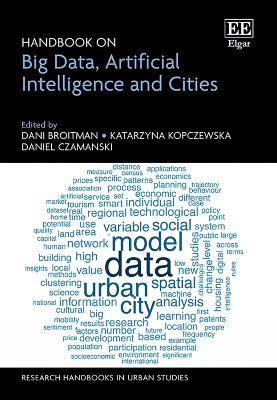
Handbook on Big Data, Artificial Intelligence and Cities
Edward Elgar Publishing Ltd (Verlag)
978-1-80392-804-3 (ISBN)
Chapters delve into specific applications of big data and AI including mobility, tourism, and land use, drawing on case studies from diverse urban environments across Europe and North America. Expert authors evaluate future opportunities for leveraging these technologies, addressing the integration of machine learning into spatial econometric models, the use of self-organizing maps to study demographic shifts, and novel approaches to simulating contagion patterns during pandemics. Ultimately, the Handbook emphasizes the potential of AI to contribute to social good.
Academics and students in human geography, regional and urban studies, economics, sociology, and management will benefit from this multidisciplinary and comprehensive Handbook. Combining theoretical insights with practical applications, it is also a valuable resource for policymakers and practitioners interested in the ongoing digital transformation of urban spaces.
Edited by Dani Broitman, Faculty of Architecture and Town Planning, Technion – Israel Institute of Technology, Israel, Katarzyna Kopczewska, Faculty of Economic Sciences, University of Warsaw, Poland and Daniel Czamanski, Faculty of Economics and Business Administration, Ruppin Academic Center, Israel
Contents
Preface xiii
1 Introduction to the Handbook on Big Data, Artificial Intelligence and
Cities 1
Dani Broitman, Katarzyna Kopczewska and Daniel Czamanski
2 AI, design and planning processes 5
Michael Batty
PART I BIG DATA AND CITIES
3 Bayesian modelling and cities 16
Chris Brunsdon
4 A big-data-based framework for the nexus of urban smartness and urban
vitality: spotlights on small and medium-sized towns 35
Hanna Obracht-Prondzyńska, Karima Kourtit, Peter Nijkamp and
Dorota Kamrowska-Załuska
5 Detecting residential reconversion within cities: how can ‘big data’ be
mobilized to better understand what is going on? 73
Jean Dubé, Katarzyna Kopczewska and Sarah Desaulniers
6 The geography of segregated online social networks in the largest US cities 92
Balázs Lengyel, Eszter Bokányi and Sándor Juhász
7 How big is your data? Critical remarks on Big Data analytics and
co-creation processes in smart urban tourism research 110
João Romão
8 Urban economies, land use, and social dynamics in the city: big data and
measurement 125
Albert Saiz and Arianna Salazar-Miranda
9 A two-dimensional framework of citizen participation in digital
transformation of European cities 166
Yilin Wang, Haozhi Pan and Geoffrey Hewings
10 Listening and comprehending the pulse of places: cultural analysis of
emotions in Big Data and polarisation 189
Annie Tubadji, Frederic Boy, Talita Greyling, Stephanie Rossouw and
Yashi Jain
PART II ARTIFICIAL INTELLIGENCE AND CITIES
11 The urban geography of artificial intelligence in Europe 224
Camilla Lenzi
12 Self-organising maps for exploring the change in Portuguese communities
in Toronto 243
Eric Vaz
13 Machine learning applications to spatiotemporal land-use change modeling 257
Emre Tepe
14 Urban mining for direct geomarketing: mobile data analysis with
association rules 277
Maciej Sacharczuk and Katarzyna Kopczewska
15 Urban AI for social good: mapping research directions and imperatives 309
Laurie A. Schintler, Connie L. McNeely and Vasilii Nosov
16 Simulating COVID-19 contagion patterns using a machine-learningaugmented agent-based model 327
Zi Hen Lin, Yair Grinberger and Daniel Felsenstein
17 Detecting and measuring spatial spillover effects and heterogeneity using
interpretable tree-based machine learning approaches: an illustration using
the Boston housing dataset 349
Mehmet Güney Celbiş, Pui-Hang Wong, Karima Kourtit and Peter Nijkamp
18 Predicting housing price bubbles: the power and limits of selected machine
learning methods 377
Alon Sagi, Avigdor Gal and Dani Broitman
Index 390
| Erscheinungsdatum | 26.04.2025 |
|---|---|
| Reihe/Serie | Research Handbooks in Urban Studies series |
| Verlagsort | Cheltenham |
| Sprache | englisch |
| Maße | 169 x 244 mm |
| Themenwelt | Mathematik / Informatik ► Informatik ► Datenbanken |
| Informatik ► Theorie / Studium ► Künstliche Intelligenz / Robotik | |
| Wirtschaft ► Volkswirtschaftslehre | |
| ISBN-10 | 1-80392-804-2 / 1803928042 |
| ISBN-13 | 978-1-80392-804-3 / 9781803928043 |
| Zustand | Neuware |
| Informationen gemäß Produktsicherheitsverordnung (GPSR) | |
| Haben Sie eine Frage zum Produkt? |
aus dem Bereich