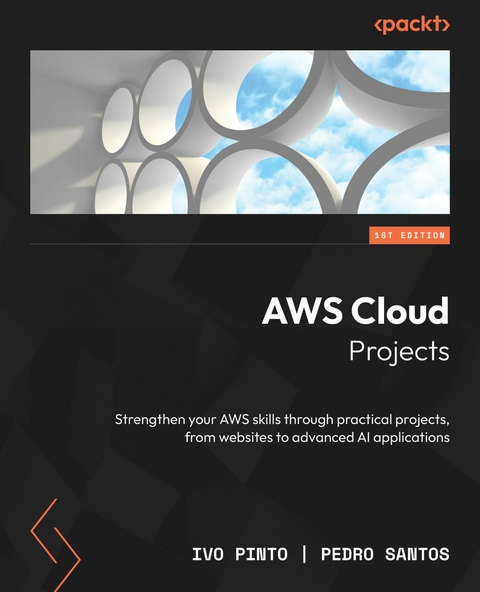
AWS Cloud Projects (eBook)
266 Seiten
Packt Publishing (Verlag)
978-1-83588-929-9 (ISBN)
Tired of resumes getting lost in the pile? This book is your roadmap to building an in-demand AWS portfolio that grabs attention and gets you hired.
This comprehensive guide unlocks AWS's full potential through eight real-world projects designed for developers of all levels. Inside, you'll find invaluable guidance for crafting stunning websites with S3, CloudFront, and Route53. You'll build robust and scalable applications, such as recipe-sharing platforms, using DynamoDB and Elastic Load Balancing. For streamlined efficiency, the book will teach you how to develop serverless architectures with AWS Lambda and Cognito. Gradually, you'll infuse your projects with artificial intelligence by creating a photo analyzer powered by Amazon Rekognition. You'll also automate complex workflows for seamless content translation using Translate, CodePipeline, and CodeBuild. Later, you'll construct intelligent virtual assistants with Amazon Lex and Bedrock to answer web development queries. The book will also show you how to visualize your data with insightful dashboards built using Athena, Glue, and QuickSight.
By the end of this book, you'll have a portfolio of AWS projects to showcase your cloud skills, making you stand out in today's competitive job market.
No detailed description available for "e;AWS Cloud Projects"e;.
1
Deploying and Interacting with AWS Services
Embarking on the journey to build solutions on the Amazon Web Services (AWS) platform requires a comprehensive understanding of the available tools and approaches. This chapter introduces various methodologies for architecting on AWS, beginning with preparatory activities such as requirements gathering, service selection, and diagramming.
You will then explore the various methods and tools available for deploying and interacting with AWS services, including the AWS Console, AWS Command Line Interface (CLI), AWS Software Development Kits (SDKs), and Infrastructure as Code (IaC).
This is a theoretical chapter, structured around the following main topics:
- Architecting on AWS
- Getting started with AWS Console
- Navigating AWS CLI and SDK
- Understanding IaC
By the end of this chapter, you will possess the knowledge and skills necessary to create, operate, and monitor AWS services using the approach that best aligns with your requirements and preferences, whether it be through the user-friendly AWS Console, the CLI, programmatic access via SDKs, or the powerful IaC tools.
Technical requirements
Although this is a theoretical chapter, you will find code snippets in the GitHub repository of this chapter at https://github.com/PacktPublishing/AWS-Cloud-Projects/tree/main/chapter1/code.
To follow along, you will need an AWS account.
Architecting on AWS
Architecting on AWS refers to the process of designing and planning cloud-based solutions using AWS. It involves understanding the various AWS services, their capabilities, and how they can be combined to build scalable, secure, and cost-effective architectures.
When architecting on AWS, the following four aspects should be considered, each detailed later in this chapter:
- Requirements gathering: This is a crucial step in the process of architecting solutions on AWS. It involves understanding the business needs, functional requirements, non-functional requirements, and constraints that will shape the design and implementation of the AWS architecture.
- Architecture patterns: AWS provides various architecture patterns and reference architectures that serve as starting points for common use cases, such as web applications, data processing pipelines, or serverless architectures. You can leverage these patterns and customize them to meet their specific requirements.
- Service selection: AWS offers a broad range of services, including compute, storage, databases, networking, analytics, machine learning, and more. You must carefully evaluate the requirements of the applications and select the appropriate AWS services that best fit those needs.
- Diagramming: Creating visual representations of the proposed architecture is a crucial step in the architecting process. There are no AWS official tools, but draw.io or simply Microsoft PowerPoint can be used to create architecture diagrams, which helps communicate the design and facilitate collaboration and implementation.
Let’s look at these aspects in detail.
Requirements gathering
Clear and well-defined requirements are crucial for architects to design AWS solutions that meet the specific needs of the organization and provide the desired outcomes. Gathering requirements can involve collaborating with stakeholders, conducting workshops, analyzing existing systems and data, and understanding the business context.
However, if your project has a smaller scope, not all these steps may apply. Nonetheless, it is important to understand what type of requirements can be gathered before a project starts:
- Business requirements: The first step is to understand the business objectives, goals, and drivers behind the solution being architected. This includes factors such as the target market, expected growth, revenue models, and any specific business constraints or regulations that need to be considered.
- Functional requirements: These requirements define the specific features, functionalities, and capabilities that the solution must provide. This could include requirements related to user interfaces, data processing, integration with existing systems, or specific business logic.
- Non-functional requirements: Non-functional requirements define the qualitative attributes that the solution must possess, such as performance, scalability, availability, security, and compliance. These requirements are often critical in determining the appropriate AWS services and architectural patterns to be used.
- Technical requirements: Technical requirements encompass the specific technologies, programming languages, frameworks, and tools that need to be used or integrated with the AWS solution. This could include requirements for specific databases, messaging systems, or third-party services.
- Data requirements: Understanding the data requirements is essential when architecting on AWS. This includes the types of data (structured, unstructured, or semi-structured), data volumes, data sources, data processing needs, and any specific data governance or compliance requirements.
- Integration requirements: If the AWS solution needs to integrate with existing on-premises systems, third-party services, or other cloud environments, the integration requirements must be clearly defined. This includes identifying the integration points, data formats, protocols, and security considerations.
- Security and compliance requirements: Depending on the industry and the nature of the data being handled, there may be specific security and compliance requirements that need to be addressed in the AWS architecture. These could include regulatory standards, data protection laws, or industry-specific certifications.
- Financial requirements: AWS offers a pay-as-you-go pricing model. Understanding the budget constraints and cost requirements is essential for selecting the appropriate AWS services and implementing cost-effective architectures.
Bear in mind that some folks consider costs or security requirements part of the umbrella of functional and non-functional requirements. Don’t be pedantic about naming; just gather all your requirements.
Choosing an architecture pattern
Architecture patterns and reference architectures serve as starting points for designing and implementing cloud-based solutions. These patterns encapsulate best practices, proven designs, and architectural principles tailored to specific use cases and requirements. You can find many of these in the AWS Architecture Center: https://aws.amazon.com/architecture.
By leveraging AWS architecture patterns and reference architectures, you can build upon proven designs, accelerate the development process, and ensure that your solutions align with AWS best practices and industry standards.
Architecture patterns address common scenarios and requirements. These include patterns for web applications, data processing pipelines, serverless architectures, microservices, event-driven architectures, and more. You can leverage these patterns as a foundation and customize them to meet specific needs.
In addition to general patterns, AWS provides reference architectures for specific domains and industries, such as e-commerce, media and entertainment, healthcare, financial services, and more. These reference architectures offer detailed guidance on how to design and implement solutions using AWS services and best practices specific to those domains.
To select a pattern or architecture, you must carefully evaluate the requirements, constraints, and use cases of their solutions to select the most appropriate one. This selection process involves understanding the strengths, weaknesses, and trade-offs of each pattern, as well as their alignment with the rest of the technical stack. This is often detailed in their description.
While architecture patterns provide a solid starting point, they are rarely implemented as-is. You must customize and adapt the patterns to fit your specific requirements, integrating additional AWS services, adjusting configurations, and incorporating security, monitoring, and operational considerations.
It can also happen that what you need is a hybrid or multi-pattern architecture. Some solutions require a combination of multiple architecture patterns or a hybrid approach that combines components of different patterns. There is an extra challenge in determining how to effectively integrate and orchestrate the different patterns into a cohesive and scalable...
| Erscheint lt. Verlag | 8.11.2024 |
|---|---|
| Sprache | englisch |
| Themenwelt | Mathematik / Informatik ► Informatik ► Web / Internet |
| ISBN-10 | 1-83588-929-8 / 1835889298 |
| ISBN-13 | 978-1-83588-929-9 / 9781835889299 |
| Informationen gemäß Produktsicherheitsverordnung (GPSR) | |
| Haben Sie eine Frage zum Produkt? |
 EPUB (Ohne DRM)
Digital Rights Management: ohne DRM
Dieses eBook enthält kein DRM oder Kopierschutz. Eine Weitergabe an Dritte ist jedoch rechtlich nicht zulässig, weil Sie beim Kauf nur die Rechte an der persönlichen Nutzung erwerben.
Dateiformat: EPUB (Electronic Publication)
EPUB ist ein offener Standard für eBooks und eignet sich besonders zur Darstellung von Belletristik und Sachbüchern. Der Fließtext wird dynamisch an die Display- und Schriftgröße angepasst. Auch für mobile Lesegeräte ist EPUB daher gut geeignet.
Systemvoraussetzungen:
PC/Mac: Mit einem PC oder Mac können Sie dieses eBook lesen. Sie benötigen dafür die kostenlose Software Adobe Digital Editions.
eReader: Dieses eBook kann mit (fast) allen eBook-Readern gelesen werden. Mit dem amazon-Kindle ist es aber nicht kompatibel.
Smartphone/Tablet: Egal ob Apple oder Android, dieses eBook können Sie lesen. Sie benötigen dafür eine kostenlose App.
Geräteliste und zusätzliche Hinweise
Buying eBooks from abroad
For tax law reasons we can sell eBooks just within Germany and Switzerland. Regrettably we cannot fulfill eBook-orders from other countries.
aus dem Bereich