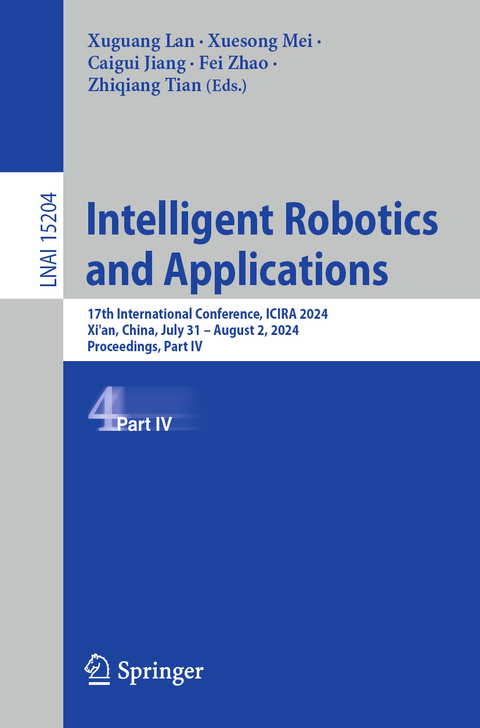
Intelligent Robotics and Applications
Springer Nature Switzerland AG (Verlag)
978-981-96-0797-6 (ISBN)
- Titel nicht im Sortiment
- Artikel merken
The 10-volume set LNAI 15201-15210 constitutes the proceedings of the 17th International Conference on Intelligent Robotics and Applications, ICIRA 2024, which took place in Xi'an, China, during July 31-August 2, 2024.
The 321 full papers included in these proceedings were carefully reviewed and selected from 489 submissions.
They were organized in topical sections as follows:
Part I: Innovative Design and Performance Evaluation of Robot Mechanisms.
Part II: Robot Perception and Machine Learning; Cognitive Intelligence and Security Control for Multi-domain Unmanned Vehicle Systems.
Part III: Emerging Techniques for Intelligent Robots in Unstructured Environment; Soft Actuators and Sensors; and Advanced Intelligent and Flexible Sensor Technologies for Robotics.
Part IV: Optimization and Intelligent Control of Underactuated Robotic Systems; and Technology and application of modular robots.
Part V: Advanced actuation and intelligent control in medical robotics: Advancements in Machine Vision for Enhancing Human-Robot Interaction; and Hybrid Decision-making and Control for Intelligent Robots.
Part VI: Advances in Marine Robotics; Visual, Linguistic, Affective Agents: Hybrid-augmented Agents for Robotics; and Wearable Robots for Assistance, Augmentation and Rehabilitation of human movements.
Part VII: Integrating World Models for Enhanced Robotic Autonomy; Advanced Sensing and Control Technologies for Intelligent Human-Robot Interaction; and Mini-Invasive Robotics for In-Situ Manipulation.
Part VIII: Robot Skill Learning and Transfer; Human-Robot Dynamic System: Learning, Modelling and Control; AI-Driven Smart Industrial Systems; and Natural Interaction and Coordinated Collaboration of Robots in Dynamic Unstructured Environments.
Part IX: Robotics in Cooperative Manipulation, MultiSensor Fusion, and Multi-Robot Systems; Human-machine Co-adaptive Interface; Brain inspired intelligence for robotics; Planning, control and application of bionic novel concept robots; and Robust Perception for Safe Driving.
Part X: AI Robot Technology for Healthcare as a Service; Computational Neuroscience and Cognitive Models for Adaptive Human-Robot Interactions; Dynamics and Perception of Human-Robot Hybrid Systems; and Robotics for Rehabilitation: Innovations, Challenges, and Future Directions.
.- Optimization and Intelligent Control of Underactuated Robotic Systems.
.- Study of Kinematics and Trajectory Planning for the Pneumatic Soft Manipulator.
.- Modeling and Nonlinear Coordinated Stabilizing Control for Dual Ship-mounted Cranes Subject to Roll and Heave Motions.
.- Double closed-loop trajectory tracking control strategy for wheeled mobile robot.
.- Sliding mode control of VTOL aircraft based on stability criterion.
.- Neural Network-Based Adaptive Tracking Control for Marine Lifting Arm System.
.- Hierarchical Optimization-based Hybrid Whole-body Control for Wheel-Legged Robots.
.- Fixed-Time Fault-Tolerant Control for Robotic Manipulators Based on Bias Neural Network with Input Saturation.
.- Multi-contact trajectory planning of humanoid based on relaxed contact constraint.
.- Adaptive anti-swing control for a Ship board boom crane.
.- ESO-Based Tracking Controller of A Nonlinear System with Disturbance: An FAS Approach.
.- Design of A Pneumatic-Driven Bionic Robot Fish Based on A Fish Tail Structure.
.- Nonlinear Model predictive control based on disturbance observer for cross-domain unmanned platform.
.- A Novel Bio-Inspired Optimal Control Strategy of Heavy-Duty Robots Considering Leg Momentum.
.- A Quadruped Manipulator Robot that Achieves Bipedal Motion via ZMP Planning and Dynamic Control.
.- A New Unified Frame and System of Bionic Variable Structure Robots: Design and Applications.
.- Technology and application of modular robots.
.- Development of a Bistable Multi-Joint Modular Gripper with Enhanced Adaptability and Speed.
.- Online Parallel Optimization Motion Planner for Robots under Moving Obstacle Circumstances.
.- Design, modeling and implementation of a novel rigid-flexible hybrid robotic arm.
.- Design and Development of a Modular Pneumatic-Driven Soft Tripod Robot.
.- Parallel Self-Assembly for Modular Robots Using Deep Reinforcement Learning.
.- Optimal Configuration Generation of Reconfigurable Modular Robots for Specific Tasks.
.- Nested Dual-chamber Origami (NDO) Actuator with Pressure Compounding and Enhanced Payload.
.- A Locomotion Control Method for Modular Robot Based on PPO Algorithm.
.-Design a pneumatic-driven sorting modular soft hand based on visual object detection.
.- Design and Kinematic Simulation Analysis of Spherical Modular Robots.
.- Pick-and-place trajectory optimization for a two-DOF cable-suspended modular parallel robot.
.- MOPARAS: A Modular Parallel Spherical Robot with Position-Adjustable Connectors.
.- Rolling Contact Motion Modeling for Spherical Modular Self-Reconfigurable Robots.
| Erscheinungsdatum | 25.01.2025 |
|---|---|
| Reihe/Serie | Lecture Notes in Artificial Intelligence | Lecture Notes in Computer Science |
| Zusatzinfo | 208 Illustrations, color; 23 Illustrations, black and white |
| Verlagsort | Cham |
| Sprache | englisch |
| Maße | 155 x 235 mm |
| Themenwelt | Mathematik / Informatik ► Informatik ► Software Entwicklung |
| Informatik ► Theorie / Studium ► Künstliche Intelligenz / Robotik | |
| Schlagworte | development and control • Human-Robot Interaction • learning and linguistics • Machining robots • Medical Robot • Mobile robots and intelligent autonomous systems • Navigation/Localization • parallel robots • recognition and reconstruction • Robot Design • Robotic vision • Robot Intelligence • Robot legged locomotion • Robot motion analysis and planning • Soft Robots • Space and underwater robots |
| ISBN-10 | 981-96-0797-3 / 9819607973 |
| ISBN-13 | 978-981-96-0797-6 / 9789819607976 |
| Zustand | Neuware |
| Informationen gemäß Produktsicherheitsverordnung (GPSR) | |
| Haben Sie eine Frage zum Produkt? |
aus dem Bereich