


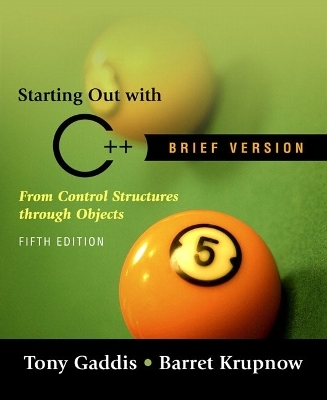
Starting out with C++ Brief
Pearson
9780321412911 (ISBN)
- Titel erscheint in neuer Auflage
- Artikel merken
In the brief version of Starting Out with C++, Gaddis takes a problem-solving approach, inspiring students to understand the logic behind developing quality programs while introducing the C++ programming language. This style of teaching builds programming confidence and enhances each student’s development of programming skills.
This edition in the 'Starting Out' Series covers the core programming concepts that are introduced in the first semester introductory programming course.
Tony Gaddis teaches computer science courses at Haywood Community College in North Carolina. He has also taught C and C++ programming for several corporations and government agencies, including NASA's Kennedy Space Center. Tony is a highly acclaimed instructor who is a former North Carolina Community College "Teacher of the Year" and a recipient of the Teaching Excellence award from the National Institute for Staff and Organizational Development in 1997. He is the principal author of the `Starting Out’ Series that includes Java, C++, Visual Basic and C# programming titles.
Preface
CHAPTER 1 Introduction to Computers and Programming
1.1 Why Program?
1.2 Computer Systems: Hardware and Software
1.3 Programs and Programming Languages
1.4 What Is a Program Made of?
1.5 Input, Processing, and Output
1.6 The Programming Process
1.7 Procedural and Object-Oriented Programming
CHAPTER 2 Introduction to C++
2.1 The Parts of a C++ Program
2.2 The cout Object
2.3 The # include Directive
2.4 Variables and Literals
2.5 Identifiers
2.6 Integer Data Types
2.7 The char Data Type
2.8 Floating-Point Data Types
2.9 The bool Data Type
2.10 Determining the Size of a Data Type
2.11 Variable Assignments and Initialization
2.12 Scope
2.13 Arithmetic Operators
2.14 Comments
2.15 Focus on Software Engineering: Programming Style
2.16 If You Plan to Continue in Computer Science: Standard and Prestandard C++
CHAPTER 3 Expressions and Interactivity
3.1 The cin Object
3.2 Mathematical Expressions
3.3 When You Mix Apples and Oranges: Type Conversion
3.4 Overflow and Underflow
3.5 Type Casting
3.6 Named Constants
3.7 Multiple Assignment and Combined Assignment
3.8 Formatting Output
3.9 Formatted Input
3.10 Focus on Object-Oriented Programming: More About Member Functions
3.11 More Mathematical Library Functions
3.12 Focus on Debugging: Hand Tracing a Program
3.13 Focus on Problem Solving: A Case Study
3.14 Introduction to File Input and Output
CHAPTER 4 Making Decisions
4.1 Relational Operators
4.2 The if Statement
4.3 Flags
4.4 Expanding the if Statement
4.5 The if/else Statement
4.6 The if/else if Statement
4.7 Using a Trailing else
4.8 Menus
4.9 Focus on Software Engineering: Nested if Statements
4.10 Logical Operators
4.11 Checking Numeric Ranges with Logical Operators
4.12 Focus on Software Engineering: Validating User Input
4.13 More About Variable Definitions and Scope
4.14 Comparing Strings
4.15 The Conditional Operator
4.16 The switch Statement
4.17 Testing for File Open Errors
CHAPTER 5 Looping
5.1 The Increment and Decrement Operators
5.2 Introduction to Loops: The while Loop
5.3 Using the while Loop for Input Validation
5.4 Counters
5.5 The do-while Loop
5.6 The for Loop
5.7 Keeping a Running Total
5.8 Sentinels
5.9 Using a Loop to Read Data from a File
5.10 Focus on Software Engineering: Deciding Which Loop to Use
5.11 Nested Loops
5.12 Breaking Out of a Loop
5.13 The continue Statement
CHAPTER 6 Functions
6.1 Focus on Software Engineering: Modular Programming
6.2 Defining and Calling Functions
6.3 Function Prototypes
6.4 Sending Data into a Function
6.5 Passing Data by Value
6.6 Focus on Software Engineering: Using Functions in a Menu-Driven Program
6.7 The return Statement
6.8 Returning a Value from a Function
6.9 Returning a Boolean Value
6.10 Local and Global Variables
6.11 Static Local Variables
6.12 Default Arguments
6.13 Using Reference Variables as Parameters
6.14 Overloading Functions
6.15 The exit () Function
6.16 Stubs and Drivers
CHAPTER 7 Arrays
7.1 Arrays Hold Multiple Values
7.2 Accessing Array Elements
7.3 No Bounds Checking in C++
7.4 Array Initialization
7.5 Processing Array Contents
7.6 Focus on Software Engineering: Using Parallel Arrays
7.7 Arrays as Function Arguments
7.8 Two-Dimensional Arrays
7.9 Arrays of Strings
7.10 Arrays with Three or More Dimensions
7.11 Focus on Problem Solving and Program Design: A Case Study
7.12 If You Plan to Continue in Computer Science: Introduction to the STL vector
CHAPTER 8 Pointers
8.1 Getting the Address of a Variable
8.2 Pointer Variables
8.3 The Relationship Between Arrays and Pointers
8.4 Pointer Arithmetic
8.5 Initializing Pointers
8.6 Comparing Pointers
8.7 Pointers as Function Parameters
8.8 Focus on Software Engineering: Dynamic Memory Allocation
8.9 Focus on Software Engineering: Returning Pointers from Functions
8.10 Focus on Problem Solving and Program Design: A Case Study
CHAPTER 9 Characters, Strings, and the string Class
9.1 Character Testing
9.2 Character Case Conversion
9.3 Review of the Internal Storage of C-Strings
9.4 Library Functions for Working with C-Strings
9.5 String/Numeric Conversion Functions
9.6 Focus on Software Engineering: Writing Your Own
C-String-Handling Functions
9.7 The C++ string Class
9.8 Focus on Problem Solving and Program Design: A Case Study
CHAPTER 10 Structured Data
10.1 Abstract Data Types
10.2 Focus on Software Engineering: Combining Data into Structures
10.3 Accessing Structure Members
10.4 Initializing a Structure
10.5 Arrays of Structures
10.6 Focus on Software Engineering: Nested Structures
10.7 Structures as Function Arguments
10.8 Returning a Structure from a Function
10.9 Pointers to Structures
10.10 Focus on Software Engineering: When to Use., When to Use ->, and When to Use *
10.11 Unions
10.12 Enumerated Data Types
CHAPTER 11 Advanced File Operations
11.1 File Operations
11.2 File Output Formatting
11.3 Passing File Stream Objects to Functions
11.4 More Detailed Error Testing
11.5 Member Functions for Reading and Writing Files
11.6 Focus on Software Engineering: Working with Multiple Files
11.7 Binary Files
11.8 Creating Records with Structures
11.9 Random-Access Files
11.10 Opening a File for Both Input and Output
CHAPTER 12 Introduction to Classes
12.1 Procedural and Object-Oriented Programming
12.2 Introduction to Classes
12.3 Defining an Instance of a Class
12.4 Why Have Private Members?
12.5 Focus on Software Engineering: Separating Class Specification from Implementation
12.6 Inline Member Functions
12.7 Constructors
12.8 Passing Arguments to Constructors
12.9 Destructors
12.10 Overloading Constructors
12.11 Private Member Functions
12.12 Arrays of Objects
12.13 Focus on Problem Solving and Program Design: An OOP Case Study
12.14 Focus on Object-Oriented Programming: Creating an Abstract Array Data Type
12.15 Focus on Object-Oriented Design: The Unified Modeling Language (UML)
12.16 Focus on Object-Oriented Design: Finding the Classes and Their Responsibilities
CHAPTER 13 More About Classes
13.1 Instance and Static Members
13.2 Friends of Classes
13.3 Memberwise Assignment
13.4 Copy Constructors
13.5 Operator Overloading
13.6 Object Conversion
13.7 Aggregation
13.8 Focus on Object-Oriented Design: Class Collaborations
CHAPTER 14 Inheritance, Polymorphism, and Virtual Functions
14.1 What Is Inheritance?
14.2 Protected Members and Class Access
14.3 Constructors and Destructors in Base and Derived Classes
14.4 Redefining Base Class Functions
14.5 Class Hierarchies
14.6 Polymorphism and Virtual Member Functions
14.7 Abstract Base Classes and Pure Virtual Functions
14.8 Multiple Inheritance
Appendix A: The ASCII Character Set
Appendix B: Operator Precedence and Associativity
Index
Student CD The following chapters and appendices are on the accompanying Student CD.
CHAPTER B (Bonus Chapter): Searching and Sorting Arrays
B-1 Focus on Software Engineering: Introduction to Search Algorithms
B-2 Focus on Problem Solving and Program Design: A Case Study
B-3 Focus on Software Engineering: Introduction to Sorting Algorithms
B-4 Focus on Problem Solving and Program Design: A Case Study
B-5 If You Plan to Continue in Computer Science: Sorting and Searching vectors
Appendix C: Introduction to Flowcharting
Appendix D: Using UML in Class Design
Appendix E: Namespaces
Appendix F: Writing Managed C++ Code for the .NET Framework
Appendix G: Passing Command Line Arguments
Appendix H: Header File and Library Function Reference
Appendix I: Binary Numbers and Bitwise Operations
Appendix J: Multi-Source File Programs
Appendix K: Stream Member Functions for Formatting
Appendix L: Installing and Using Borland C++ Builder 6
Appendix M: Introduction to Microsoft Visual C++ 2005 Express Edition
Appendix N: Answers to Checkpoints
Appendix O: Answers to Odd-Numbered Review Questions
| Erscheint lt. Verlag | 13.10.2006 |
|---|---|
| Sprache | englisch |
| Gewicht | 1556 g |
| Themenwelt | Mathematik / Informatik ► Informatik ► Programmiersprachen / -werkzeuge |
| ISBN-13 | 9780321412911 / 9780321412911 |
| Zustand | Neuware |
| Informationen gemäß Produktsicherheitsverordnung (GPSR) | |
| Haben Sie eine Frage zum Produkt? |


