


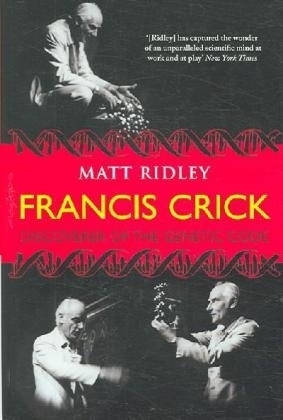
Francis Crick
Discoverer of the Genetic Code
Seiten
2006
HarperPress (Verlag)
9780007213306 (ISBN)
HarperPress (Verlag)
9780007213306 (ISBN)
- Titel ist leider vergriffen;
keine Neuauflage - Artikel merken
On 28 February 1953, Francis Crick announced that he and his American colleague James Watson 'had found the secret of life'. This book traces the life of the man who discovered the structure of DNA. It traces the work behind one of mankind's greatest discoveries and displays the life of a scientist considered to be of the very first rank.
In the launch title of an exciting new series, acclaimed author Matt Ridley traces the colourful life of the man who discovered the structure of DNA, the building blocks of life. Building on a biographical tradition that can be traced back to Aubrey's "Brief Lives", Dr Johnson's "Lives of the Poets" and Lytton Strachey's "Eminent Victorians", this exciting and ground breaking new series pairs great biographers, historians and novelists with iconic subjects, the writing bristling with original and distinctive points of view. On 28 February 1953, Francis Crick walked into The Eagle pub in Cambridge and announced that he and his American colleague James Watson 'had found the secret of life'. In fact, they had indeed done so. That morning, Crick and Watson had worked out the structure of DNA (deoxyribonucleic acid). They had discovered its 'double helix' form, one which could replicate itself, confirming theories that it carried life's hereditary information. Matt Ridley's life of Crick begins with his birth in 1916 at the home of a shoe factory owner, his early explosive experiments at primary school and time developing torpedoes in the Navy.
After his seismic genetic code discovery, which won him the Nobel Prize before he'd even gained a PhD, the scientist's later work was rarely uncontroversial. From California, he proposed that life began when micro-organisms from another planet were dropped here by a spaceship sent to Earth, and maintained that the 'human soul' was entirely explicable in terms of brain activity. Matt Ridley's entertaining account traces the colourful and entirely original work behind one of mankind's greatest discoveries and displays the life of a scientist considered to be of the very first rank.
In the launch title of an exciting new series, acclaimed author Matt Ridley traces the colourful life of the man who discovered the structure of DNA, the building blocks of life. Building on a biographical tradition that can be traced back to Aubrey's "Brief Lives", Dr Johnson's "Lives of the Poets" and Lytton Strachey's "Eminent Victorians", this exciting and ground breaking new series pairs great biographers, historians and novelists with iconic subjects, the writing bristling with original and distinctive points of view. On 28 February 1953, Francis Crick walked into The Eagle pub in Cambridge and announced that he and his American colleague James Watson 'had found the secret of life'. In fact, they had indeed done so. That morning, Crick and Watson had worked out the structure of DNA (deoxyribonucleic acid). They had discovered its 'double helix' form, one which could replicate itself, confirming theories that it carried life's hereditary information. Matt Ridley's life of Crick begins with his birth in 1916 at the home of a shoe factory owner, his early explosive experiments at primary school and time developing torpedoes in the Navy.
After his seismic genetic code discovery, which won him the Nobel Prize before he'd even gained a PhD, the scientist's later work was rarely uncontroversial. From California, he proposed that life began when micro-organisms from another planet were dropped here by a spaceship sent to Earth, and maintained that the 'human soul' was entirely explicable in terms of brain activity. Matt Ridley's entertaining account traces the colourful and entirely original work behind one of mankind's greatest discoveries and displays the life of a scientist considered to be of the very first rank.
Matt Ridley received his BA and D. Phil at Oxford researching the evolution of behaviour. He has been science editor, Washington correspondent and American editor of The Economist. He has a regular column in the Daily Telegraph. He is also the author of 'The Red Queen' (1993) and 'The Origins of Virtue' (1996). Matt Ridley is currently the chairman of The International Centre for Life.
| Erscheint lt. Verlag | 4.9.2006 |
|---|---|
| Reihe/Serie | Eminent Lives |
| Verlagsort | London |
| Sprache | englisch |
| Maße | 141 x 209 mm |
| Gewicht | 350 g |
| Themenwelt | Literatur ► Biografien / Erfahrungsberichte |
| Sachbuch/Ratgeber ► Natur / Technik | |
| Informatik ► Weitere Themen ► Bioinformatik | |
| Naturwissenschaften ► Biologie ► Genetik / Molekularbiologie | |
| ISBN-13 | 9780007213306 / 9780007213306 |
| Zustand | Neuware |
| Informationen gemäß Produktsicherheitsverordnung (GPSR) | |
| Haben Sie eine Frage zum Produkt? |
Mehr entdecken
aus dem Bereich


aus dem Bereich
Allgemeine und spezielle Kodierrichtlinien für die Verschlüsselung …
Buch | Softcover (2026)
Deutscher Ärzteverlag
CHF 13,95
Internationale statistische Klassifikation der Krankheiten und …
Buch | Softcover (2025)
Deutscher Ärzteverlag
CHF 34,95
Operationen- und Prozedurenschlüssel; Internationale Klassifikation …
Buch | Softcover (2025)
Deutscher Ärzteverlag
CHF 34,95


