


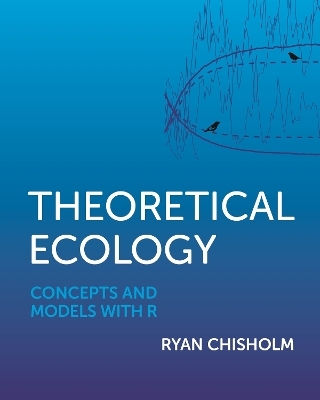
Theoretical Ecology
Concepts and Models with R
Seiten
2025
Princeton University Press (Verlag)
978-0-691-27531-4 (ISBN)
Princeton University Press (Verlag)
978-0-691-27531-4 (ISBN)
An accessible and wide-ranging introduction to the concepts and tools of theoretical ecology
Theoretical ecology explores the mechanisms that structure ecological communities using a variety of mathematical and computational tools. Theoretical Ecology shows you how to translate ecological problems into mechanistic models using both mathematics and the programming language R. The book teaches key concepts and core quantitative skills while also devoting significant attention to the reasons for building mathematical ecological models. Why do species populations fluctuate over time and space? How do multiple species coexist? What forces drive nutrient and carbon cycles? Does higher species diversity lead to higher biomass? Each chapter in this incisive and informative book is motivated by questions like these, and every chapter includes boxes that delve into mathematical details and provide coding examples in R.
Focuses on mathematical and computational methods while also drawing on conceptual and graphical approaches, and explores how the various approaches complement one another
Teaches students the skills they need to implement and analyze ecological models in R
Covers topics ranging from single-species, competition, and predator–prey models to community ecology, island biogeography, and nutrient-flux models
Provides exercises of gradated difficulty at the end of every chapter
Ideal for advanced undergraduate and graduate classrooms and for independent study
Includes a road map for class planning and self-study
Theoretical ecology explores the mechanisms that structure ecological communities using a variety of mathematical and computational tools. Theoretical Ecology shows you how to translate ecological problems into mechanistic models using both mathematics and the programming language R. The book teaches key concepts and core quantitative skills while also devoting significant attention to the reasons for building mathematical ecological models. Why do species populations fluctuate over time and space? How do multiple species coexist? What forces drive nutrient and carbon cycles? Does higher species diversity lead to higher biomass? Each chapter in this incisive and informative book is motivated by questions like these, and every chapter includes boxes that delve into mathematical details and provide coding examples in R.
Focuses on mathematical and computational methods while also drawing on conceptual and graphical approaches, and explores how the various approaches complement one another
Teaches students the skills they need to implement and analyze ecological models in R
Covers topics ranging from single-species, competition, and predator–prey models to community ecology, island biogeography, and nutrient-flux models
Provides exercises of gradated difficulty at the end of every chapter
Ideal for advanced undergraduate and graduate classrooms and for independent study
Includes a road map for class planning and self-study
Ryan Chisholm is associate professor in the Department of Biological Sciences at the National University of Singapore and a leading theoretical ecologist.
| Erscheinungsdatum | 11.09.2025 |
|---|---|
| Zusatzinfo | 77 b/w illus. 11 tables. |
| Verlagsort | New Jersey |
| Sprache | englisch |
| Maße | 203 x 254 mm |
| Themenwelt | Mathematik / Informatik ► Informatik ► Theorie / Studium |
| Naturwissenschaften ► Biologie ► Ökologie / Naturschutz | |
| ISBN-10 | 0-691-27531-9 / 0691275319 |
| ISBN-13 | 978-0-691-27531-4 / 9780691275314 |
| Zustand | Neuware |
| Informationen gemäß Produktsicherheitsverordnung (GPSR) | |
| Haben Sie eine Frage zum Produkt? |
Mehr entdecken
aus dem Bereich



aus dem Bereich
was jeder über Informatik wissen sollte
Buch | Softcover (2024)
Springer Vieweg (Verlag)
CHF 53,15
Grundlagen – Anwendungen – Perspektiven
Buch | Softcover (2022)
Springer Vieweg (Verlag)
CHF 53,15
Teil 2 der gestreckten Abschlussprüfung Fachinformatiker/-in …
Buch | Softcover (2025)
Europa-Lehrmittel (Verlag)
CHF 37,90


