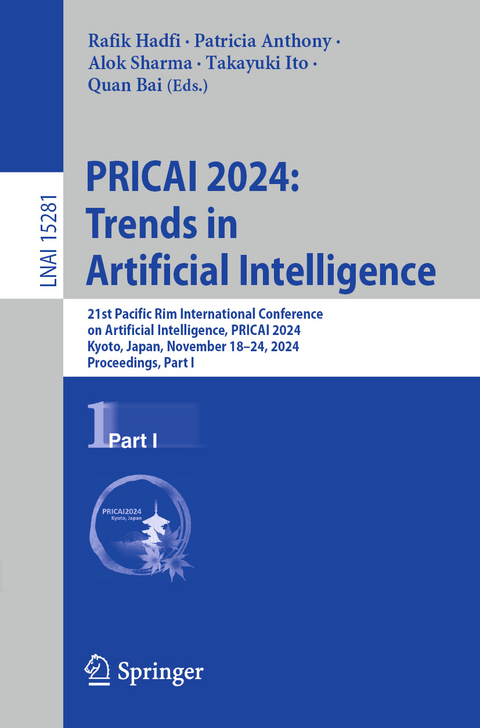
PRICAI 2024: Trends in Artificial Intelligence
Springer Nature Switzerland AG (Verlag)
978-981-96-0115-8 (ISBN)
- Titel nicht im Sortiment
- Artikel merken
The five-volume proceedings set LNAI 15281-15285, constitutes the refereed proceedings of the 21st Pacific Rim International Conference on Artificial Intelligence, PRICAI 2024, held in Kyoto, Japan, in November 18-24, 2024.
The 145 full papers and 35 short papers included in this book were carefully reviewed and selected from 543 submissions.
The papers are organized in the following topical sections:
Part I: Machine Learning, Deep Learning
Part II: Deep Learning, Federated Learning, Generative AI, Natural Language Processing, Large Language Models,
Part III: Large Language Models, Computer Vision
Part IV: Computer Vision, Autonomous Driving, Agents and Multiagent Systems, Knowledge Graphs, Speech Processing, Optimization
Part V: Optimization, General Applications, Medical Applications, Theoretical Foundations of AI
.- Machine Learning.
.- Quantitative Analysis of Training Methods, Data Size, and User-Specific Effectiveness in DL-Based Personalized Aesthetic Evaluation.
.- EQUISCALE: Equitable Scaling for Abstention Learning.
.- Unsupervised Clustering Using a Variational Autoencoder with Constrained Mixtures for Posterior and Prior.
.- UTBoost: Gradient Boosted Decision Trees for Uplift Modeling.
.- CodeMosaic Patch: Physical Adversarial Attacks Against Infrared Aerial Object Detectors.
.- Sequential Clustering for Real-world Datasets.
.- Dual-mode Contrastive Learning-Enhanced Knowledge Tracing.
.- Leveraging Information Consistency in Frequency and Spatial Domain for Adversarial Attacks.
.- Characterization of Similarity Metrics in Epistemic Logic.
.- A Relaxed Symmetric Non-negative Matrix Factorization Approach for Community Discovery.
.- Enhanced Cognitive Distortions Detection and Classification through Data Augmentation Techniques.
.- Enhancing Music Genre Classification using Augmented Features Ensemble Learning Technique.
.- A Multi-Layer Network Community Detection Method via Network Feature Augmentation and Contrastive Learning.
.- Scene Text Recognition Based on Corner Point and Attention Mechanism.
.- A Comprehensive Framework for Debiased Sample Selection across All Noise Types.
.- A Traffic Flow Prediction Model Integrating Dynamic Implicit Graph Information.
.- A Recursive Learning Algorithm for the Least Squares SVM.
.- BDEL: A Backdoor Attack Defense Method Based on Ensemble Learning.
.- Customizing Spatial-Temporal Graph Mamba Networks for Pandemic Forecasting.
.- Distribution-aligned Sequential Counterfactual Explanation with Local Outlier Factor.
.- T-FIA: Temporal-Frequency Interactive Attention Network for Long-term Time Series Forecasting.
.- Multi-modal Food Recommendation using Clustering andSelf-supervised Learning.
.- A quality assessment method of few-shot datasets based on the fusion of quantity and quality.
.- Deep Learning.
.- CSDCNet: A Semantic Segmentation Network for Tubular Structures.
.- Neural Network Surrogate based on Binary Classification for Assisting Genetic Programming in Searching Scheduling Heuristic.
.- HN-Darts:Hybrid Network Differentiable Architecture Search for Industrial Scenarios.
High-Order Structure Enhanced Graph Clustering.
.- CAFGO: Confidence-Adaptive Factor Graph Optimization Algorithm for Fusion Localization.
.- MFNAS: Multi-Fidelity Exploration in Neural Architecture Search with Stable Zero-shot Proxy.
.- DyAGL: A Dynamic-aware Adaptive Graph Learning Network for Next POI Recommendation.
.- Acoustic classification of bird species using improved pre-trained models.
.- Aspect Term Extraction via Dynamic Attention and a Densely Connected Graph Convolutional Network.
.- NLDF: Neural Light Dynamic Fields for 3D Talking Head Generation.
.- Enhanced Knowledge Tracing via Frequency Integration and Order Sensitivity.
.- Position-Aware Dynamic Graph Convolutional Recurrent Network for Traffic Forecasting.
.- Pose Preserving Landmark Guided Neural Radiation Fields for Talking Portrait Synthesis.
.- Adaptive Optimisation of PyTorch Memory Pools for DNNs.
.- Detaching Range from Depth: Personalized Recommendation Meets Personalized PageRank.
.- Context-Aware Structural Adaptive Graph Neural Networks.
.- multi-GAT: Integrative Analysis of scRNA-seq and scATAC-seq Data Using Graph Attention Networks for Cell Annotation.
| Erscheinungsdatum | 19.11.2024 |
|---|---|
| Reihe/Serie | Lecture Notes in Artificial Intelligence | Lecture Notes in Computer Science |
| Zusatzinfo | 113 Illustrations, color; 14 Illustrations, black and white |
| Verlagsort | Cham |
| Sprache | englisch |
| Maße | 155 x 235 mm |
| Themenwelt | Mathematik / Informatik ► Informatik ► Netzwerke |
| Informatik ► Theorie / Studium ► Künstliche Intelligenz / Robotik | |
| Schlagworte | Agents • Artificial Intelligence • Bioinformatics • computer vision • Decision Theory • Deep learning • generative AI • Large Language Models • machine learning • Natural Language Processing • Optimization |
| ISBN-10 | 981-96-0115-0 / 9819601150 |
| ISBN-13 | 978-981-96-0115-8 / 9789819601158 |
| Zustand | Neuware |
| Informationen gemäß Produktsicherheitsverordnung (GPSR) | |
| Haben Sie eine Frage zum Produkt? |
aus dem Bereich