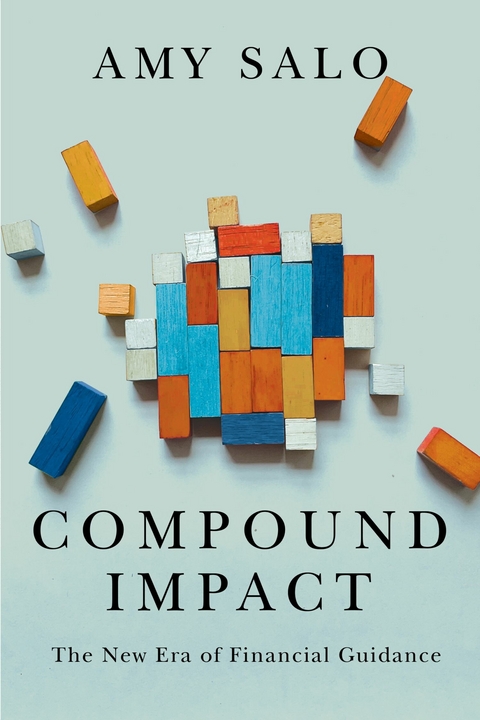
Compound Impact (eBook)
220 Seiten
Ballast Books (Verlag)
978-1-964934-31-0 (ISBN)
Amy Salo has always believed that knowledge isn't just power-it's empowerment. With a distinguished career in financial services, Amy has uncovered a glaring truth: many individuals aren't receiving the comprehensive advice they deserve. As a dedicated advocate for consumer-centric advice, diversity, and collaborative improvement, Amy is on a mission to transform the financial services industry and empower both advisors and clients to achieve greater success. By shifting the perception of the profession, she aims to enhance economic mobility within our communities. As a leader of Forest Hills Financial Group (FHFG), Amy fosters a culture that attracts and retains top-tier advisors, ensuring the next generation prospers. With thirty thousand clients and nearly one hundred career agents, FHFG emphasizes customer-driven, innovative planning techniques. Amy also serves on the Finseca board, chairing multiple committees and advocating for diversity and proper financial education. She frequently speaks on topics such as transitioning to consumer-driven sales, creating opportunities for women in financial services, boosting advisor retention rates, and navigating the financial services business in the age of influencers.
Americans want sound financial advice, but they often put more trust in family and friends-not to mention search engines, celebrity influencers, and digital platforms-than in trained professionals. As financial advisors and leaders in the field, we know how deeply our work impacts clients, as well as the devastating costs of the public's lack of trust in the financial services industry. But when we celebrate short-sighted product sales without directly incentivizing long-term client and community impact, we reinforce the stereotype of ourselves as self-interested product pushers. We have had a wholly unimpressive impact in relation to our potential as advisors and leaders because of our industry's inability to evolve. Consumers don't need more salespeople; they need integrated financial guidance from professionals they trust. We build that trust through authentic engagement and comprehensive plans based on each client's vision for an optimal financial future. In Compound Impact, Amy Salo makes the case for a sea change within the financial guidance industry that has the potential to ripple out across communities and through generations. In this engaging, practical blueprint for advisor success in the new era, Salo provides strategies and insights to help both advisors and industry leaders align with a client-centered, impact-driven model of guidance and design a better financial future for all Americans.
DRIVE for ADVISORS
One of the most resonating tips I give new financial advisors originally came from my undergraduate trombone professor.
During my junior year as a trombone performance major at the University of Hartford’s Hartt School of Music, I designed and performed a forty-five-minute solo concert. Since the concert was an official measure of my progress, I selected challenging music and worked very hard to prepare. (In those days, with my entire focus on perfecting this craft, “working hard” meant practicing five hours a day, in addition to classes and rehearsals.)
I felt quite proud after this first full-length solo performance. During my next weekly session with my trombone professor, private instructor, and mentor, I eagerly asked, “What did you think?”
“It was okay,” came his nonchalant reply. (The man famously didn’t mince words.)
Okay??? Obviously this was not the response I wanted. When I swallowed my pride and asked what I could have done better, he said something I’ll never forget:
“You need to hang your ears on the end of your bell.”
Even to a trombone major, his response didn’t make much sense at first—so if you’re scratching your head, stay with me. If you held a trombone (the one with that long slide) and reached your left arm straight ahead, the end of the bell would rest just above your wrist—not right next to your head, but out in front.
“When you’re on stage,” he explained, “first, think about the audience. Hear the music as they hear it. Take your ears out of your own head and hang them on the edge of your bell. It’s not what’s in your head that matters, it’s what is coming out of that bell.”
He went on: “Next, think about the composer. Ask yourself: ‘Am I being a good steward of this composer’s music by doing justice to the intended vision and spirit?’ Only then should you think about yourself—and only insofar as you get yourself dressed and out on stage.”
Audience first. Composer second. Hang your ears on the edge of your bell. I got it; his message was clear.
As a musician, you become audience-centric by showing up fully present and focused. Not focused on how much you’ve prepared or how brilliantly you’re going to play or how many accolades you’re going to get from your fans or your professor—but on delivering the greatest possible impact to everyone who paid the price of admission.
Similarly, if you want to succeed as a financial advisor, you need a truly client-centered, impact-driven focus—not a transactional approach aimed at enriching or promoting yourself.
Let’s talk about the concept of drive. First, we’ll explore how to measure your own success based on client impact and why focusing on your clients’ financial well-being is most important.
Next, we’ll talk about how to become independently driven to achieve your own professional goals rather than being driven purely by income. Both personal career goals and financial gain are important, and both begin with getting out of your own head and shifting your focus from sales to client impact.
There’s an art and a science to this business. The art is being able to envision and communicate the greatest potential of where a client can land, by zooming out to ask the right questions and then zooming back in to paint a fuller picture of their ideal financial future.
The science involves designing an integrated, comprehensive approach targeted to each client’s unique set of goals and circumstances. What do they need to do each month to achieve their goals? This approach also applies to your own career—figuring out the metrics of what you need to do each day or each week to make sure you get where you want to be.
You do this through unlocking your own potential to optimize client success. Not (necessarily) to beat your competition, or achieve job security, or line your own pockets. Don’t get me wrong—those are great things to do. But they shouldn’t be your primary focus; they should be the outcome of your primary focus.
The good news is that, whether you’re driven primarily by personal goals or directly by impact, a client-centered approach will get you where you want to go. It becomes exponentially easier to earn and rise in our field when you pay attention to what matters to other people.
Ripple Effects
The art of this business requires vision, people skills, and client advocacy, in addition to expertise. What is the greatest possible positive impact you can imagine for each client’s life? To answer that question, you need an in-depth understanding of not just their balance sheet but also their personal goals, family situation, attitude toward risk, and more.
To get this information, you have to build trust. First, ask the right questions and actually listen, then use what you learn to build the best, most comprehensive plan appropriate to each client’s unique situation.
You can’t authentically and consistently do that if you’re distracted by how your quarterly sales record compares to that of your peers and how quickly you need the client to make a decision for your own metrics.
If you are overly focused on yourself, your advice to a client might end up being more about making you money or improving your own status than about what’s in the best interest of the client. If a client implements your plan, and it leaves them under-prepared—because you were in a rush or needed a win—what will be the ripple effects?
What is the cost of each oversight or missed opportunity—for them and for you, for your firm and your community?
Here’s one example. Several years ago, back when we still visited people in their homes, I sat down with a retirement-aged gentleman. He was, let’s say, “traditional.” Despite the fact that his wife of forty-plus years was home, and even in the next room, he didn’t invite her to join us, preferring to meet with me alone.
The man opened by asking if I could beat his advisor’s returns. I knew he had only a single life pension and no long-term care insurance for his wife. When I asked him what he ultimately wanted for himself in retirement and for his wife and adult kids as a legacy, he said he just wanted to beat his returns.
It would have been easy enough to make a character judgment, blaming this man for his lack of vision—but I didn’t. I interpreted him as a good-natured, well-intentioned victim of our industry’s relentless badgering about unrealized “returns” on investment statements, while mainly ignoring the actual purpose behind that money earned and saved: safeguarding long-term security, prosperity, and legacy for himself and his family. While this has improved over the years, we are still not connecting the dots for people like we should.
I could have convinced him that I can competitively manage a portfolio of funds. But I knew how poorly things could go if that were our only focus.
Based on the statistics (and my years of observation), it’s likely this man would pass away before his spouse of four decades. At that point, his single life pension would abruptly stop, along with the lower of their two social security payments, leaving her with almost no income at all and no means of affording advanced care should she need it. Either way, her quality of life would plummet, likely forcing their adult children to adjust their lives to support the financial and health care needs of their mother.
I tried to share all of this in that meeting, but my relative inexperience could not combat the years of commercials pummeled into his head. While I don’t know how things turned out for this family, this interaction haunts me each time I encounter clients whose lives get upended by a perfectly avoidable lack of planning. One that’s actively encouraged by the traditional, shark-like, returns-focused style of financial advice.
What’s Your Core Drive?
I’m not here to tell anyone what their central motivation in life or work is or should be. But if client success means nothing to you and personal gain is your only professional drive or measure for success, I do have some impactful advice for you: Find another career.
Granted, if you picked up this book, you’re probably interested in how we can do a better job as a profession, and I bet you bring a high degree of integrity to your work. But just to be safe, let’s go ahead and make one thing clear: I am writing this book for advisors and industry leaders who want to change this industry into something truly client centered. A field genuinely dedicated to increasing financial security and prosperity for Americans, their families, and our communities.
That’s not some crunchy, sentimental plea for you to go volunteer all your time in service to humanity. You very much can—and absolutely should—build a successful, lucrative career for yourself through client-centered financial guidance.
Of course, there’s a time and a place for volunteering. (As we’ll see in part three, it’s a vital and rewarding part of any advisor’s outreach strategy.) But my career wasn’t built on pro bono impulses. It was based on doing what I understand to be my job: to diagnose how I can have the...
| Erscheint lt. Verlag | 7.1.2025 |
|---|---|
| Sprache | englisch |
| Themenwelt | Mathematik / Informatik ► Informatik ► Netzwerke |
| ISBN-10 | 1-964934-31-1 / 1964934311 |
| ISBN-13 | 978-1-964934-31-0 / 9781964934310 |
| Informationen gemäß Produktsicherheitsverordnung (GPSR) | |
| Haben Sie eine Frage zum Produkt? |
 EPUB (Ohne DRM)
Größe: 2,8 MB
Digital Rights Management: ohne DRM
Dieses eBook enthält kein DRM oder Kopierschutz. Eine Weitergabe an Dritte ist jedoch rechtlich nicht zulässig, weil Sie beim Kauf nur die Rechte an der persönlichen Nutzung erwerben.
Dateiformat: EPUB (Electronic Publication)
EPUB ist ein offener Standard für eBooks und eignet sich besonders zur Darstellung von Belletristik und Sachbüchern. Der Fließtext wird dynamisch an die Display- und Schriftgröße angepasst. Auch für mobile Lesegeräte ist EPUB daher gut geeignet.
Systemvoraussetzungen:
PC/Mac: Mit einem PC oder Mac können Sie dieses eBook lesen. Sie benötigen dafür die kostenlose Software Adobe Digital Editions.
eReader: Dieses eBook kann mit (fast) allen eBook-Readern gelesen werden. Mit dem amazon-Kindle ist es aber nicht kompatibel.
Smartphone/Tablet: Egal ob Apple oder Android, dieses eBook können Sie lesen. Sie benötigen dafür eine kostenlose App.
Geräteliste und zusätzliche Hinweise
Buying eBooks from abroad
For tax law reasons we can sell eBooks just within Germany and Switzerland. Regrettably we cannot fulfill eBook-orders from other countries.
aus dem Bereich