


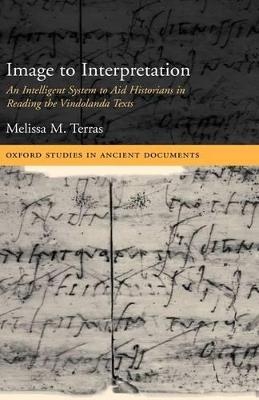
Image to Interpretation
An Intelligent System to Aid Historians in Reading the Vindolanda Texts
Seiten
2006
Oxford University Press (Verlag)
978-0-19-920455-7 (ISBN)
Oxford University Press (Verlag)
978-0-19-920455-7 (ISBN)
The ink and stylus tablets discovered at the Roman fort of Vindolanda are a unique historical resource but are extremely difficult to read. This book details the development of what appears to be the first system constructed to aid experts in the process of reading an ancient document, exploring the use of techniques from Artificial Intelligence.
The ink and stylus tablets discovered at the Roman fort of Vindolanda are a unique resource for scholars of ancient history. However, the stylus tablets in particular are extremely difficult to read. This book details the development of what appears to be the first system constructed to aid experts in the process of reading an ancient document, exploring the extent to which techniques from Artificial Intelligence can be used to develop a system that could aid historians in reading the stylus texts. Image to Interpretation includes a model of how experts read ancient texts, a corpora of letter forms from the Vindolanda text corpus, and a detailed description of the architecture of the system. It will be of interest to papyrologists, researchers in Roman history and palaeography, computer and engineering scientists working in the field of Artificial Intelligence and image processing, and those interested in the use of computing in the humanities.
The ink and stylus tablets discovered at the Roman fort of Vindolanda are a unique resource for scholars of ancient history. However, the stylus tablets in particular are extremely difficult to read. This book details the development of what appears to be the first system constructed to aid experts in the process of reading an ancient document, exploring the extent to which techniques from Artificial Intelligence can be used to develop a system that could aid historians in reading the stylus texts. Image to Interpretation includes a model of how experts read ancient texts, a corpora of letter forms from the Vindolanda text corpus, and a detailed description of the architecture of the system. It will be of interest to papyrologists, researchers in Roman history and palaeography, computer and engineering scientists working in the field of Artificial Intelligence and image processing, and those interested in the use of computing in the humanities.
Melissa Terras is Lecturer in Electronic Communication, School of Library, Archive and Information Studies, University College London.
1. Introduction ; 2. How Do Papyrologists Read Ancient Texts? Knowledge Elicitation and the Papyrologist (1) ; 3. The Palaeography of Vindolanda. Knowledge Elicitation and the Papyrologist (2) ; 4. Image to Interpretation (1). Using Artificial Intelligence to Read the Vindolanda Texts ; 5. Image to Interpretation (2). Results ; 6. Conclusion
| Erscheint lt. Verlag | 19.10.2006 |
|---|---|
| Reihe/Serie | Oxford Studies in Ancient Documents |
| Zusatzinfo | 86 in-text illustrations |
| Verlagsort | Oxford |
| Sprache | englisch |
| Maße | 140 x 220 mm |
| Gewicht | 483 g |
| Themenwelt | Geschichte ► Allgemeine Geschichte ► Vor- und Frühgeschichte |
| Geisteswissenschaften ► Geschichte ► Regional- / Ländergeschichte | |
| Informatik ► Theorie / Studium ► Künstliche Intelligenz / Robotik | |
| ISBN-10 | 0-19-920455-1 / 0199204551 |
| ISBN-13 | 978-0-19-920455-7 / 9780199204557 |
| Zustand | Neuware |
| Informationen gemäß Produktsicherheitsverordnung (GPSR) | |
| Haben Sie eine Frage zum Produkt? |
Mehr entdecken
aus dem Bereich


aus dem Bereich
Reise in die Römerzeit
Buch | Hardcover (2025)
Galiani Berlin (Verlag)
CHF 44,75
auf den Spuren der frühen Zivilisationen
Buch | Hardcover (2023)
C.H.Beck (Verlag)
CHF 27,95


