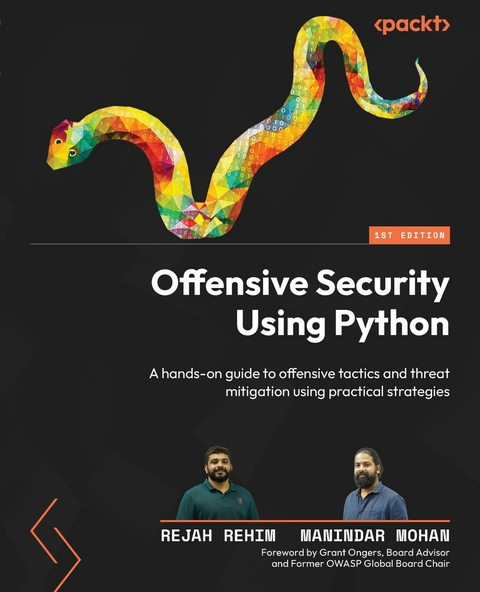
Offensive Security Using Python (eBook)
248 Seiten
Packt Publishing (Verlag)
978-1-83546-063-4 (ISBN)
Offensive Security Using Python is your go-to manual for mastering the quick-paced field of offensive security. This book is packed with valuable insights, real-world examples, and hands-on activities to help you leverage Python to navigate the complicated world of web security, exploit vulnerabilities, and automate challenging security tasks.
From detecting vulnerabilities to exploiting them with cutting-edge Python techniques, you'll gain practical insights into web security, along with guidance on how to use automation to improve the accuracy and effectiveness of your security activities. You'll also learn how to design personalized security automation tools. While offensive security is a great way to stay ahead of emerging threats, defensive security plays an equal role in protecting organizations from cyberattacks. In this book, you'll get to grips with Python secure coding techniques to improve your ability to recognize dangers quickly and take appropriate action. As you progress, you'll be well on your way to handling the contemporary challenges in the field of cybersecurity using Python, as well as protecting your digital environment from growing attacks.
By the end of this book, you'll have a solid understanding of sophisticated offensive security methods and be able to stay ahead in the constantly evolving cybersecurity space.
1
Introducing Offensive Security and Python
Staying ahead of attackers is not a choice in the ever-changing world of cybersecurity; it is a requirement. As technology advances, so do the approaches and tactics of those seeking to exploit it. Offensive security emerges as a critical front line in the never-ending battle to protect digital assets.
The phrase offensive security brings up images of skilled hackers and covert operations, but it refers to a lot more. It is a proactive approach to cybersecurity that enables organizations to uncover vulnerabilities, faults, and threats before hostile actors do. At its core, offensive security empowers professionals to think and act like the adversaries they wish to beat, and Python is an invaluable friend in this endeavor.
So, buckle up and get ready to enter a world where cybersecurity meets offense, where Python transforms from a programming language into a formidable weapon in the hands of security professionals. This chapter introduces offensive security fundamentals, showing the role of Python in this domain. By the chapter’s conclusion, you will possess a solid understanding of offensive security and appreciate Python’s pivotal role in this dynamic field. This foundational knowledge is essential as subsequent chapters will delve into its practical applications.
In this chapter, we are going to cover the following main topics:
- Understanding the offensive security landscape
- The role of Python in offensive operations
- Ethical hacking and legal considerations
- Exploring offensive security methodologies
- Setting up a Python environment for offensive tasks
- Exploring Python tools for penetration testing
- Case study – Python in the real world
Understanding the offensive security landscape
Offensive security is critical in the world of cybersecurity for protecting enterprises from hostile attacks. Offensive security involves aggressively finding and exploiting gaps to assess the security posture of systems, networks, and applications. Offensive security professionals help firms uncover vulnerabilities before bad actors can exploit them by adopting an attacker’s mindset.
Offensive security seeks out faults and vulnerabilities in a company’s systems, applications, and infrastructure. In contrast to defensive security, which focuses on guarding against attacks, offensive security professionals actively seek weaknesses to counter potential breaches. In this section, we will delve into the realm of offensive security, tracing its origins, examining its evolution and significance within the industry, and exploring various real-world applications.
Defining offensive security
Offensive security proactively probes for and exploits computer system vulnerabilities to evaluate an organization’s security stance from an attacker’s viewpoint. This field involves ethical hacking to simulate cyber threats, uncover defense gaps, and guide the strengthening of cybersecurity measures, ensuring robust protection against malevolent entities. Its main objective is to analyze an organization’s security posture by simulating actual attack scenarios. Exploiting vulnerabilities actively allows ethical hackers to do the following:
- Identify flaws: Ethical hackers assist companies in locating gaps and vulnerabilities in their apps, networks, and systems. By doing this, they offer insightful information about possible points of access for bad actors.
- Strengthen defenses: By resolving vulnerabilities found during offensive security assessments, organizations can increase their security measures. Organizations can stay ahead of cyber threats with the support of this proactive approach.
- Evaluate an organization’s ability to respond to incidents: Offensive security assessments also analyze an organization’s ability to respond to incidents. Organizations can find weaknesses in their response strategies and enhance their capacity to recognize, address, and recover from security problems by simulating attacks.
Previously, we painted a picture of what offensive security entails, peeking into its core tactics and purpose. Next, we are going to dive into its backstory, exploring how it all started and the journey it has taken to become a pivotal element in the ever-changing world of cybersecurity.
The origins and evolution of offensive security
Offensive security has its roots in the early days of computing, when hackers began exploiting flaws for personal gain or mischief. In contrast, the formalization of ethical hacking began in the 1970s, with the introduction of the first computer security conferences and the development of organizations such as the International Subversives, later known as the Chaos Computer Club.
Over time, offensive security practices emerged, and corporations understood the value of ethical hacking in improving their security posture. The formation of organizations such as L0pht Heavy Industries, as well as the publication of the Hacker’s Manifesto (http://phrack.org/issues/7/3.html), aided in the rise of ethical hacking as a legitimate field.
Use cases and examples of offensive security
The practice of offensive security is adaptable and has uses in a variety of contexts. Typical use cases and examples include the following:
- Penetration testing: Organizations employ offensive security experts to find weaknesses in their apps, networks, and systems. Penetration testers assist organizations in understanding their security weaknesses and developing ways to minimize them by simulating real-world attacks.
- Red teaming: To evaluate an organization’s overall security resilience, red teaming entails simulating real-world attacks against its defenses. Red team exercises examine an organization’s ability to detect and respond to assaults using its people, procedures, and technology. This goes beyond typical penetration testing.
- Vulnerability research: Offensive security specialists regularly participate in vulnerability research to discover new flaws in software, hardware, and systems. They play an important role in responsible disclosure by informing vendors about vulnerabilities and supporting them in developing patches before they may be used maliciously.
- Capture the Flag (CTF): CTF competitions give people interested in offensive security a chance to show off their problem-solving abilities. These contests frequently model real-world situations and inspire competitors to use their imaginations to identify weaknesses and take advantage of them.
We have just explored the roots and growth of offensive security, including illustrative examples. Moving forward, our discussion will shift to its role in today’s industry and the valuable best practices that guide professionals in navigating the complex terrain of offensive cybersecurity strategies effectively.
Industry relevance and best practices
Since cyber threats are becoming more sophisticated, offensive security is becoming increasingly vital in today’s digital environment. Organizations recognize the importance of proactive security measures for identifying vulnerabilities and mitigating risks. Some offensive security best practices are as follows:
- Continuous learning: Offensive security experts must keep up with the most recent attack methods, security flaws, and defensive tactics. Professionals may keep ahead in this quickly growing sector by participating in CTF tournaments, attending conferences, and conducting ongoing research.
- Embrace ethical principles: Ethical hackers must follow ethical rules and act within legal boundaries. Before performing assessments, professionals should secure the necessary consent, protect privacy, and uphold confidentiality.
- Collaboration and communication: Offensive security personnel are frequently part of bigger security teams. Effective teamwork and interpersonal skills are required to ensure that findings are well-documented, vulnerabilities are addressed appropriately, and suggestions are effectively conveyed to stakeholders.
As we conclude our overview of the offensive security landscape, we have seen how it, akin to ethical hacking, serves as an indispensable component in uncovering hidden vulnerabilities and enhancing overall cybersecurity measures. By stepping into the shoes of an attacker, experts in this field empower organizations to fortify their defenses and refine their ability to respond to threats effectively.
Now, let us pivot our attention to the next section, where we will delve into the integral role of...
| Erscheint lt. Verlag | 30.9.2024 |
|---|---|
| Vorwort | Grant Ongers |
| Sprache | englisch |
| Themenwelt | Informatik ► Netzwerke ► Sicherheit / Firewall |
| ISBN-10 | 1-83546-063-1 / 1835460631 |
| ISBN-13 | 978-1-83546-063-4 / 9781835460634 |
| Informationen gemäß Produktsicherheitsverordnung (GPSR) | |
| Haben Sie eine Frage zum Produkt? |
 EPUB (Ohne DRM)
Digital Rights Management: ohne DRM
Dieses eBook enthält kein DRM oder Kopierschutz. Eine Weitergabe an Dritte ist jedoch rechtlich nicht zulässig, weil Sie beim Kauf nur die Rechte an der persönlichen Nutzung erwerben.
Dateiformat: EPUB (Electronic Publication)
EPUB ist ein offener Standard für eBooks und eignet sich besonders zur Darstellung von Belletristik und Sachbüchern. Der Fließtext wird dynamisch an die Display- und Schriftgröße angepasst. Auch für mobile Lesegeräte ist EPUB daher gut geeignet.
Systemvoraussetzungen:
PC/Mac: Mit einem PC oder Mac können Sie dieses eBook lesen. Sie benötigen dafür die kostenlose Software Adobe Digital Editions.
eReader: Dieses eBook kann mit (fast) allen eBook-Readern gelesen werden. Mit dem amazon-Kindle ist es aber nicht kompatibel.
Smartphone/Tablet: Egal ob Apple oder Android, dieses eBook können Sie lesen. Sie benötigen dafür eine kostenlose App.
Geräteliste und zusätzliche Hinweise
Buying eBooks from abroad
For tax law reasons we can sell eBooks just within Germany and Switzerland. Regrettably we cannot fulfill eBook-orders from other countries.
aus dem Bereich