Biomedical Imaging (eBook)
347 Seiten
Springer Nature Singapore (Verlag)
978-981-97-5345-1 (ISBN)
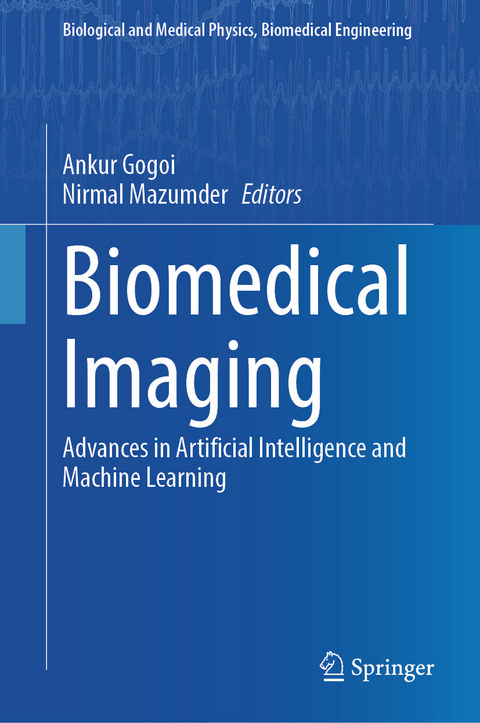
This book presents the rapidly developing field of artificial intelligence and machine learning and its application in biomedical imaging. As is known, starting from the diagnosis of fractures by using X-rays to understanding the complex structure and function of the brain, biomedical imaging has contributed immensely toward the development of precision diagnosis and treatment strategies for numerous diseases. While continuous evolution in imaging technologies have enabled the acquisition of images having resolution and contrast far better than ever, it significantly increased the volume of data associated with each image scan—making it increasingly difficult for experts to analyze and interpret. In this context, the application of artificial intelligence (AI) and machine learning (ML) tools has become one of the most exciting frontlines of contemporary research in biomedical imaging due to their capability to extract minute traces of various disease signatures from large and complicated datasets and providing clear insight into the potential abnormalities with excellent accuracy, sensitivity, and specificity. The hallmark of this book will be the contributions from international leaders on different AI-aided advanced biomedical imaging modalities and techniques. Included will be comprehensive description of several of the technology-driven spectacular advances made over the past few years that have allowed early detection and delineation of abnormalities with sub-pixel image segmentation and classification. Starting from the fundamentals of biomedical image processing, the book presents a streamlined and focused coverage of the core principles, theoretical and experimental approaches, and state-of-the-art applications of most of the currently used biomedical imaging techniques powered by AI.
This book presents the rapidly developing field of artificial intelligence and machine learning and its application in biomedical imaging. As is known, starting from the diagnosis of fractures by using X-rays to understanding the complex structure and function of the brain, biomedical imaging has contributed immensely toward the development of precision diagnosis and treatment strategies for numerous diseases. While continuous evolution in imaging technologies have enabled the acquisition of images having resolution and contrast far better than ever, it significantly increased the volume of data associated with each image scan-making it increasingly difficult for experts to analyze and interpret. In this context, the application of artificial intelligence (AI) and machine learning (ML) tools has become one of the most exciting frontlines of contemporary research in biomedical imaging due to their capability to extract minute traces of various disease signatures from large and complicated datasets and providing clear insight into the potential abnormalities with excellent accuracy, sensitivity, and specificity. The hallmark of this book will be the contributions from international leaders on different AI-aided advanced biomedical imaging modalities and techniques. Included will be comprehensive description of several of the technology-driven spectacular advances made over the past few years that have allowed early detection and delineation of abnormalities with sub-pixel image segmentation and classification. Starting from the fundamentals of biomedical image processing, the book presents a streamlined and focused coverage of the core principles, theoretical and experimental approaches, and state-of-the-art applications of most of the currently used biomedical imaging techniques powered by AI.
| Erscheint lt. Verlag | 26.9.2024 |
|---|---|
| Reihe/Serie | Biological and Medical Physics, Biomedical Engineering |
| Zusatzinfo | XX, 347 p. 104 illus., 85 illus. in color. |
| Sprache | englisch |
| Themenwelt | Informatik ► Theorie / Studium ► Künstliche Intelligenz / Robotik |
| Medizin / Pharmazie ► Medizinische Fachgebiete ► Onkologie | |
| Medizin / Pharmazie ► Physiotherapie / Ergotherapie ► Orthopädie | |
| Naturwissenschaften ► Biologie | |
| Naturwissenschaften ► Chemie ► Analytische Chemie | |
| Naturwissenschaften ► Physik / Astronomie ► Angewandte Physik | |
| Technik ► Maschinenbau | |
| Technik ► Medizintechnik | |
| Schlagworte | Biophotonics • brain tumour • cancer diagnosis • Deep learning • diffuse optical imaging • Fluorescence spectroscopy • Light Endoscopy • Medical Image Processing • Multiphoton microscopy • Nonlinear Optical Microscopy • Optical Coherence Tomography (OCT) • Photoacoustic Imaging • Raman Spectroscopy/Microscopy • Second Harmonic Generation (SHG) • Stokes Mueller Polarization |
| ISBN-10 | 981-97-5345-7 / 9819753457 |
| ISBN-13 | 978-981-97-5345-1 / 9789819753451 |
| Informationen gemäß Produktsicherheitsverordnung (GPSR) | |
| Haben Sie eine Frage zum Produkt? |
 PDF (Wasserzeichen)
DRM: Digitales Wasserzeichen
Dieses eBook enthält ein digitales Wasserzeichen und ist damit für Sie personalisiert. Bei einer missbräuchlichen Weitergabe des eBooks an Dritte ist eine Rückverfolgung an die Quelle möglich.
Dateiformat: PDF (Portable Document Format)
Mit einem festen Seitenlayout eignet sich die PDF besonders für Fachbücher mit Spalten, Tabellen und Abbildungen. Eine PDF kann auf fast allen Geräten angezeigt werden, ist aber für kleine Displays (Smartphone, eReader) nur eingeschränkt geeignet.
Systemvoraussetzungen:
PC/Mac: Mit einem PC oder Mac können Sie dieses eBook lesen. Sie benötigen dafür einen PDF-Viewer - z.B. den Adobe Reader oder Adobe Digital Editions.
eReader: Dieses eBook kann mit (fast) allen eBook-Readern gelesen werden. Mit dem amazon-Kindle ist es aber nicht kompatibel.
Smartphone/Tablet: Egal ob Apple oder Android, dieses eBook können Sie lesen. Sie benötigen dafür einen PDF-Viewer - z.B. die kostenlose Adobe Digital Editions-App.
Buying eBooks from abroad
For tax law reasons we can sell eBooks just within Germany and Switzerland. Regrettably we cannot fulfill eBook-orders from other countries.
aus dem Bereich