


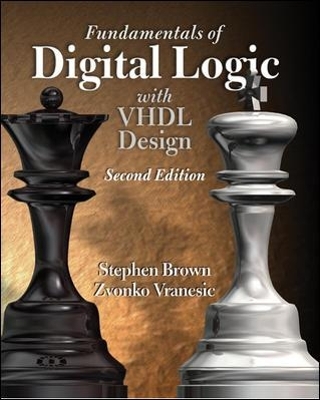
Fundamentals of Digital Logic with VHDL Design with CD-ROM
2004
|
2nd edition
McGraw-Hill Professional
9780072499384 (ISBN)
McGraw-Hill Professional
9780072499384 (ISBN)
- Titel ist leider vergriffen;
keine Neuauflage - Artikel merken
Zu diesem Artikel existiert eine Nachauflage
Teaches the basic design techniques for logic circuits. This book emphasizes the synthesis of circuits and explains how circuits are implemented in real chips. It illustrates fundamental concepts by using examples. It uses VHDL to demonstrate how the basic building blocks and larger systems are defined in a hardware description language.
Fundamentals of Digital Logic With VHDL Design teaches the basic design techniques for logic circuits. It emphasizes the synthesis of circuits and explains how circuits are implemented in real chips. Fundamental concepts are illustrated by using small examples, which are easy to understand. Then, a modular approach is used to show how larger circuits are designed. VHDL is used to demonstrate how the basic building blocks and larger systems are defined in a hardware description language, producing designs that can be implemented with modern CAD tools.
The book emphasizes the concepts that should be covered in an introductory course on logic design, focusing on:
Logic functions, gates, and rules of Boolean algebraCircuit synthesis and optimization techniquesNumber representation and arithmetic circuitsCombinational-circuit building blocks, such as multiplexers, decoders, encoders, and code convertersSequential-circuit building blocks, such as flip-flops, registers, and countersDesign of synchronous sequential circuitsUse of the basic building blocks in designing larger systems
It also includes chapters that deal with important, but more advanced topics:
Design of asynchronous sequential circuitsTesting of logic circuits
For students who have had no exposure to basic electronics, but are interested in learning a few key concepts, there is a chapter that presents the most basic aspects of electronic implementation of digital circuits.
Major changes in the second edition of the book include
new examples to clarify the presentation of fundamental conceptsover 50 new examples of solved problems provided at the end of chaptersNAND and NOR gates now introduced in Chapter 2more complete discussion of techniques for minimization of logic functions in Chapter 4 (including the tabular method)a new chapter explaining the CAD flow for synthesis of logic circuitsAltera's Quartus II CAD software provided on a CD-ROMthree appendices that give tutorials on the use of Quartus II software
Fundamentals of Digital Logic With VHDL Design teaches the basic design techniques for logic circuits. It emphasizes the synthesis of circuits and explains how circuits are implemented in real chips. Fundamental concepts are illustrated by using small examples, which are easy to understand. Then, a modular approach is used to show how larger circuits are designed. VHDL is used to demonstrate how the basic building blocks and larger systems are defined in a hardware description language, producing designs that can be implemented with modern CAD tools.
The book emphasizes the concepts that should be covered in an introductory course on logic design, focusing on:
Logic functions, gates, and rules of Boolean algebraCircuit synthesis and optimization techniquesNumber representation and arithmetic circuitsCombinational-circuit building blocks, such as multiplexers, decoders, encoders, and code convertersSequential-circuit building blocks, such as flip-flops, registers, and countersDesign of synchronous sequential circuitsUse of the basic building blocks in designing larger systems
It also includes chapters that deal with important, but more advanced topics:
Design of asynchronous sequential circuitsTesting of logic circuits
For students who have had no exposure to basic electronics, but are interested in learning a few key concepts, there is a chapter that presents the most basic aspects of electronic implementation of digital circuits.
Major changes in the second edition of the book include
new examples to clarify the presentation of fundamental conceptsover 50 new examples of solved problems provided at the end of chaptersNAND and NOR gates now introduced in Chapter 2more complete discussion of techniques for minimization of logic functions in Chapter 4 (including the tabular method)a new chapter explaining the CAD flow for synthesis of logic circuitsAltera's Quartus II CAD software provided on a CD-ROMthree appendices that give tutorials on the use of Quartus II software
Zvonko Vranesic (Toronto, Canada) Professor of Computer Engineering at Toronto University, Canada.
1 Design Concepts2 Introduction to Logic Circuits3 Implementation Technology4 Optimized Implementation of Logic Functions5 Number Representation and Arithmetic Circuits6 Combinational-Circuit Building Blocks7 Flip-Flops, Registers, Counters, and a Simple Processor8 Synchronous Sequential Circuits9 Asynchronous Sequential Circuits10 Digital System Design11 Testing of Logic Circuits12 Computer Aided Design ToolsAppendix A VHDL ReferenceAppendix B Tutorial 1 - Using Quartus II CAD SoftwareAppendix C Tutorial 2 - Implementing Circuits in Altera DevicesAppendix D Tutorial 3 - Physical Implementations in a PLDAppendix D Commercial Devices
| Erscheint lt. Verlag | 16.8.2004 |
|---|---|
| Sprache | englisch |
| Maße | 191 x 239 mm |
| Gewicht | 1631 g |
| Themenwelt | Mathematik / Informatik ► Informatik ► Theorie / Studium |
| ISBN-13 | 9780072499384 / 9780072499384 |
| Zustand | Neuware |
| Informationen gemäß Produktsicherheitsverordnung (GPSR) | |
| Haben Sie eine Frage zum Produkt? |
Mehr entdecken
aus dem Bereich

aus dem Bereich
Finite- and Infinite-Dimensional Systems
Media-Kombination (2025)
Springer International Publishing
CHF 329,50


