


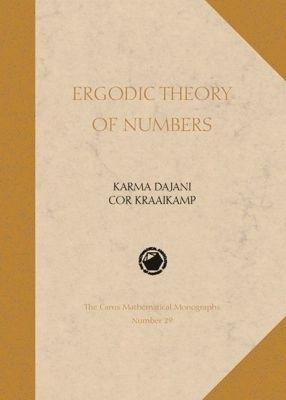
Ergodic Theory of Numbers
Seiten
2002
Mathematical Association of America (Verlag)
978-0-88385-034-3 (ISBN)
Mathematical Association of America (Verlag)
978-0-88385-034-3 (ISBN)
Explores the interaction between two fields of mathematics: number theory and ergodic theory (as part of dynamical systems). This is an introduction to the ergodic theory behind common number expansions, like decimal expansions, continued fractions, and many others. It is also an introduction to a “dynamical way of thinking”.
Ergodic Theory of Numbers looks at the interaction between two fields of mathematics: number theory and ergodic theory (as part of dynamical systems). It is an introduction to the ergodic theory behind common number expansions, like decimal expansions, continued fractions, and many others. However, its aim does not stop there. For undergraduate students with sufficient background knowledge in real analysis and graduate students interested in the area, it is also an introduction to a ""dynamical way of thinking"". The questions studied here are dynamical as well as number theoretical in nature, and the answers are obtained with the help of ergodic theory. Attention is focused on concepts like measure-preserving, ergodicity, natural extension, induced transformations, and entropy. These concepts are then applied to familiar expansions to obtain old and new results in an elegant and straightforward manner. What it means to be ergodic and the basic ideas behind ergodic theory will be explained along the way. The subjects covered vary from classical to recent, which makes this book appealing to researchers as well as students.
Ergodic Theory of Numbers looks at the interaction between two fields of mathematics: number theory and ergodic theory (as part of dynamical systems). It is an introduction to the ergodic theory behind common number expansions, like decimal expansions, continued fractions, and many others. However, its aim does not stop there. For undergraduate students with sufficient background knowledge in real analysis and graduate students interested in the area, it is also an introduction to a ""dynamical way of thinking"". The questions studied here are dynamical as well as number theoretical in nature, and the answers are obtained with the help of ergodic theory. Attention is focused on concepts like measure-preserving, ergodicity, natural extension, induced transformations, and entropy. These concepts are then applied to familiar expansions to obtain old and new results in an elegant and straightforward manner. What it means to be ergodic and the basic ideas behind ergodic theory will be explained along the way. The subjects covered vary from classical to recent, which makes this book appealing to researchers as well as students.
1. Introduction; 2. Variations on a theme; 3. Ergodicity; 4. Systems obtained from other systems; 5. Diophantine approximation and continued fractions; 6. Entropy.
| Erscheint lt. Verlag | 30.12.2002 |
|---|---|
| Reihe/Serie | Carus Mathematical Monographs |
| Sprache | englisch |
| Maße | 152 x 229 mm |
| Gewicht | 350 g |
| Themenwelt | Mathematik / Informatik ► Mathematik ► Analysis |
| Mathematik / Informatik ► Mathematik ► Arithmetik / Zahlentheorie | |
| ISBN-10 | 0-88385-034-6 / 0883850346 |
| ISBN-13 | 978-0-88385-034-3 / 9780883850343 |
| Zustand | Neuware |
| Informationen gemäß Produktsicherheitsverordnung (GPSR) | |
| Haben Sie eine Frage zum Produkt? |
Mehr entdecken
aus dem Bereich

aus dem Bereich
Festigkeits- und Verformungslehre, Baudynamik, Wärmeübertragung, …
Buch | Hardcover (2025)
De Gruyter Oldenbourg (Verlag)
CHF 125,90


