


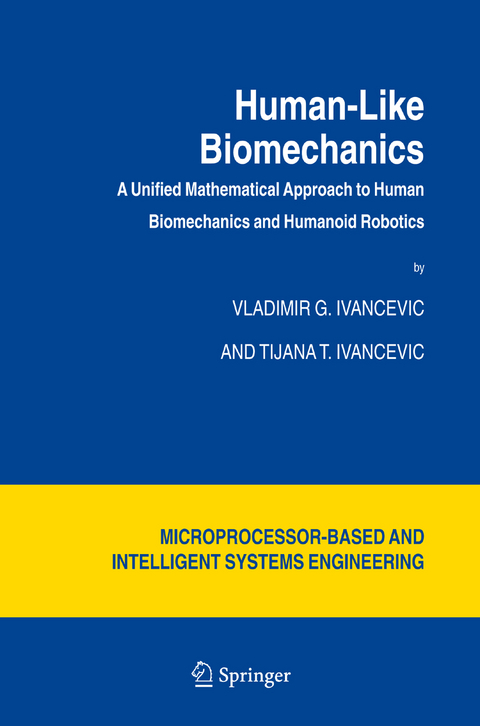
Human-Like Biomechanics
A Unified Mathematical Approach to Human Biomechanics and Humanoid Robotics
Seiten
2006
|
2006 ed.
Springer-Verlag New York Inc.
978-1-4020-4116-7 (ISBN)
Springer-Verlag New York Inc.
978-1-4020-4116-7 (ISBN)
Human-Like Biomechanics is a comprehensive introduction into modern geometrical methods to be used as a unified research approach in two apparently separate and rapidly growing fields: mathematical biomechanics and humanoid robotics.
The book contains six Chapters and an Appendix.
Human-Like Biomechanics is a comprehensive introduction into modern geometrical methods to be used as a unified research approach in two apparently separate and rapidly growing fields: mathematical biomechanics and humanoid robotics.
The book contains six Chapters and an Appendix. The first Chapter is an Introduction, giving a brief review of mathematical techniques to be used in the text. The second Chapter develops geometrical basis of human-like biomechanics, while the third Chapter develops its mechanical basis, mainly from generalized Lagrangian and Hamiltonian perspective. The fourth Chapter develops topology of human-like biomechanics, while the fifth Chapter reviews related nonlinear control techniques. The sixth Chapter develops covariant biophysics of electro-muscular stimulation. The Appendix consists of two parts: classical muscular mechanics and modern path integral methods, which are both used frequently in the main text. The whole book is based on the authors’ own research papers in human-like biomechanics.
The book contains six Chapters and an Appendix.
Human-Like Biomechanics is a comprehensive introduction into modern geometrical methods to be used as a unified research approach in two apparently separate and rapidly growing fields: mathematical biomechanics and humanoid robotics.
The book contains six Chapters and an Appendix. The first Chapter is an Introduction, giving a brief review of mathematical techniques to be used in the text. The second Chapter develops geometrical basis of human-like biomechanics, while the third Chapter develops its mechanical basis, mainly from generalized Lagrangian and Hamiltonian perspective. The fourth Chapter develops topology of human-like biomechanics, while the fifth Chapter reviews related nonlinear control techniques. The sixth Chapter develops covariant biophysics of electro-muscular stimulation. The Appendix consists of two parts: classical muscular mechanics and modern path integral methods, which are both used frequently in the main text. The whole book is based on the authors’ own research papers in human-like biomechanics.
Geometric Basis of Human–Like Biomechanics.- Mechanical Basis of Human–Like Biomechanics.- Topology of Human–Like Biomechanics.- Nonlinear Control in Human–Like Biomechanics.- Covariant Biophysics of Electro–Muscular Stimulation.
| Erscheint lt. Verlag | 27.1.2006 |
|---|---|
| Reihe/Serie | Intelligent Systems, Control and Automation: Science and Engineering ; 28 |
| Zusatzinfo | XIV, 470 p. |
| Verlagsort | New York, NY |
| Sprache | englisch |
| Maße | 155 x 235 mm |
| Themenwelt | Mathematik / Informatik ► Informatik ► Theorie / Studium |
| Mathematik / Informatik ► Mathematik ► Angewandte Mathematik | |
| Studium ► 1. Studienabschnitt (Vorklinik) ► Physiologie | |
| Naturwissenschaften ► Biologie | |
| Technik | |
| ISBN-10 | 1-4020-4116-0 / 1402041160 |
| ISBN-13 | 978-1-4020-4116-7 / 9781402041167 |
| Zustand | Neuware |
| Informationen gemäß Produktsicherheitsverordnung (GPSR) | |
| Haben Sie eine Frage zum Produkt? |
Mehr entdecken
aus dem Bereich


aus dem Bereich


