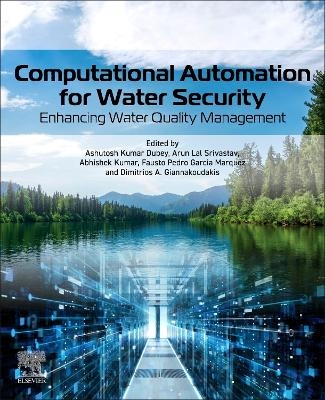
Computational Automation for Water Security
Elsevier - Health Sciences Division (Verlag)
978-0-443-33321-7 (ISBN)
Ashutosh Kumar Dubey is an Associate Professor in the Department of Computer Science and Engineering at Chitkara University, Himachal Pradesh, India. He is also a Postdoctoral Fellow of the Ingenium Research Group Lab, Universidad de Castilla-La Mancha, Ciudad Real, Spain. Dr. Arun Lal Srivastav is an Associate Professor in the Department of Applied Sciences at Chitkara University, Himachal Pradesh, India. Dr Abhishek Kumar is Assistant Director and Professor in the Department of Computer Science & Engineering at Chandigarh University, Punjab. He holds a PhD in Computer Science from the University of Madras and completed postdoctoral research at the Ingenium Research Group Lab, Universidad de Castilla-La Mancha, Spain. He brings extensive expertise in data science and AI-driven analytical modelling. He has published impactful research in reputed journals such as Expert Systems with Applications, Archives of Computational Methods in Engineering, and Scientific Reports, and has published books such as Computer Vision and Machine Intelligence for Renewable Energy Systems (Elsevier) and Quantum Protocols in Blockchain Security (Springer). His research areas are artificial intelligence, renewable energy, machine learning, and image processing. Fausto Pedro García Márquez works as a Professor and as Director of the Ingenium Research Group at the Universidad De Castilla-La Mancha, Spain. He is an Honorary Senior Research Fellow at Birmingham University, UK, and a Lecturer at the Postgraduate European Institute. He has published more than 150 papers and 31 books (Elsevier, Springer, Pearson, McGraw-Hill, Intech, IGI, Marcombo, AlfaOmega). He has been Principal Investigator in 4 European projects, 6 national projects, and more than 150 projects for universities, companies, and other institutions. His main interests are: Artificial Intelligence, Maintenance, Management, Renewable Energy, Transport, Advanced Analytics, and Data Science. Dr. Dimitrios Giannakoudakis graduated as chemist from Aristotle University of Thessaloniki (AUTh) in Greece, where he obtained also two M.Sc. degrees (in Physical-chemistry & Electrochemistry and in New Educational Technologies). He received his PhD degree on “Nanotechnology and Materials Chemistry from the City University of New York (CUNY) with full scholarship, in 02/2017. Then, he continued as postdoctoral-fellow and adjunct tutor at the City College of New York, AUTh, and the Institute of Physical Chemistry (IChF) of Polish Academy of Sciences. Afterwards, he served at IChF as adj. Assistant Professor and tutor of “Modern nano-Topics in Physical Chemistry. Currently, he is Research Associate and tutor at AUTh. He has co-authored more than 105 publications in leading peer-reviewed journals (avg. Impact Factor as 1st author above 11), with the articles to be cited more than 3000 times, one monograph by Springer, three edited books by Elsevier, more than 20 book chapters, and 3 invention patents. For more details: www.DaGchem.com
About the Editors
Preface
1. Introduction to Computational Automation in Water Quality Management
2. Real Time Water Quality Monitoring Systems
3. Automated Water Data Sampling: Enhancing Efficiency and Accuracy in Hydrological Analysis
4. Role of Data Processing and Analysis in water quality management
5. Machine Learning and Artificial Intelligence Applications in Automating Water Quality Monitoring, Analysis and Management
6. Significance of Automation in Water Treatment Processes
7. Real-time Control Systems for Water Supply chain and management
8. Integration of Automation and Internet of Things (IoT) for water security
9. Cybersecurity and Data Privacy in Automated Systems used in water quality management.
10. Cost-Benefit Analysis of Automation in Water Quality Management
11. Automation in Water Distribution Networks
12. Remote Sensing and Satellite Imagery for Water Quality Assessment
13. Case Studies: Successful Implementation of Automation for Water Quality Assessment
14. Future Trends and Emerging Technologies in water quality management
15. Challenges and Ethical Considerations in water Automation
| Erscheinungsdatum | 23.04.2025 |
|---|---|
| Verlagsort | Philadelphia |
| Sprache | englisch |
| Maße | 191 x 235 mm |
| Gewicht | 450 g |
| Themenwelt | Informatik ► Theorie / Studium ► Künstliche Intelligenz / Robotik |
| Naturwissenschaften ► Geowissenschaften ► Hydrologie / Ozeanografie | |
| Technik ► Umwelttechnik / Biotechnologie | |
| ISBN-10 | 0-443-33321-1 / 0443333211 |
| ISBN-13 | 978-0-443-33321-7 / 9780443333217 |
| Zustand | Neuware |
| Informationen gemäß Produktsicherheitsverordnung (GPSR) | |
| Haben Sie eine Frage zum Produkt? |
aus dem Bereich