


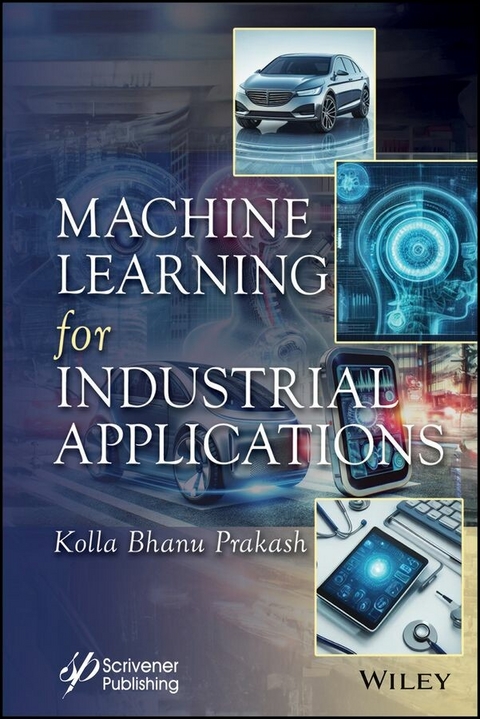
Machine Learning for Industrial Applications (eBook)
496 Seiten
Wiley-Scrivener (Verlag)
978-1-394-26897-9 (ISBN)
The main goal of the book is to provide a comprehensive and accessible guide that empowers readers to understand, apply, and leverage machine learning algorithms and techniques effectively in real-world scenarios.
Welcome to the exciting world of machine learning! In recent years, machine learning has rapidly transformed from a niche field within computer science to a fundamental technology shaping various aspects of our lives. Whether you realize it or not, machine learning algorithms are at work behind the scenes, powering recommendation systems, autonomous vehicles, virtual assistants, medical diagnostics, and much more. This book is designed to serve as your comprehensive guide to understanding the principles, algorithms, and applications of machine learning. Whether a student diving into this field for the first time, a seasoned professional looking to broaden your skillset, or an enthusiast eager to explore cutting-edge advancements, this book has something for you.
The primary goal of Machine Learning for Industrial Applications is to demystify machine learning and make it accessible to a wide audience. It provides a solid foundation in the fundamental concepts of machine learning, covering both the theoretical underpinnings and practical applications. Whether you're interested in supervised learning, unsupervised learning, reinforcement learning, or innovative techniques like deep learning, you'll find comprehensive coverage here. Throughout the book, a hands-on approach is emphasized. As the best way to learn machine learning is by doing, the book includes numerous examples, exercises, and real-world case studies to reinforce your understanding and practical skills.
Audience
The book will enjoy a wide readership as it will appeal to all researchers, students, and technology enthusiasts wanting a hands-on guide to the new advances in machine learning.
Kolla Bhanu Prakash, PhD, is a professor and associate dean and R & D head for A.I. & Data Science Research Group at K L University, Vijayawada, Andhra Pradesh, India. He is also an adjunct professor at Taylors University, Malaysia. He has published 150+ research papers in international and national journals and conferences. He has authored two and edited 12 books as well as published 15 patents. His research interests include deep learning, data science, and quantum computing. He has received the 'Best Researcher Award' 4 times.
The main goal of the book is to provide a comprehensive and accessible guide that empowers readers to understand, apply, and leverage machine learning algorithms and techniques effectively in real-world scenarios. Welcome to the exciting world of machine learning! In recent years, machine learning has rapidly transformed from a niche field within computer science to a fundamental technology shaping various aspects of our lives. Whether you realize it or not, machine learning algorithms are at work behind the scenes, powering recommendation systems, autonomous vehicles, virtual assistants, medical diagnostics, and much more. This book is designed to serve as your comprehensive guide to understanding the principles, algorithms, and applications of machine learning. Whether a student diving into this field for the first time, a seasoned professional looking to broaden your skillset, or an enthusiast eager to explore cutting-edge advancements, this book has something for you. The primary goal of Machine Learning for Industrial Applications is to demystify machine learning and make it accessible to a wide audience. It provides a solid foundation in the fundamental concepts of machine learning, covering both the theoretical underpinnings and practical applications. Whether you re interested in supervised learning, unsupervised learning, reinforcement learning, or innovative techniques like deep learning, you ll find comprehensive coverage here. Throughout the book, a hands-on approach is emphasized. As the best way to learn machine learning is by doing, the book includes numerous examples, exercises, and real-world case studies to reinforce your understanding and practical skills. Audience The book will enjoy a wide readership as it will appeal to all researchers, students, and technology enthusiasts wanting a hands-on guide to the new advances in machine learning.
1
Overview of Machine Learning
1.1 Introduction
Machine learning is a branch of artificial intelligence (AI) that focuses on developing algorithms and models that enable computers to learn and make predictions or decisions without being explicitly programmed. It is a field that has gained significant attention and prominence due to its ability to solve complex problems and make sense of large amounts of data.
Machine learning teaches computers how to learn from data and improve their performance over time. This is achieved through various techniques and algorithms that allow machines to recognize patterns, make predictions, and adapt their behavior based on their input.
There are several key concepts and components within machine learning:
Data: Data are the foundation of machine learning. Algorithms learn from data, which can be in the form of text, images, videos, numerical values, or any other structured or unstructured format.
Features: Features are the attributes or characteristics of the data that are used by algorithms to make predictions or classifications. Selecting relevant features is crucial for the success of a machine learning model.
Labels: In supervised learning, which is a common type of machine learning, data are labeled with the correct output. The algorithm learns from the labeled data to predict new, unseen data.
Algorithms: Machine learning algorithms are mathematical models that process and learn from data. These algorithms can be categorized into different types, such as regression, classification, clustering, and reinforcement learning, each designed for specific tasks.
Training: Training a machine learning model involves feeding it labeled data and allowing it to adjust its internal parameters to minimize the difference between its predictions and the actual labels.
Testing and Validation: The model’s performance is evaluated on new, unseen data to assess its generalization ability after training. This helps ensure the model is balanced (performing well on training data but poorly on new data).
Supervised, Unsupervised, and Reinforcement Learning: These are the main categories of machine learning. In supervised learning, the algorithm learns from labeled data to make predictions. In unsupervised learning, the algorithm identifies patterns and relationships in data without explicit labels. Reinforcement learning involves training agents to take action in an environment to maximize a reward.
Overfitting and Underfitting: Overfitting occurs when a model learns the training data too well and performs poorly on new data. Conversely, underfitting happens when a model is too simplistic to capture the underlying patterns in the data.
Hyperparameters: These are parameters that are set before training a model, such as the learning rate or the number of hidden layers in a neural network. Tuning hyperparameters is an essential aspect of optimizing model performance.
Deep Learning: Deep learning is a subset of machine learning focusing on multiple layers of neural networks. It has revolutionized fields like computer vision, natural language processing, and speech recognition.
Machine learning has many applications, including image and speech recognition, medical diagnosis, recommendation systems, fraud detection, and autonomous vehicles. As more data become available and computing power increases, machine learning advances and shapes various aspects of our lives.
Machine learning is a subset of AI that focuses on developing algorithms and statistical models, allowing computers to learn and improve their performance on specific tasks without being explicitly programmed. The core idea behind machine learning is to enable systems to recognize patterns, make predictions, and learn from data, mimicking how humans learn from experience.
In traditional programming, a set of rules and instructions is provided to a computer to solve a problem or perform a task. In contrast, machine learning algorithms learn from data, adjusting their parameters and improving their performance based on the patterns they identify within the data. This process is often referred to as “training” the model.
Machine learning can be broadly categorized into three types:
Supervised Learning: In supervised learning, the algorithm is provided with labeled data, where each data point has an associated “correct” output. The model learns by comparing its predictions with the actual labels and adjusting its parameters accordingly. It is commonly used for tasks like classification and regression.
Unsupervised Learning: Unsupervised learning involves training the algorithm on unlabeled data, where there are no predefined outputs. The model learns to identify patterns and structures within the data without explicit guidance. Clustering and dimensionality reduction are typical applications of unsupervised learning.
Reinforcement Learning: Reinforcement learning is concerned with training agents to interact with an environment and learn from the feedback they receive. The agent’s actions lead to rewards or penalties, helping it improve its decision-making process over time.
Machine learning has many applications across industries, including finance, healthcare, marketing, robotics, natural language processing, and image recognition. Its ability to extract valuable insights from vast amounts of data has significantly impacted industry development, enabling businesses to make data-driven decisions, optimize processes, enhance user experiences, and discover new opportunities for growth and innovation.
However, the successful implementation of machine learning requires careful data preparation, feature engineering, model selection, and ongoing monitoring to ensure its accuracy, reliability, and ethical use. As the field continues to evolve, advancements in deep learning, neural networks, and other techniques are further pushing the boundaries of what machine learning can achieve, making it a critical component in the advancement of technology and industry in the modern world.
Through getting to know an example from design inputs, the gadget concentrating on calculation predicts and performs errands completely based absolutely at the found example and not a predefined programming arrangement. Framework acquiring information is a way-of-life rescuer in a few cases where applying severe calculations is absurd. It will examine the spic-and-span technique from going before styles and executing the expertise.
One of the devices concentrating on applications that we are acquainted with is the way our email transporters help us address spam. Garbage mail channels utilize a calculation to become mindful of and pass approaching garbage messages to your spam organizer. Various web-based business bunches also use machine getting-to-know calculations related to various IT insurance devices to forestall misrepresentation and upgrade their recommendation motor performance [1].
1.2 Sorts of Machine Learning
Depending on your concern assertion, you can utilize both of the three methods to instruct your machine:
1.3 Regulated Gaining Knowledge of Dog and Human
Regulated device dominating should be carried out to datasets wherein the mark/class of every data is perceived. Allow us to reflect that we genuinely wish to train our system to distinguish between images of a human and a dog. Imagine that we have a collection of images that are categorized as either human or dog (human annotators carry out marking to ensure a greater top-notch data). Presently, we can utilize this dataset and data examples to prepare our calculation to concentrate on the appropriate way. When our arrangement of rules learns the method for grouping photos, we will utilize it on extraordinary datasets that are expecting the mark of any new realities factor.
1.4 Solo Learning
As you could wager from the call, the unaided device acquiring information is without any administering guidelines or names. We simply give our gadget a lot of realities and the attributes of every realities piece. As an example, thinking ahead of time occurrence, we basically took care of a few pictures (of people and pups) to our device giving each photograph a capacity. The qualities of individuals can be comparative and uncommon from young doggies. Utilizing these attributes, we will teach our gadget to bunch data into classes. An unmanaged variation of “type” is ordered “gathering.” In bunching, we do not have any marks. The association of the datasets is dependent absolutely on ordinary characteristics.
1.5 Support Mastering
In support, realizing that there are no examples or attributes, there is essentially a stop point–skip or fall flat. To perceive this better, consider the occasion of acquiring information to play chess. After each game, the gadget is educated regarding the success/misfortune notoriety. In this sort of case, our gadget does now not have each stream named as “legitimate” or “erroneous,” yet least complex has the final product. As our calculation plays more computer games eventually of the tutoring, it will safeguard giving bigger “loads” (importance) to the blend of those activities that prompted a win [2].
1.6 Bundles or Applications of Machine Learning
Contraption dominating is a popular expression for most recent age, and it is far developing startlingly each day. We are the use of gadget learning in our step by step life even without understanding it, which incorporates Google Maps, Google...
| Erscheint lt. Verlag | 1.8.2024 |
|---|---|
| Sprache | englisch |
| Themenwelt | Mathematik / Informatik ► Informatik ► Theorie / Studium |
| ISBN-10 | 1-394-26897-1 / 1394268971 |
| ISBN-13 | 978-1-394-26897-9 / 9781394268979 |
| Informationen gemäß Produktsicherheitsverordnung (GPSR) | |
| Haben Sie eine Frage zum Produkt? |
 EPUB (Adobe DRM)
Kopierschutz: Adobe-DRM
Adobe-DRM ist ein Kopierschutz, der das eBook vor Mißbrauch schützen soll. Dabei wird das eBook bereits beim Download auf Ihre persönliche Adobe-ID autorisiert. Lesen können Sie das eBook dann nur auf den Geräten, welche ebenfalls auf Ihre Adobe-ID registriert sind.
Details zum Adobe-DRM
Dateiformat: EPUB (Electronic Publication)
EPUB ist ein offener Standard für eBooks und eignet sich besonders zur Darstellung von Belletristik und Sachbüchern. Der Fließtext wird dynamisch an die Display- und Schriftgröße angepasst. Auch für mobile Lesegeräte ist EPUB daher gut geeignet.
Systemvoraussetzungen:
PC/Mac: Mit einem PC oder Mac können Sie dieses eBook lesen. Sie benötigen eine
eReader: Dieses eBook kann mit (fast) allen eBook-Readern gelesen werden. Mit dem amazon-Kindle ist es aber nicht kompatibel.
Smartphone/Tablet: Egal ob Apple oder Android, dieses eBook können Sie lesen. Sie benötigen eine
Geräteliste und zusätzliche Hinweise
Buying eBooks from abroad
For tax law reasons we can sell eBooks just within Germany and Switzerland. Regrettably we cannot fulfill eBook-orders from other countries.
aus dem Bereich


