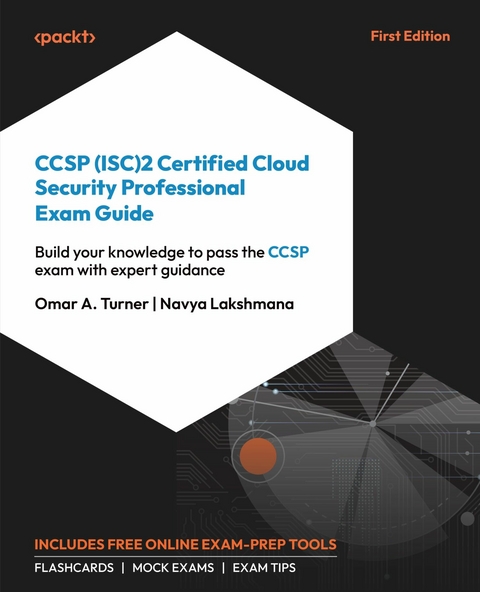
CCSP (ISC)2 Certified Cloud Security Professional Exam Guide (eBook)
560 Seiten
Packt Publishing (Verlag)
978-1-83898-435-9 (ISBN)
Preparing for the Certified Cloud Security Professional (CCSP) exam can be challenging, as it covers a wide array of topics essential for advancing a cybersecurity professional's career by validating their technical skills. To prepare for the CCSP exam, you need a resource that not only covers all the exam objectives but also helps you prepare for the format and structure of the exam.
Written by two seasoned cybersecurity professionals with a collective experience of hundreds of hours training CCSP bootcamps, this CCSP study guide reflects the journey you'd undertake in such training sessions.
The chapters are packed with up-to-date information necessary to pass the (ISC)2 CCSP exam. Additionally, to boost your confidence, the book provides self-assessment questions, exam tips, and mock exams with detailed answer explanations. You'll be able to deepen your understanding using illustrative explanations that briefly review key points.
As you progress, you'll delve into advanced technical aspects of cloud domain security, such as application security, design, managing and securing data, and infrastructure in the cloud using best practices and legal policies and procedures.
By the end of this guide, you'll be ready to breeze through the exam and tackle real-world cloud security challenges with ease.
No detailed description available for "e;CCSP (ISC)2 Certified Cloud Security Professional Exam Guide"e;.
Preface
Cloud security is critically important for enterprises as the adoption of cloud infrastructure and services continues to grow at a rapid pace. As businesses move more and more of their data, services, and applications to the cloud, they need talented and certified professionals to help them secure these cloud environments. Today, cloud computing has moved from being a nice-to-have to being a core competency in the enterprise.
This has led to a high demand for knowledgeable and talented cloud security engineers and architects who can help organizations design, build, and operate secure cloud environments. This, combined with the myriad of security compromises out there, is creating challenges for organizations of all types. Cloud certifications can help organizations identify and develop critical skills for implementing various cloud initiatives. Certifications can also help individuals demonstrate their technical knowledge, skills, and abilities to potential employers to advance their careers.
The goal of this book is to help you pass the Certified Cloud Security Professional (CCSP) certification by ISC2. The CCSP certification is the most sought-after global credential and represents the highest standard for cloud security expertise. It confirms your ability to apply best practices to cloud security architecture, design, operations, and service orchestration.
As you progress through this book, you’ll engage with practical and straightforward explanations of cloud security concepts designed to educate you on the challenges security professionals face in cloud environments. The chapters in this book cover the domains of topics relevant to the CCSP exam, including developing a comprehensive cloud security policy, conducting risk assessments for cloud deployments, implementing identity and access management solutions, securing data in cloud storage, and designing disaster recovery plans. Each chapter will guide you through scenarios that test your understanding of the CCSP domains, from architectural considerations to legal and compliance frameworks.
By the conclusion of this study guide, you’ll possess a solid understanding of cloud security principles and practices, as well as the confidence needed to apply this knowledge in your current role. You will also be well prepared to take the CCSP exam.
Who This Book Is For
This book is for those who are preparing to take the CCSP exam. It is recommended that you have at least five years of experience in IT, with two of those years being focused on aspects such as cloud security, application security, privacy, or data governance.
What This Book Covers
Chapter 1, Core Cloud Concepts, introduces the most relevant cloud computing characteristics and concepts with regard to cloud service models, cloud deployment models, and the different types of stakeholders in cloud computing.
Chapter 2, Cloud Reference Architecture, covers the cloud reference architecture, cloud service models, cloud deployment models, and cloud capabilities. We will also introduce the shared considerations for cloud deployments and the impact of new and emerging technologies on the evolution of cloud computing.
Chapter 3, Top Threats and Essential Cloud Security Concepts and Controls, describes the common threats to cloud deployments and attack vectors. We will introduce the control frameworks and control types necessary to secure data, network, and virtualization layers for cloud computing.
Chapter 4, Design Principles for Secure Cloud Computing, focuses on the service model security considerations.
Chapter 5, How to Evaluate Your Cloud Service Provider, discusses how to review and understand key cloud service contractual documents from the perspective of cloud service consumers. We will provide the best practices on how to evaluate your CSP based on a set of criteria.
Chapter 6, Cloud Data Security Concepts and Architectures, describes cloud data concepts, cloud data storage architectures, data security, data classification, and cloud data security technologies. We will review the stages of the cloud data life cycle in cloud environments, from creation to safe destruction practices.
Chapter 7, Data Governance Essentials, reviews the most important concepts of governance oversight for data life cycle phases in the cloud environment. We will introduce the concepts of Information Rights Management (IRM) and best practices for auditability, traceability, and accountability when it comes to data use in cloud environments.
Chapter 8, Essential Infrastructure and Platform Components for a Secure Data Center, reviews key cloud infrastructure and platform components and the best practices for the secure design of the logical, physical, and environmental components of a modern data center.
Chapter 9, Analyzing Risks, identifies the top risks to the physical, logical, and virtual environments as a cloud consumer and provider. We will discuss how to analyze, assess, and address the risk with safeguards and countermeasures.
Chapter 10, Security Control Implementation, provides an overview of the key concepts of the selection, planning, and implementation of security controls in cloud environments.
Chapter 11, Planning for the Worst-Case Scenario – Business Continuity and Disaster Recovery, discusses how organizations are preparing to withstand disasters and business disruptions to be able to continue the delivery of products and services within acceptable time frames.
Chapter 12, Application Security, reviews development basics, the challenges organizations face, and the common cloud vulnerabilities for web applications.
Chapter 13, Secure Software Development Life Cycle, is dedicated to educating you on the Secure Software Development Life Cycle (S-SDLC), including coverage of topics such as defining requirements, what methodology to use to apply the S-SDLC, threat modeling, and secure coding.
Chapter 14, Assurance, Validation, and Verification in Security, describes key processes as they relate to functional testing, profiling security testing methodologies, QA, and other solutions.
Chapter 15, Application-Centric Cloud Architecture, reviews the important specifics of traditional cloud application architecture, with a focus on essential security components such as WAF, DAM, API gateways, cryptography, sandboxing, and securing virtualized applications.
Chapter 16, IAM Design, focuses on Identity and Access Management (IAM) solutions, which are critical elements of securing organizations. This chapter covers identity providers, federated identities, secrets management, and other important IAM solutions.
Chapter 17, Cloud Physical and Logical Infrastructure (Operationalization and Maintenance), reviews the key physical and logical infrastructure configuration requirements for cloud environments. We will also provide an overview of the most common configurations and controls for operational and maintenance activities for physical and logical infrastructures.
Chapter 18, International Operational Controls and Standards, reviews the leading industry standards for Information Technology Service Management (ITSM).
Chapter 19, Digital Forensics, discusses forensic data collection methodologies, evidence management, and other key concepts for the collection, acquisition, and preservation of digital evidence.
Chapter 20, Managing Communications, covers the best practices for the communication channels and procedures that need to be set up if an organization intends to be resilient against impacts of all types. We will review the most common communication channels with vendors, customers, regulators, partners, and other stakeholders.
Chapter 21, Security Operations Center Management, covers the best practices for establishing the primary requirements of a security operations center and how they are informed by the business mission, regulatory and legal requirements, and service offerings. We will review a wide range of tools related to monitoring and logging that are necessary for effective security operations center management.
Chapter 22, Legal Challenges and the Cloud, discusses compliance with legal and contractual requirements. The chapter covers in detail the policies, standards, guidelines, baselines, and procedures...
| Erscheint lt. Verlag | 5.7.2024 |
|---|---|
| Sprache | englisch |
| Themenwelt | Informatik ► Netzwerke ► Sicherheit / Firewall |
| Mathematik / Informatik ► Informatik ► Theorie / Studium | |
| Informatik ► Weitere Themen ► Zertifizierung | |
| ISBN-10 | 1-83898-435-6 / 1838984356 |
| ISBN-13 | 978-1-83898-435-9 / 9781838984359 |
| Informationen gemäß Produktsicherheitsverordnung (GPSR) | |
| Haben Sie eine Frage zum Produkt? |
 EPUB (Ohne DRM)
Digital Rights Management: ohne DRM
Dieses eBook enthält kein DRM oder Kopierschutz. Eine Weitergabe an Dritte ist jedoch rechtlich nicht zulässig, weil Sie beim Kauf nur die Rechte an der persönlichen Nutzung erwerben.
Dateiformat: EPUB (Electronic Publication)
EPUB ist ein offener Standard für eBooks und eignet sich besonders zur Darstellung von Belletristik und Sachbüchern. Der Fließtext wird dynamisch an die Display- und Schriftgröße angepasst. Auch für mobile Lesegeräte ist EPUB daher gut geeignet.
Systemvoraussetzungen:
PC/Mac: Mit einem PC oder Mac können Sie dieses eBook lesen. Sie benötigen dafür die kostenlose Software Adobe Digital Editions.
eReader: Dieses eBook kann mit (fast) allen eBook-Readern gelesen werden. Mit dem amazon-Kindle ist es aber nicht kompatibel.
Smartphone/Tablet: Egal ob Apple oder Android, dieses eBook können Sie lesen. Sie benötigen dafür eine kostenlose App.
Geräteliste und zusätzliche Hinweise
Buying eBooks from abroad
For tax law reasons we can sell eBooks just within Germany and Switzerland. Regrettably we cannot fulfill eBook-orders from other countries.
aus dem Bereich