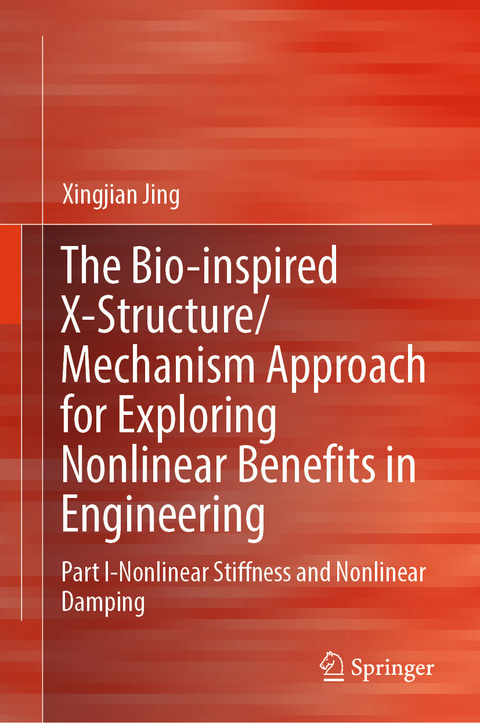
The Bio-inspired X-Structure/Mechanism Approach for Exploring Nonlinear Benefits in Engineering (eBook)
402 Seiten
Springer Nature Singapore (Verlag)
978-981-97-3492-4 (ISBN)
This book presents a unique approach to the design and analysis of beneficial nonlinearity, which can take an important and critical role in engineering systems and thus cannot be simply ignored in structural design, dynamic response analysis, and parameter selection. A key issue in the area is thus systematically addressed about how to analyze and design potential nonlinearities introduced to or inherent in a system, which is a must-do task in many practical applications involving vibration control, energy harvesting, sensor systems and robots, etc. This book, therefore, presents an up-to-date summary on the most recent development of a cutting-edge method for nonlinearity manipulation and employment developed in recent several years, known as the X-shaped structure or mechanism approach. The method is inspired from animal leg/limb skeletons and can provide passive low-cost high-efficiency adjustable and beneficial nonlinear stiffness (high static and ultra-low dynamic), nonlinear damping (dependent on resonant frequency and vibration excitation amplitude), and nonlinear inertia (low static and high dynamic) individually or simultaneously. The X-shaped structure or mechanism is a generic structure or mechanism representing a class of beneficial geometric nonlinearity with realizable and flexible linkage mechanism or structural design of different variants or forms (quadrilateral, diamond, polygon, K/Z/S/V/A/W-shape, or others) which all share similar geometric nonlinearity and thus similar nonlinear stiffness/damping properties, flexible in design, and easy to implement.
This book systematically introduces the research background, motivation, essential bio-inspired ideas, advantages of this novel method, beneficial nonlinear properties in stiffness, damping and inertia, associated theory for analysis and design of nonlinear dynamics, potential applications and case studies, most of which have been developed ever since 2010. This is Part I of this book series, and the results in this book focus on beneficial nonlinear stiffness and damping characteristics of the fundamental X-shaped structure/mechanism and its variants, and provide an in-depth understanding of potential nonlinear properties that can be achieved through passive structural/mechanism designs via this class of X-structures or mechanisms.
This book presents a unique approach to the design and analysis of beneficial nonlinearity, which can take an important and critical role in engineering systems and thus cannot be simply ignored in structural design, dynamic response analysis, and parameter selection. A key issue in the area is thus systematically addressed about how to analyze and design potential nonlinearities introduced to or inherent in a system, which is a must-do task in many practical applications involving vibration control, energy harvesting, sensor systems and robots, etc. This book, therefore, presents an up-to-date summary on the most recent development of a cutting-edge method for nonlinearity manipulation and employment developed in recent several years, known as the X-shaped structure or mechanism approach. The method is inspired from animal leg/limb skeletons and can provide passive low-cost high-efficiency adjustable and beneficial nonlinear stiffness (high static and ultra-low dynamic), nonlinear damping (dependent on resonant frequency and vibration excitation amplitude), and nonlinear inertia (low static and high dynamic) individually or simultaneously. The X-shaped structure or mechanism is a generic structure or mechanism representing a class of beneficial geometric nonlinearity with realizable and flexible linkage mechanism or structural design of different variants or forms (quadrilateral, diamond, polygon, K/Z/S/V/A/W-shape, or others) which all share similar geometric nonlinearity and thus similar nonlinear stiffness/damping properties, flexible in design, and easy to implement.This book systematically introduces the research background, motivation, essential bio-inspired ideas, advantages of this novel method, beneficial nonlinear properties in stiffness, damping and inertia, associated theory for analysis and design of nonlinear dynamics, potential applications and case studies, most of which have been developed ever since 2010. This is Part I of this book series, and the results in this book focus on beneficial nonlinear stiffness and damping characteristics of the fundamental X-shaped structure/mechanism and its variants, and provide an in-depth understanding of potential nonlinear properties that can be achieved through passive structural/mechanism designs via this class of X-structures or mechanisms.
| Erscheint lt. Verlag | 20.6.2024 |
|---|---|
| Zusatzinfo | XII, 402 p. 283 illus., 252 illus. in color. |
| Sprache | englisch |
| Themenwelt | Mathematik / Informatik ► Informatik ► Theorie / Studium |
| Mathematik / Informatik ► Mathematik ► Angewandte Mathematik | |
| Naturwissenschaften | |
| Technik ► Bauwesen | |
| Technik ► Elektrotechnik / Energietechnik | |
| Schlagworte | Bio-inspired Methods • Energy harvesting • Nonlinear Dynamics • Passive vibration isolation • Quasi-zero Stiffness • vehicle suspension • Vibration Absorption • Vibration Control |
| ISBN-10 | 981-97-3492-4 / 9819734924 |
| ISBN-13 | 978-981-97-3492-4 / 9789819734924 |
| Informationen gemäß Produktsicherheitsverordnung (GPSR) | |
| Haben Sie eine Frage zum Produkt? |
 PDF (Wasserzeichen)
DRM: Digitales Wasserzeichen
Dieses eBook enthält ein digitales Wasserzeichen und ist damit für Sie personalisiert. Bei einer missbräuchlichen Weitergabe des eBooks an Dritte ist eine Rückverfolgung an die Quelle möglich.
Dateiformat: PDF (Portable Document Format)
Mit einem festen Seitenlayout eignet sich die PDF besonders für Fachbücher mit Spalten, Tabellen und Abbildungen. Eine PDF kann auf fast allen Geräten angezeigt werden, ist aber für kleine Displays (Smartphone, eReader) nur eingeschränkt geeignet.
Systemvoraussetzungen:
PC/Mac: Mit einem PC oder Mac können Sie dieses eBook lesen. Sie benötigen dafür einen PDF-Viewer - z.B. den Adobe Reader oder Adobe Digital Editions.
eReader: Dieses eBook kann mit (fast) allen eBook-Readern gelesen werden. Mit dem amazon-Kindle ist es aber nicht kompatibel.
Smartphone/Tablet: Egal ob Apple oder Android, dieses eBook können Sie lesen. Sie benötigen dafür einen PDF-Viewer - z.B. die kostenlose Adobe Digital Editions-App.
Buying eBooks from abroad
For tax law reasons we can sell eBooks just within Germany and Switzerland. Regrettably we cannot fulfill eBook-orders from other countries.
aus dem Bereich