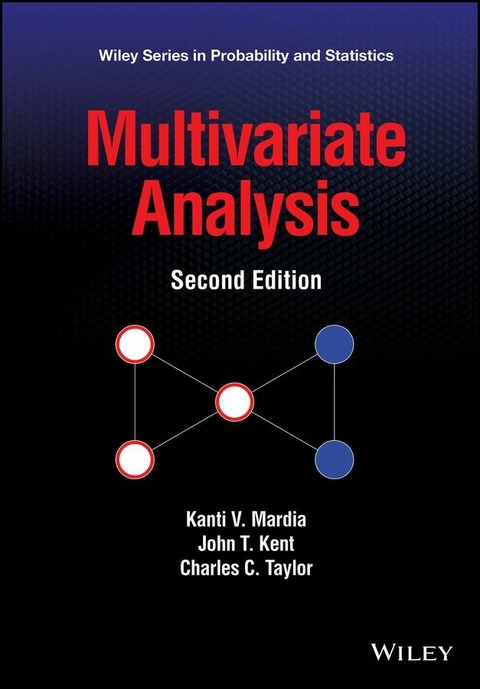
Multivariate Analysis (eBook)
1094 Seiten
Wiley (Verlag)
978-1-118-89251-0 (ISBN)
Comprehensive Reference Work on Multivariate Analysis and its Applications
The first edition of this book, by Mardia, Kent and Bibby, has been used globally for over 40 years. This second edition brings many topics up to date, with a special emphasis on recent developments.
A wide range of material in multivariate analysis is covered, including the classical themes of multivariate normal theory, multivariate regression, inference, multidimensional scaling, factor analysis, cluster analysis and principal component analysis. The book also now covers modern developments such as graphical models, robust estimation, statistical learning, and high-dimensional methods. The book expertly blends theory and application, providing numerous worked examples and exercises at the end of each chapter. The reader is assumed to have a basic knowledge of mathematical statistics at an undergraduate level together with an elementary understanding of linear algebra. There are appendices which provide a background in matrix algebra, a summary of univariate statistics, a collection of statistical tables and a discussion of computational aspects. The work includes coverage of:
- Basic properties of random vectors, copulas, normal distribution theory, and estimation
- Hypothesis testing, multivariate regression, and analysis of variance
- Principal component analysis, factor analysis, and canonical correlation analysis
- Discriminant analysis, cluster analysis, and multidimensional scaling
- New advances and techniques, including supervised and unsupervised statistical learning, graphical models and regularization methods for high-dimensional data
Although primarily designed as a textbook for final year undergraduates and postgraduate students in mathematics and statistics, the book will also be of interest to research workers and applied scientists.
Kanti V. Mardia OBE is a Senior Research Professor in the Department of Statistics at the University of Leeds, Leverhulme Emeritus Fellow, and Visiting Professor in the Department of Statistics, University of Oxford.
John T. Kent and Charles C. Taylor are both Professors in the Department of Statistics, University of Leeds.
Multivariate Analysis Comprehensive Reference Work on Multivariate Analysis and its Applications The first edition of this book, by Mardia, Kent and Bibby, has been used globally for over 40 years. This second edition brings many topics up to date, with a special emphasis on recent developments. A wide range of material in multivariate analysis is covered, including the classical themes of multivariate normal theory, multivariate regression, inference, multidimensional scaling, factor analysis, cluster analysis and principal component analysis. The book also now covers modern developments such as graphical models, robust estimation, statistical learning, and high-dimensional methods. The book expertly blends theory and application, providing numerous worked examples and exercises at the end of each chapter. The reader is assumed to have a basic knowledge of mathematical statistics at an undergraduate level together with an elementary understanding of linear algebra. There are appendices which provide a background in matrix algebra, a summary of univariate statistics, a collection of statistical tables and a discussion of computational aspects. The work includes coverage of: Basic properties of random vectors, copulas, normal distribution theory, and estimation Hypothesis testing, multivariate regression, and analysis of variance Principal component analysis, factor analysis, and canonical correlation analysis Discriminant analysis, cluster analysis, and multidimensional scaling New advances and techniques, including supervised and unsupervised statistical learning, graphical models and regularization methods for high-dimensional data Although primarily designed as a textbook for final year undergraduates and postgraduate students in mathematics and statistics, the book will also be of interest to research workers and applied scientists.
Notation, Abbreviations, and Key Ideas
Matrices and Vectors
- Vectors are viewed as column vectors and are represented using bold lower case letters. Round brackets are generally used when a vector is expressed in terms of its elements. For example, in which the th element or component is denoted . The transpose of is denoted , so is a row vector.
- Matrices are written using bold upper case letters, e.g. and . The matrix may be written as in which is the element of the matrix in row and column . If has rows and columns, then the th row of , written as a column vector, is
and the th column is written as
Hence, can be expressed in various forms,
We generally use square brackets when a matrix is expanded in terms of its elements.
Operations on a matrix include
- – transpose:
- – determinant:
- – inverse:
- – generalized inverse:
where for the final three operations, is assumed to be square, and for the inverse operation, is additionally assumed to be nonsingular. Different types of matrices are given in Tables A.1 and A.3. Table A.2 lists some further matrix operations.
Random Variables and Data
- In general, a random vector and a nonrandom vector are both indicated using a bold lower case letter, e.g. . Thus, the distinction between the two must be determined from the context. This convention is in contrast to the standard convention in statistics where upper case letters are used to denote random quantities, and lower case letters their observed values.
- The reason for our convention is that bold upper case letters are generally used for a data matrix , both random and fixed.
- In spite of the above convention, we very occasionally (e.g. parts of Chapters 2 and 10) use bold upper case letters for a random vector when it is important to distinguish between the random vector and a possible value .
- The phrase “high‐dimensional data” often implies , whereas the phrase “big data” often just indicates that or is large.
Parameters and Statistics
Elements of an data matrix are generally written , where indices are used to label the observations, and indices are used to label the variables.
If the rows of a data matrix are normally distributed with mean and covariance matrix , and , the following notation is used to distinguish various population and sample quantities:
| Parameter | Sample |
| Mean vector |
| Covariance matrix |
| Unbiased covariance matrix |
| Concentration matrix |
| Correlation matrix |
Distributions
The following notation is used for univariate and multivariate distributions. Appendix B summarizes the univariate distributions used in the Book.
| cumulative distribution function/distribution function (d.f.) |
| probability density function (p.d.f.) |
| expectation |
| c.f. | characteristic function |
| d.f. | distribution function |
| Hotelling |
| multivariate normal distribution in ‐dimensions with mean (column vector of length ) and covariance matrix |
| variance–covariance matrix |
| correlation matrix |
| Wishart distribution |
The terms variance matrix, covariance matrix, and variance–covariance matrix are synonymous.
Matrix Decompositions
- Any symmetric matrix can (by the spectral decomposition theorem) be written as where is a diagonal matrix of eigenvalues of (which are real‐valued), i.e. , and is an orthogonal matrix whose columns are standardized eigenvectors, i.e. and . See Theorem A.6.8.
- Using the above, we define the symmetric square root of a positive definite matrix by
- If is an matrix of rank , then by the singular value decomposition, it can be written as where and are column orthonormal matrices, and is a diagonal matrix with positive elements. See Theorem A.6.8.
Geometry
Table A.5 sets out the basic concepts in ‐dimensional geometry. In particular,
| Length of a vector |
| Euclidean distance between and |
| Squared Mahalanobis distance – one of the most important distances in multivariate analysis, since it takes account of a covariance, i.e. |
Table 14.6 gives a list of various distances.
Main Abbreviations and Commonly Used Notation
| approximately equal to |
| (conditionally) independent of |
| is distributed as |
| the set of elements that are members of but not |
| Euclidean distance between and |
| transpose of matrix |
| determinant of matrix |
| inverse of matrix |
| ‐inverse (generalized inverse) |
| column vector of 1s |
| column vector or matrix of 0s |
| between‐groups sum of squares and products (SSP) matrix |
| beta variable |
| normalizing constant for beta distribution (note nonitalic font to distinguish from the above) |
| BLUE | best linear unbiased estimate |
| covariance between and |
| chi‐squared distribution with degrees of freedom |
| upper α critical value of chi‐squared distribution with degrees of freedom |
| c.f. | characteristic function |
| partial derivative – multivariate examples in Appendix A.9 |
| distance matrix |
| squared Mahalanobis distance |
| d.f. | distribution function |
| Kronecker delta |
| diagonal elements of a square matrix (as column vector) or diagonal matrix created from a vector |
| (see above) |
| expectation |
| distribution with degrees of freedom and |
| upper α critical value of distribution with degrees of freedom and |
| cumulative distribution function |
| probability density function |
| gamma function |
| GLS | generalized least squares |
| centering matrix |
| identity matrix |
| ICA | independent component analysis |
| i.i.d. | independent and identically distributed |
| Jacobian of transformation (see Table 2.1) |
| concentration matrix () |
| likelihood |
| log likelihood |
| LDA | linear discriminant analysis |
| logarithm to the base (natural logarithm) |
| LRT | likelihood ratio test |
| MANOVA | multivariate analysis of variance |
| MDS | multidimensional scaling |
| ML | maximum likelihood |
| m.l.e. | maximum likelihood estimate |
| mean (population) vector |
| multivariate normal distribution for... |
| Erscheint lt. Verlag | 10.6.2024 |
|---|---|
| Reihe/Serie | Wiley Series in Probability and Statistics | Wiley Series in Probability and Statistics |
| Sprache | englisch |
| Themenwelt | Mathematik / Informatik ► Mathematik ► Statistik |
| Mathematik / Informatik ► Mathematik ► Wahrscheinlichkeit / Kombinatorik | |
| Schlagworte | Angewandte Wahrscheinlichkeitsrechnung u. Statistik • Applied Probability & Statistics • basic multivariate normal theory • cluster analysis • Data Analysis • Datenanalyse • directional data • discriminant analysis • Factor Analysis • Multidimensional Scaling • multiple regression • Multivariate Analyse • multivariate analysis • Principal Component Analysis • Statistics • Statistik • structural equations models |
| ISBN-10 | 1-118-89251-8 / 1118892518 |
| ISBN-13 | 978-1-118-89251-0 / 9781118892510 |
| Informationen gemäß Produktsicherheitsverordnung (GPSR) | |
| Haben Sie eine Frage zum Produkt? |
 EPUB (Adobe DRM)
Kopierschutz: Adobe-DRM
Adobe-DRM ist ein Kopierschutz, der das eBook vor Mißbrauch schützen soll. Dabei wird das eBook bereits beim Download auf Ihre persönliche Adobe-ID autorisiert. Lesen können Sie das eBook dann nur auf den Geräten, welche ebenfalls auf Ihre Adobe-ID registriert sind.
Details zum Adobe-DRM
Dateiformat: EPUB (Electronic Publication)
EPUB ist ein offener Standard für eBooks und eignet sich besonders zur Darstellung von Belletristik und Sachbüchern. Der Fließtext wird dynamisch an die Display- und Schriftgröße angepasst. Auch für mobile Lesegeräte ist EPUB daher gut geeignet.
Systemvoraussetzungen:
PC/Mac: Mit einem PC oder Mac können Sie dieses eBook lesen. Sie benötigen eine
eReader: Dieses eBook kann mit (fast) allen eBook-Readern gelesen werden. Mit dem amazon-Kindle ist es aber nicht kompatibel.
Smartphone/Tablet: Egal ob Apple oder Android, dieses eBook können Sie lesen. Sie benötigen eine
Geräteliste und zusätzliche Hinweise
Buying eBooks from abroad
For tax law reasons we can sell eBooks just within Germany and Switzerland. Regrettably we cannot fulfill eBook-orders from other countries.
aus dem Bereich