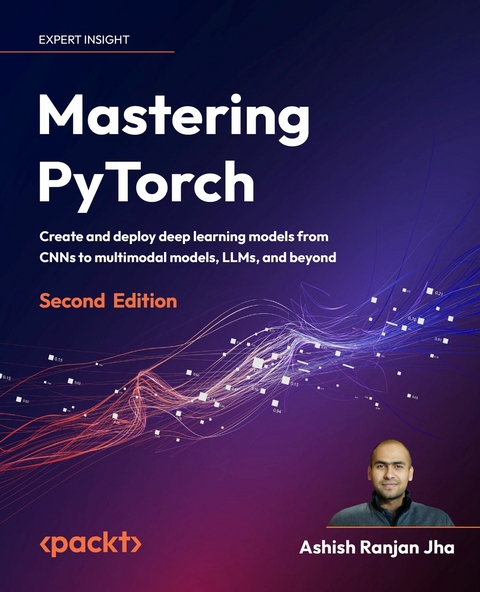
Mastering PyTorch (eBook)
558 Seiten
Packt Publishing Limited (Verlag)
978-1-80107-996-9 (ISBN)
No detailed description available for "e;Mastering PyTorch"e;.
Preface
Deep learning is driving the AI revolution and PyTorch is making it easier than ever before for anyone to build deep learning applications. This book will help you uncover expert techniques and gain insights to get the most out of your data and build complex neural network models.
The book starts with a quick overview of PyTorch and explores convolutional neural network (CNN) architectures for image classification. Similarly, you will explore recurrent neural network (RNN) architectures as well as Transformers and use them for sentiment analysis. Next, you will learn how to create arbitrary neural network architectures and build Graph neural networks (GNNs). As you advance, you’ll apply deep learning (DL) across different domains such as music, text, and image generation using generative models including Generative adversarial networks (GANs) and diffusion.
Next, you’ll build and train your own deep reinforcement learning models in PyTorch, as well as interpreting DL models. You will not only learn how to build models but also how to deploy them into production and to mobile devices (Android and iOS) using expert tips and techniques. Next, you will master the skills of training large models efficiently in a distributed fashion, searching neural architectures effectively with AutoML, as well as rapidly prototyping models using fastai. You’ll then create a recommendation system using PyTorch. Finally, you’ll use major Hugging Face libraries together with PyTorch to build cutting edge artificial intelligence (AI) models.
By the end of this PyTorch book, you’ll be well equipped to perform complex deep learning tasks using PyTorch to build smart AI models.
Who this book is for
This book is for data scientists, machine learning researchers, and deep learning practitioners looking to implement advanced deep learning paradigms using PyTorch 2.x. Working knowledge of deep learning with Python programming is required.
What this book covers
Chapter 1, Overview of Deep Learning Using PyTorch, includes brief notes on various deep learning terminologies and concepts useful for understanding later parts of this book. This chapter also gives a quick overview of PyTorch in contrast with TensorFlow as a language and tools that will be used throughout this book for building deep learning models. Finally, we train a neural network model using PyTorch.
Chapter 2, Deep CNN Architectures, is a rundown of the most advanced deep CNN model architectures that have been developed in recent years. We use PyTorch to create many of these models and train them for appropriate tasks.
Chapter 3, Combining CNNs and LSTMs, walks through an example where we build a neural network model with a CNN and LSTM that generates text/captions as output when given images as inputs using PyTorch.
Chapter 4, Deep Recurrent Model Architectures, goes through recent advancements in recurrent neural architectures, specifically RNNs, LSTMs, and GRUs. Upon completion, you will be able to create complex recurrent architecture in PyTorch.
Chapter 5, Advanced Hybrid Models, discusses some advanced, unique hybrid neural architectures such as the Transformers that have revolutionized the world of natural language processing. This chapter also discusses RandWireNNs, taking a peek into the world of neural architecture search, using PyTorch.
Chapter 6, Graph Neural Networks, walks us through the basic concepts behind GNNs, different kinds of graph learning tasks, and different types of GNN model architectures. The chapter then dives deep into a few of those architectures, namely Graph Convolutional Networks (GCNs) and Graph Attention Networks (GATs). This chapter uses PyTorch Geometric as the library of choice for building GNNs in PyTorch.
Chapter 7, Music and Text Generation with PyTorch, demonstrates the use of PyTorch to create deep learning models that can compose music and write text with practically nothing being provided to them at runtime.
Chapter 8, Neural Style Transfer, discusses a special type of CNN model that can mix multiple input images and generate artistic-looking arbitrary images.
Chapter 9, Deep Convolutional GANs, explains GANs and trains one using PyTorch on a specific task.
Chapter 10, Image Generation Using Diffusion, implements a diffusion model from scratch as a state-of-the-art text-to-image generation model, using PyTorch.
Chapter 11, Deep Reinforcement Learning, explores how PyTorch can be used to train agents on a deep reinforcement learning task, such as a player in a video game.
Chapter 12, Model Training Optimizations, explores how to efficiently train large models with limited resources through distributed training as well as mixed precision training practices in PyTorch. By the end of this chapter, you will have mastered the skill of training large models efficiently using PyTorch.
Chapter 13, Operationalizing PyTorch Models into Production, runs through the process of deploying a deep learning model written in PyTorch into a real production system using Flask and Docker, as well as TorchServe. Then you’ll learn how to export PyTorch models both using TorchScript and ONNX. You’ll also learn how to ship PyTorch code as a C++ application. Finally, you’ll learn how to use PyTorch on some of the popular cloud computing platforms.
Chapter 14, PyTorch on Mobile and Embedded Devices, walks through the process of using various pre-trained PyTorch models and deploying them on different mobile operating systems – Android and iOS.
Chapter 15, Rapid Prototyping with PyTorch, discusses various tools and libraries such as fastai and PyTorch Lightning that make the process of model training in PyTorch several times faster. This chapter also explains how to profile PyTorch code to understand resource utilization.
Chapter 16, PyTorch and AutoML, walks through setting up ML experiments effectively using AutoML and Optuna with PyTorch.
Chapter 17, PyTorch and Explainable AI, focuses on making machine learning models interpretable to a layman using tools such as Captum, combined with PyTorch.
Chapter 18, Recommendation Systems with PyTorch, builds a deep-learning-based movie recommendation system from scratch using PyTorch.
Chapter 19, PyTorch and Hugging Face, discusses how to use Hugging Face libraries such as Transformers, Accelerate, Optimum, and so on, with PyTorch to build cutting-edge multi-modal AI models.
To get the most out of this book
To fully benefit from this book, it is necessary that you meet the following prerequisites and recommendations:
- Hands-on Python experience as well as basic knowledge of PyTorch is expected. Because most exercises in this book are in the form of notebooks, a working experience with Jupyter notebooks is expected.
- Some of the exercises in some of the chapters might require a GPU for faster model training, and therefore having an NVIDIA GPU is a plus.
- Finally, having registered accounts with cloud computing platforms such as AWS, Google Cloud, and Microsoft Azure will be helpful to navigate parts of Chapter 13 as well as to facilitate distributed training in Chapter 12 over several virtual machines.
Download the example code files
The code bundle for the book is hosted on GitHub at https://github.com/arj7192/MasteringPyTorchV2. We also have other code bundles from our rich catalog of books and videos available at https://github.com/PacktPublishing/. Check them out!
Download the color images
We also provide a PDF file that has color images of the screenshots/diagrams used in this book. You can download it here: https://packt.link/gbp/9781801074308.
Conventions used
There are a number of text conventions used throughout this book.
Code in text: Indicates code words in text, database table names, folder names, filenames, file extensions, pathnames, dummy URLs, user input, and Twitter handles. For example: “Mount the downloaded WebStorm-10*.dmg disk image file as another disk in your system.”
A block of code is set as follows:
def forward(self, source): source = self.enc(source) * torch.sqrt(self.num_inputs) source = self.position_enc(source) op = self.enc_transformer(source, self.mask_source) op = self.dec(op) return op When we wish to draw your attention to a particular part of a code block, the relevant lines or items are set in bold:
def forward(self, source): source = self.enc(source) * torch.sqrt(self.num_inputs) source = self.position_enc(source) op = self.enc_transformer(source, self.mask_source) op = self.dec(op) return op Any command-line input or output is...
| Erscheint lt. Verlag | 14.6.2024 |
|---|---|
| Sprache | englisch |
| Themenwelt | Mathematik / Informatik ► Informatik ► Netzwerke |
| Informatik ► Theorie / Studium ► Künstliche Intelligenz / Robotik | |
| ISBN-10 | 1-80107-996-X / 180107996X |
| ISBN-13 | 978-1-80107-996-9 / 9781801079969 |
| Informationen gemäß Produktsicherheitsverordnung (GPSR) | |
| Haben Sie eine Frage zum Produkt? |
 EPUB (Adobe DRM)
Größe: 41,3 MB
Kopierschutz: Adobe-DRM
Adobe-DRM ist ein Kopierschutz, der das eBook vor Mißbrauch schützen soll. Dabei wird das eBook bereits beim Download auf Ihre persönliche Adobe-ID autorisiert. Lesen können Sie das eBook dann nur auf den Geräten, welche ebenfalls auf Ihre Adobe-ID registriert sind.
Details zum Adobe-DRM
Dateiformat: EPUB (Electronic Publication)
EPUB ist ein offener Standard für eBooks und eignet sich besonders zur Darstellung von Belletristik und Sachbüchern. Der Fließtext wird dynamisch an die Display- und Schriftgröße angepasst. Auch für mobile Lesegeräte ist EPUB daher gut geeignet.
Systemvoraussetzungen:
PC/Mac: Mit einem PC oder Mac können Sie dieses eBook lesen. Sie benötigen eine
eReader: Dieses eBook kann mit (fast) allen eBook-Readern gelesen werden. Mit dem amazon-Kindle ist es aber nicht kompatibel.
Smartphone/Tablet: Egal ob Apple oder Android, dieses eBook können Sie lesen. Sie benötigen eine
Geräteliste und zusätzliche Hinweise
Buying eBooks from abroad
For tax law reasons we can sell eBooks just within Germany and Switzerland. Regrettably we cannot fulfill eBook-orders from other countries.
 PDF (Wasserzeichen)
Größe: 46,9 MB
DRM: Digitales Wasserzeichen
Dieses eBook enthält ein digitales Wasserzeichen und ist damit für Sie personalisiert. Bei einer missbräuchlichen Weitergabe des eBooks an Dritte ist eine Rückverfolgung an die Quelle möglich.
Dateiformat: PDF (Portable Document Format)
Mit einem festen Seitenlayout eignet sich die PDF besonders für Fachbücher mit Spalten, Tabellen und Abbildungen. Eine PDF kann auf fast allen Geräten angezeigt werden, ist aber für kleine Displays (Smartphone, eReader) nur eingeschränkt geeignet.
Systemvoraussetzungen:
PC/Mac: Mit einem PC oder Mac können Sie dieses eBook lesen. Sie benötigen dafür einen PDF-Viewer - z.B. den Adobe Reader oder Adobe Digital Editions.
eReader: Dieses eBook kann mit (fast) allen eBook-Readern gelesen werden. Mit dem amazon-Kindle ist es aber nicht kompatibel.
Smartphone/Tablet: Egal ob Apple oder Android, dieses eBook können Sie lesen. Sie benötigen dafür einen PDF-Viewer - z.B. die kostenlose Adobe Digital Editions-App.
Buying eBooks from abroad
For tax law reasons we can sell eBooks just within Germany and Switzerland. Regrettably we cannot fulfill eBook-orders from other countries.
EPUB (Ohne DRM)Digital Rights Management: ohne DRM
Dieses eBook enthält kein DRM oder Kopierschutz. Eine Weitergabe an Dritte ist jedoch rechtlich nicht zulässig, weil Sie beim Kauf nur die Rechte an der persönlichen Nutzung erwerben.
Dateiformat: EPUB (Electronic Publication)
EPUB ist ein offener Standard für eBooks und eignet sich besonders zur Darstellung von Belletristik und Sachbüchern. Der Fließtext wird dynamisch an die Display- und Schriftgröße angepasst. Auch für mobile Lesegeräte ist EPUB daher gut geeignet.
Systemvoraussetzungen:
PC/Mac: Mit einem PC oder Mac können Sie dieses eBook lesen. Sie benötigen dafür die kostenlose Software Adobe Digital Editions.
eReader: Dieses eBook kann mit (fast) allen eBook-Readern gelesen werden. Mit dem amazon-Kindle ist es aber nicht kompatibel.
Smartphone/Tablet: Egal ob Apple oder Android, dieses eBook können Sie lesen. Sie benötigen dafür eine kostenlose App.
Geräteliste und zusätzliche Hinweise
Buying eBooks from abroad
For tax law reasons we can sell eBooks just within Germany and Switzerland. Regrettably we cannot fulfill eBook-orders from other countries.
aus dem Bereich