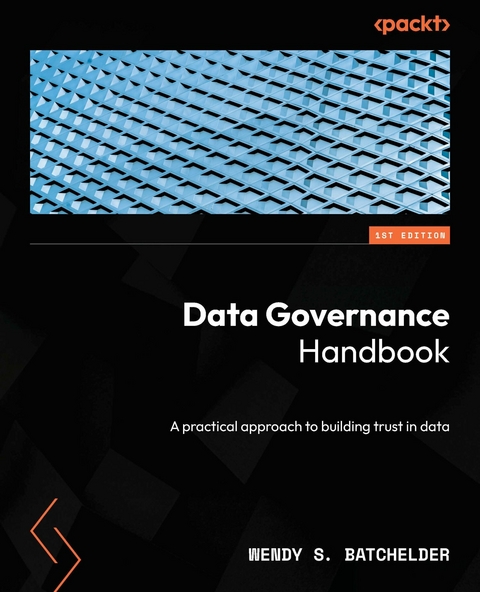
Data Governance Handbook (eBook)
394 Seiten
Packt Publishing (Verlag)
978-1-80324-247-7 (ISBN)

No detailed description available for "e;Data Governance Handbook"e;.
Preface
The world generates ~2.5 quintillion bytes of data every single day (and growing!). As a result, understanding and managing the data created becomes more complex every single day. It’s our job to drive simplicity, understanding, and ease of use to make accessing and using data as easy and understandable as possible.
As a data professional, our role is to ensure we can govern data and empower our businesses with the right data, at the right time, with the right controls. This book is a comprehensive guide on how to better understand what data governance is, its key components, and how to successfully position solutions in a way that translates into real, understandable business results. After reading this book, you will be able to successfully pitch and gain support for a data governance program, with measured outcomes in terms the business will understand and deeply value.
We will move from establishing a Chief Data and Analytics Office and building a business case to successfully implementing the more technical capabilities that any CDAO will need to deliver to drive successful data management. You will notice in this book that I emphasize the “why” behind these capabilities. In my experience, simply explaining what the capabilities are without being able to see how they can impact a business is a recipe for failure.
There are many more technical books available on each of these topics, and where I hope this book will provide a variance from what is already available is that: business value. I will spend time explaining the technical capabilities in terms your business stakeholders can understand, with the aim of creating a business-led program.
Ultimately, if you want to get into details about a specific tool or technical implementation, there are loads of other great resources (including books) you can head to drive your implementation, including a wonderful inventory from the publisher of this book, Packt.
Who this book is for
This book is for chief data officers, data governance leaders, data stewards, engineers who want to understand the business value of their work. It is also for IT professionals seeking further understanding of data management. Any business leader who wants to better understand data governance would also benefit from learning the basics, as well as any executive finding themselves managing a chief data and analytics officer who wants to better understand the discipline at a higher level. You should have a basic understanding of working with data and understand the basic needs of a business and how to meet those needs with data solutions. You do not need to have the knowledge or skills needed to sell solutions to executives, nor coding experience.
What you will learn:
- Exactly how to position data governance to obtain executive buy-in
- How to launch a governance program at scale with measured impact
- Real-world use cases that enable you to take action quickly
- How to obtain support for data governance-led digital transformations
- How to launch strong, with confidence
- A detailed step-by-step guide from ideation to delivery and beyond
What this book covers
Chapter 1, What Is Data Governance?, introduces you to data governance. At face value, data governance may seem like a cost center, if not approached with value generation in mind. Many companies start a data governance program without the right support, structure, or funding model. First, you will learn the basics of what data governance is and how it relates to adjacent capabilities. Then, you will learn the components of data governance programs, why each component matters, and finally, why to treat data governance as an enabler for business value.
Chapter 2, How to Build a Coalition of Advocates, explores gaining support for your program, which is arguably the most important part of launching a data governance program that drives impact. First, you will learn why and how to identify and secure the right executive sponsor for the data program, and then how to bring in additional leadership support. Lastly, you will learn how to engage and energize the entire company to collaborate toward value-based outcomes that matter to them.
Chapter 3, Building a High-Performing Team, focuses on establishing a high-performing data governance team, which is a critical and long-term investment in the success of a company’s use of data. First, you will be introduced to the key roles in a successful data governance function, how they should optimally structure for results, and finally, how to establish routines and rhythms to support the operations of the team.
Chapter 4, Baseline Your Organization, teaches you the importance of defining a baseline, not only for the organization as a whole but also for individual projects. A key component of measuring success is measuring where you start. You will learn how to capture a baseline and who to communicate it to. Finally, we will discuss how to ensure agreement on the baseline before beginning work.
Chapter 5, Define Success and Align on Outcomes, focuses on the area where many data transformations fall flat – aligning on outcomes that matter to a business. Most data transformations stop with data outcomes and fail to reach the final mile – where the business uses the delivered data capabilities to drive operational efficiency, increased revenues, and better insights. In this chapter, you will learn why defining success beyond data and with the business matters, how to successfully map all relevant stakeholders (including secondary and tertiary stakeholders), and how to translate results into business terms.
Chapter 6, Metadata Management, delves into establishing a high-value, high-return metadata management capability, which is required for any data governance program. The success or failure of a chief data and analytics officer hinges on being able to answer a few fundamental, core questions. Where is my data? Who owns it? How is it classified? Is it safe and secure? Can I leverage it for value? Do I know how to reduce risk? You will learn the answers to these questions and be guided through how to tactically set up a metadata management capability for success.
Chapter 7, Technical Metadata and Data Lineage, explores establishing a high-value, high-return data lineage capability, which is a core capability for any data governance program. Following on from Chapter 6, this chapter focuses on the data supply chain. You will learn the answers to the questions in Chapter 6, with a focus on data lineage, and will be guided through how to set up data lineage for success.
Chapter 8, Data Quality, examines understanding the quality of data and being able to have a defendable stance when it comes to “Can I trust it?”, which is key for any user of data or information that is used to make decisions. Establishing a data quality capability enables the CDO/CDAO and their teams to stand behind their data, being able to defend the quality of the information. This solution can also, when coupled with metadata management and data lineage, lead to a data certification process. You will learn the answers to the questions and be guided through how to tactically set up a data quality capability.
Chapter 9, Data Architecture, delves into data architecture. Designing the patterns and optimal flow of information throughout an organization is sometimes more art than science. With data architecture, you will learn just that. First, you will be grounded in what good data architecture is, when and how it should be applied to an organization, why perfection is not the goal, and when not to involve data architects in a program.
Chapter 10, Primary Data Management, focuses on primary data. One of the core capabilities of any organization is the ability to standardize and conform its most critical information – customer, product, and reference data. By nature, rationalized data provides a solution, whereas data used by multiple divisions for many uses is standardized and cleansed for the benefit of the organization as a whole. First, you will understand what primary data is and is not, clarifying misconceptions. Then, you will be guided through the various types of primary data, how to prioritize, and how to implement a strong and centralized primary data solution that will impact and elevate the power of data into a strategic asset. All the capabilities introduced so far will be woven into this powerful capability to tie them together.
Chapter 11, Data Operations, explores how to run the operations of a data organization, including support for the running of primary data management, data warehouses, data lakes, and other authorized provisioning points managed by the data organization. First, you will learn what data operations are, how to scale effectively, and when to pull in engineering. Lastly, you will learn how to optimize DataOps as a core capability and what opportunities there...
| Erscheint lt. Verlag | 14.6.2024 |
|---|---|
| Sprache | englisch |
| Themenwelt | Informatik ► Datenbanken ► Data Warehouse / Data Mining |
| Mathematik / Informatik ► Informatik ► Theorie / Studium | |
| ISBN-10 | 1-80324-247-7 / 1803242477 |
| ISBN-13 | 978-1-80324-247-7 / 9781803242477 |
| Informationen gemäß Produktsicherheitsverordnung (GPSR) | |
| Haben Sie eine Frage zum Produkt? |
 EPUB (Adobe DRM)
Größe: 8,1 MB
Kopierschutz: Adobe-DRM
Adobe-DRM ist ein Kopierschutz, der das eBook vor Mißbrauch schützen soll. Dabei wird das eBook bereits beim Download auf Ihre persönliche Adobe-ID autorisiert. Lesen können Sie das eBook dann nur auf den Geräten, welche ebenfalls auf Ihre Adobe-ID registriert sind.
Details zum Adobe-DRM
Dateiformat: EPUB (Electronic Publication)
EPUB ist ein offener Standard für eBooks und eignet sich besonders zur Darstellung von Belletristik und Sachbüchern. Der Fließtext wird dynamisch an die Display- und Schriftgröße angepasst. Auch für mobile Lesegeräte ist EPUB daher gut geeignet.
Systemvoraussetzungen:
PC/Mac: Mit einem PC oder Mac können Sie dieses eBook lesen. Sie benötigen eine
eReader: Dieses eBook kann mit (fast) allen eBook-Readern gelesen werden. Mit dem amazon-Kindle ist es aber nicht kompatibel.
Smartphone/Tablet: Egal ob Apple oder Android, dieses eBook können Sie lesen. Sie benötigen eine
Geräteliste und zusätzliche Hinweise
Buying eBooks from abroad
For tax law reasons we can sell eBooks just within Germany and Switzerland. Regrettably we cannot fulfill eBook-orders from other countries.
 PDF (Wasserzeichen)
Größe: 6,7 MB
DRM: Digitales Wasserzeichen
Dieses eBook enthält ein digitales Wasserzeichen und ist damit für Sie personalisiert. Bei einer missbräuchlichen Weitergabe des eBooks an Dritte ist eine Rückverfolgung an die Quelle möglich.
Dateiformat: PDF (Portable Document Format)
Mit einem festen Seitenlayout eignet sich die PDF besonders für Fachbücher mit Spalten, Tabellen und Abbildungen. Eine PDF kann auf fast allen Geräten angezeigt werden, ist aber für kleine Displays (Smartphone, eReader) nur eingeschränkt geeignet.
Systemvoraussetzungen:
PC/Mac: Mit einem PC oder Mac können Sie dieses eBook lesen. Sie benötigen dafür einen PDF-Viewer - z.B. den Adobe Reader oder Adobe Digital Editions.
eReader: Dieses eBook kann mit (fast) allen eBook-Readern gelesen werden. Mit dem amazon-Kindle ist es aber nicht kompatibel.
Smartphone/Tablet: Egal ob Apple oder Android, dieses eBook können Sie lesen. Sie benötigen dafür einen PDF-Viewer - z.B. die kostenlose Adobe Digital Editions-App.
Buying eBooks from abroad
For tax law reasons we can sell eBooks just within Germany and Switzerland. Regrettably we cannot fulfill eBook-orders from other countries.
EPUB (Ohne DRM)Digital Rights Management: ohne DRM
Dieses eBook enthält kein DRM oder Kopierschutz. Eine Weitergabe an Dritte ist jedoch rechtlich nicht zulässig, weil Sie beim Kauf nur die Rechte an der persönlichen Nutzung erwerben.
Dateiformat: EPUB (Electronic Publication)
EPUB ist ein offener Standard für eBooks und eignet sich besonders zur Darstellung von Belletristik und Sachbüchern. Der Fließtext wird dynamisch an die Display- und Schriftgröße angepasst. Auch für mobile Lesegeräte ist EPUB daher gut geeignet.
Systemvoraussetzungen:
PC/Mac: Mit einem PC oder Mac können Sie dieses eBook lesen. Sie benötigen dafür die kostenlose Software Adobe Digital Editions.
eReader: Dieses eBook kann mit (fast) allen eBook-Readern gelesen werden. Mit dem amazon-Kindle ist es aber nicht kompatibel.
Smartphone/Tablet: Egal ob Apple oder Android, dieses eBook können Sie lesen. Sie benötigen dafür eine kostenlose App.
Geräteliste und zusätzliche Hinweise
Buying eBooks from abroad
For tax law reasons we can sell eBooks just within Germany and Switzerland. Regrettably we cannot fulfill eBook-orders from other countries.
aus dem Bereich