Zum Hauptinhalt springen
Nicht aus der Schweiz? Besuchen Sie lehmanns.de

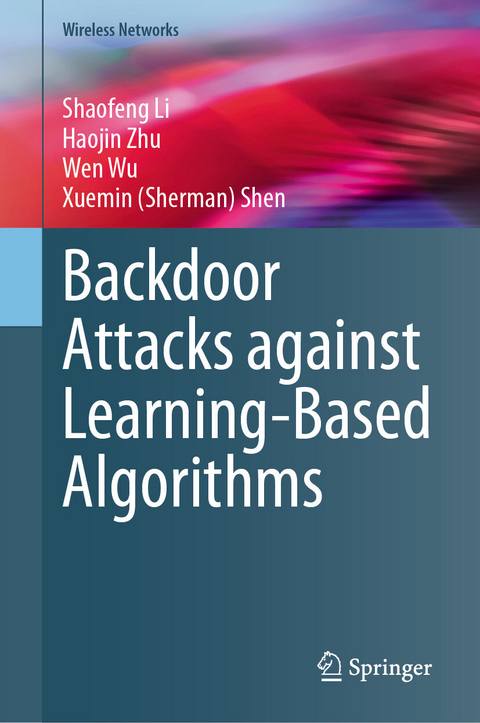
Backdoor Attacks against Learning-Based Algorithms (eBook)

eBook Download: PDF
2024
153 Seiten
Springer Nature Switzerland (Verlag)
9783031573897 (ISBN)
Lese- und Medienproben

Backdoor Attacks against Learning-Based Algorithms - Shaofeng Li, Haojin Zhu, Wen Wu, Xuemin (Sherman) Shen
Systemvoraussetzungen
160,49 inkl. MwSt
(CHF 156,80)
Der eBook-Verkauf erfolgt durch die Lehmanns Media GmbH (Berlin) zum Preis in Euro inkl. MwSt.
  • Download sofort lieferbar
  • Zahlungsarten anzeigen
This book introduces a new type of data poisoning attack, dubbed, backdoor attack. In backdoor attacks, an attacker can train the model with poisoned data to obtain a model that performs well on a normal input but behaves wrongly with crafted triggers. Backdoor attacks can occur in many scenarios where the training process is not entirely controlled, such as using third-party datasets, third-party platforms for training, or directly calling models provided by third parties. Due to the enormous threat that backdoor attacks pose to model supply chain security, they have received widespread attention from academia and industry. This book focuses on exploiting backdoor attacks in the three types of DNN applications, which are image classification, natural language processing, and federated learning.

Based on the observation that DNN models are vulnerable to small perturbations, this book demonstrates that steganography and regularization can be adopted to enhance the invisibility of backdoor triggers. Based on image similarity measurement, this book presents two metrics to quantitatively measure the invisibility of backdoor triggers. The invisible trigger design scheme introduced in this book achieves a balance between the invisibility and the effectiveness of backdoor attacks. In the natural language processing domain, it is difficult to design and insert a general backdoor in a manner imperceptible to humans. Any corruption to the textual data (e.g., misspelled words or randomly inserted trigger words/sentences) must retain context-awareness and readability to human inspectors. This book introduces two novel hidden backdoor attacks, targeting three major natural language processing tasks, including toxic comment detection, neural machine translation, and question answering, depending on whether the targeted NLP platform accepts raw Unicode characters.

The emerged distributed training framework, i.e., federated learning, has advantages in preserving users' privacy. It has been widely used in electronic medical applications, however, it also faced threats derived from backdoor attacks. This book presents a novel backdoor detection framework in FL-based e-Health systems. We hope this book can provide insightful lights on understanding the backdoor attacks in different types of learning-based algorithms, including computer vision, natural language processing, and federated learning. The systematic principle in this book also offers valuable guidance on the defense of backdoor attacks against future learning-based algorithms.


Erscheint lt. Verlag 29.5.2024
Reihe/Serie Wireless Networks
Zusatzinfo XI, 153 p. 58 illus., 56 illus. in color.
Sprache englisch
Themenwelt Mathematik / Informatik Informatik Netzwerke
Informatik Theorie / Studium Künstliche Intelligenz / Robotik
Mathematik / Informatik Mathematik Statistik
Schlagworte adversarial attacks • Backdoor attacks • Coalitional game • deep neural networks • E-Health • federated learning • Homograph attacks • image classification • Image Similarity • image steganography • Language models • Natural Language Processing • Shapley Value • text generation
ISBN-13 9783031573897 / 9783031573897
Informationen gemäß Produktsicherheitsverordnung (GPSR)
Haben Sie eine Frage zum Produkt?
PDFPDF (Wasserzeichen)

DRM: Digitales Wasserzeichen
Dieses eBook enthält ein digitales Wasser­zeichen und ist damit für Sie persona­lisiert. Bei einer missbräuch­lichen Weiter­gabe des eBooks an Dritte ist eine Rück­ver­folgung an die Quelle möglich.

Dateiformat: PDF (Portable Document Format)
Mit einem festen Seiten­layout eignet sich die PDF besonders für Fach­bücher mit Spalten, Tabellen und Abbild­ungen. Eine PDF kann auf fast allen Geräten ange­zeigt werden, ist aber für kleine Displays (Smart­phone, eReader) nur einge­schränkt geeignet.

Systemvoraussetzungen:
PC/Mac: Mit einem PC oder Mac können Sie dieses eBook lesen. Sie benötigen dafür einen PDF-Viewer - z.B. den Adobe Reader oder Adobe Digital Editions.
eReader: Dieses eBook kann mit (fast) allen eBook-Readern gelesen werden. Mit dem amazon-Kindle ist es aber nicht kompatibel.
Smartphone/Tablet: Egal ob Apple oder Android, dieses eBook können Sie lesen. Sie benötigen dafür einen PDF-Viewer - z.B. die kostenlose Adobe Digital Editions-App.

Buying eBooks from abroad
For tax law reasons we can sell eBooks just within Germany and Switzerland. Regrettably we cannot fulfill eBook-orders from other countries.

Mehr entdecken
aus dem Bereich
Die Grundlage der Digitalisierung

von Knut Hildebrand; Michael Mielke; Marcus Gebauer

eBook Download (2025)
Springer Fachmedien Wiesbaden (Verlag)
CHF 29,30
Die materielle Wahrheit hinter den neuen Datenimperien

von Kate Crawford

eBook Download (2024)
C.H.Beck (Verlag)
CHF 17,55