


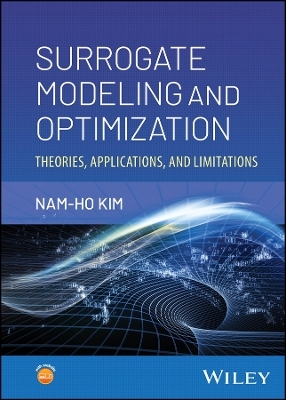
Surrogate Modeling and Optimization
Theories, Applications, and Limitations
Seiten
2026
John Wiley & Sons Inc (Verlag)
978-1-394-24581-9 (ISBN)
John Wiley & Sons Inc (Verlag)
978-1-394-24581-9 (ISBN)
- Noch nicht erschienen (ca. März 2026)
- Versandkostenfrei
- Auch auf Rechnung
- Artikel merken
An expert reference on building surrogate models, using them for optimization, their associated prediction uncertainty, and potential failures, with practical implementation in MATLAB
Surrogate Modeling and Optimization explains the meaning of different surrogate models and provides an in-depth understanding of such surrogates, emphasizing how much uncertainty is associated with them, and when and how a surrogate model can fail in approximating complex functions, helping readers understand theory through practical implementation in MATLAB. This book enables readers to obtain an accurate approximate function using as few samples as possible, thereby allowing them to replace expensive computer simulations and experiments during design optimization, sensitivity analysis, and/or uncertainty quantification.
The book is organized into three parts. Part I introduces the basics of surrogate modeling. Part II reviews various theories and algorithms of design optimization. Part III presents advanced topics in surrogate modeling, including the Kriging surrogate, neural network models, multi-fidelity surrogates, and efficient global optimization using Kriging surrogates.
Each chapter contains a multitude of examples and exercise problems. Lecture slides and a solution manual for exercise problems are available for instructors on a companion website.
Topics discussed in Surrogate Modeling and Optimization include:
Various designs of experiments, such as those developed for linear and quadratic polynomial response surfaces (PRS) in a boxlike design space
Criteria for constrained and unconstrained optimization and the most important optimization theories
Various numerical algorithms for gradient-based optimization
Gradient-free optimization algorithms, often referred to as global search algorithms, which do not require gradient or Hessian information
Detailed explanations and implementation on Kriging surrogates, often referred to as Gaussian Process, especially when samples include noise
The combination of a small number of high-fidelity samples with many low-fidelity samples to improve prediction accuracy
Neural network models, focusing on training uncertainty and its effect on prediction uncertainty
Efficient global optimization using either polynomial response surfaces or Kriging surrogates
Surrogate Modeling and Optimization is an essential learning companion for senior-level undergraduate and graduate students in all engineering disciplines, including mechanical, aerospace, civil, biomedical, and electrical engineering. The book is also valuable for industrial practitioners who apply surrogate models to solve their optimization problems.
Surrogate Modeling and Optimization explains the meaning of different surrogate models and provides an in-depth understanding of such surrogates, emphasizing how much uncertainty is associated with them, and when and how a surrogate model can fail in approximating complex functions, helping readers understand theory through practical implementation in MATLAB. This book enables readers to obtain an accurate approximate function using as few samples as possible, thereby allowing them to replace expensive computer simulations and experiments during design optimization, sensitivity analysis, and/or uncertainty quantification.
The book is organized into three parts. Part I introduces the basics of surrogate modeling. Part II reviews various theories and algorithms of design optimization. Part III presents advanced topics in surrogate modeling, including the Kriging surrogate, neural network models, multi-fidelity surrogates, and efficient global optimization using Kriging surrogates.
Each chapter contains a multitude of examples and exercise problems. Lecture slides and a solution manual for exercise problems are available for instructors on a companion website.
Topics discussed in Surrogate Modeling and Optimization include:
Various designs of experiments, such as those developed for linear and quadratic polynomial response surfaces (PRS) in a boxlike design space
Criteria for constrained and unconstrained optimization and the most important optimization theories
Various numerical algorithms for gradient-based optimization
Gradient-free optimization algorithms, often referred to as global search algorithms, which do not require gradient or Hessian information
Detailed explanations and implementation on Kriging surrogates, often referred to as Gaussian Process, especially when samples include noise
The combination of a small number of high-fidelity samples with many low-fidelity samples to improve prediction accuracy
Neural network models, focusing on training uncertainty and its effect on prediction uncertainty
Efficient global optimization using either polynomial response surfaces or Kriging surrogates
Surrogate Modeling and Optimization is an essential learning companion for senior-level undergraduate and graduate students in all engineering disciplines, including mechanical, aerospace, civil, biomedical, and electrical engineering. The book is also valuable for industrial practitioners who apply surrogate models to solve their optimization problems.
Nam-Ho Kim is a Professor in the Department of Mechanical and Aerospace Engineering at the University of Florida. His research interests include design under uncertainty, prognostics and health management, verification validation and uncertainty quantification, and nonlinear structural mechanics. He has more than twenty years of experience teaching materials in these fields to graduate students.
| Erscheint lt. Verlag | 8.3.2026 |
|---|---|
| Verlagsort | New York |
| Sprache | englisch |
| Themenwelt | Informatik ► Theorie / Studium ► Künstliche Intelligenz / Robotik |
| Technik ► Bauwesen | |
| Technik ► Maschinenbau | |
| ISBN-10 | 1-394-24581-5 / 1394245815 |
| ISBN-13 | 978-1-394-24581-9 / 9781394245819 |
| Zustand | Neuware |
| Informationen gemäß Produktsicherheitsverordnung (GPSR) | |
| Haben Sie eine Frage zum Produkt? |
Mehr entdecken
aus dem Bereich



aus dem Bereich
Eine praxisorientierte Einführung
Buch | Softcover (2025)
Springer Vieweg (Verlag)
CHF 53,15
Künstliche Intelligenz, Macht und das größte Dilemma des 21. …
Buch | Softcover (2025)
C.H.Beck (Verlag)
CHF 25,20
Buch | Softcover (2025)
Reclam, Philipp (Verlag)
CHF 11,20


