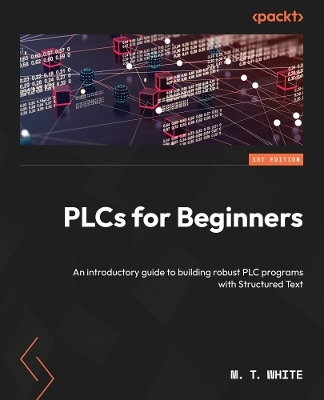
PLCs for Beginners
Packt Publishing Limited (Verlag)
978-1-80323-093-1 (ISBN)
Key Features
Build a solid foundation of Structured Text by understanding its syntax, features, and applications
Learn how to apply programming logic and design by taking a design-first approach to PLC programming
Integrate advanced concepts and technologies such as cybersecurity and generative AI with PLCs
Purchase of the print or Kindle book includes a free PDF eBook
Book DescriptionWith the rise of smart factories and advanced technology, the demand for PLC programmers with expertise beyond ladder logic is surging. Written by M.T. White, a seasoned DevOps engineer and adjunct CIS instructor, this guide offers insights from the author’s extensive experience in PLC and HMI programming across industries. This book introduces a fresh approach to PLC programming, preparing you for future automation challenges through computer science and text-based programming.
Starting with the basic components of PLCs and their integration with other modules, this book gives you a clear understanding of system functionality and helps you master PLC program execution by learning about flow and essential components for effective programming. You'll understand program design with pseudocode and flowcharts, vital for planning programs, and cover Boolean logic intricacies, harnessing logical functions and truth tables for precise control statements. The book gives you a comprehensive grasp of Structured Text, its syntax and features crucial for efficient programming. The book also focuses on advanced topics like cybersecurity in PLC systems and leveraging generative AI (GenAI), such as ChatGPT, to enhance productivity.
By the end of this book, you’ll be able to design real-world projects using pseudocode and flowcharts, and implement those designs in Structured Text.What you will learn
Implement PLC programs in Structured text
Experiment with common functions in Structured Text
Control the flow of a PLC program with loop and conditional statements
Design a PLC program with pseudocode and flowcharts
Implement common sorting algorithms such as bubble sort and insertion sort, and understand concepts such as Big O
Understand the basics of cybersecurity to protect PLC-based systems
Leverage ChatGPT for PLC programming
Get to grips with troubleshooting hardware and fixing common problems
Who this book is forThis book is for automation engineering students and individuals who are aspiring to be software, electrical, mechanical, or automation engineers with an interest in reshaping the automation industry.
M. T. White has been programming since the age of 12. His fascination with robotics flourished when he was a child programming microcontrollers. He holds an undergraduate degree in mathematics, a master's degree in software engineering, and an MBA in IT management. He is currently working as a software developer for a major US defense contractor and is an adjunct CIS instructor, where he teaches Python, C, and an array of other courses. His background mostly stems from the automation industry where he programmed PLCs and HMIs for many different types of applications. He has programmed many different brands of PLCs over the years and has developed HMIs using many different tools. Other technologies that he is fluent in include Linux, Ansible, Docker, AWS, C#, Java, and Python. Be sure to check out his channel AlchemicalComputing on YouTube.
Table of Contents
Computer Science Versus Automation Programming
PLC Components – Integrating PLCs with Other Modules
The Basics of Programming
Unleashing Computer Memory
Designing Programs – Unleashing Pseudocode and Flowcharts
Boolean Algebra
Unlocking the Power of ST
Exploring Variables and Tags
Performing Calculations in Structured Text
Unleashing Built-In Function Blocks
Unlocking the Power of Flow Control
Unlocking Advanced Control Statements
Implementing Tight Loops
Sorting with Loops
Secure PLC Programming – Stopping Cyberthreats
Troubleshooting PLCs – Fixing Issues
Leveraging Artificial Intelligence (AI)
The Final Project – Programming a Simulated Robot
| Erscheinungsdatum | 11.05.2024 |
|---|---|
| Verlagsort | Birmingham |
| Sprache | englisch |
| Maße | 191 x 235 mm |
| Themenwelt | Informatik ► Theorie / Studium ► Künstliche Intelligenz / Robotik |
| Technik ► Elektrotechnik / Energietechnik | |
| ISBN-10 | 1-80323-093-2 / 1803230932 |
| ISBN-13 | 978-1-80323-093-1 / 9781803230931 |
| Zustand | Neuware |
| Informationen gemäß Produktsicherheitsverordnung (GPSR) | |
| Haben Sie eine Frage zum Produkt? |
aus dem Bereich