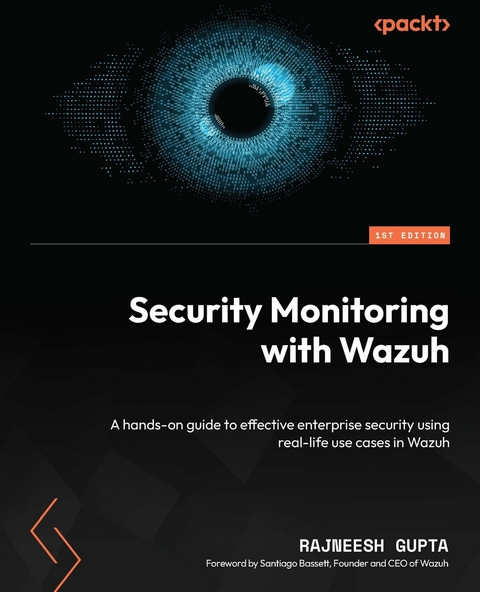
Security Monitoring with Wazuh (eBook)
322 Seiten
Packt Publishing Limited (Verlag)
978-1-83763-343-2 (ISBN)
Strengthen your cybersecurity posture with Wazuh's powerful security monitoring and compliance capabilities.
Security Monitoring with Wazuh is a comprehensive, hands-on guide that helps you deploy, configure, and optimize Wazuh to detect threats, automate incident response, and enforce compliance. With real-world use cases, step-by-step configurations, and tool integrations, this book equips you to build an enterprise-grade defense system.
You'll begin by setting up an Intrusion Detection System (IDS) using Wazuh and integrating Suricata to monitor network and host-based threats. Moving forward, you'll explore malware detection, vulnerability assessment, and security automation with SOAR. The book also covers threat intelligence, incident response, and proactive threat hunting, helping you detect and mitigate cybersecurity risks effectively.
Beyond detection, you'll enforce compliance with industry standards such as MITRE ATT&CK, PCI DSS, and GDPR, ensuring regulatory adherence and security best practices. By integrating Wazuh with TheHive, Cortex, MISP, and other security tools, you'll streamline threat analysis and response.
By the end of this book, you'll master Wazuh's full potential, enabling you to deploy, manage, and enhance security monitoring across your infrastructure-from on-premises to cloud environments.
No detailed description available for "e;Security Monitoring with Wazuh"e;.
Preface
Hi there! Welcome to Security Monitoring Using Wazuh. In this book, we will explore the realm of security operations and management using Wazuh – an open source security platform that unifies Security Incident and Event Management (SIEM) and Extended Detection and Response (XDR) capabilities – to enhance threat detection, incident response, threat hunting, and compliance management within your organizations.
Wazuh combines powerful features such as intrusion detection, log analysis, file integrity monitoring, vulnerability detection, and security configuration assessment into a unified solution.
I will provide relevant information and guide you through the deployment of the Wazuh system, its integration with several third-party security tools, and practical use cases. My expertise in open source derives from two primary sources:
- A decade of experience in consulting and constructing open-source security solutions within enterprise networks
- Insights gleaned from podcasts, interviews, and discussions with industry experts
The demand for open-source security tools such as Wazuh is fueled by their affordability, community support, and flexibility, helping organizations to enhance threat detection, incident response, security monitoring, threat intelligence, and compliance management. Learning and gaining hands-on experience with tools such as Wazuh can significantly help aspirant security analysts or professionals in enhancing their skills in intrusion detection, log analysis, incident response, vulnerability management, and custom scripts, directly from a single platform. Engaging with open source communities helps you develop network opportunities and continuous learning, positioning you to become a valuable individual in the cybersecurity industry.
Who this book is for
Security analysts, SOC analysts, and security architects can gain practical insights into how to set up a Wazuh platform and leverage it to improve an organization’s security posture.
The three main target audiences for this book are as follows:
- Security engineers: For security engineers, this book offers comprehensive guidance on deploying and configuring Wazuh for intrusion detection, malware detection, security monitoring, and so on.
- Security architects: They will gain information on designing security infrastructure with Wazuh as a core component, enabling them to build a scalable and compliant security solution that effectively mitigates risk and delivers real-time alerts.
- SOC analyst: They will benefit from practical insights and real-world use cases on the Wazuh platform. They will learn to analyze security alerts, create custom Wazuh rules and decoders, and respond promptly to threats.
What this book covers
Chapter 1, Intrusion Detection System (IDS) Using Wazuh, provides fundamentals on IDSs and Suricata and its capabilities and features, installing Wazuh and setting up Suricata, utilizing Suricata in threat detection, handling network scanning probes, identifying Metasploit exploits, simulating web-based attacks with DVWA, and measuring NIDS effectiveness with tmNIDS.
Chapter 2, Malware Detection Using Wazuh, introduces you to malware, using FIM for detection, integrating VirusTotal for enhanced analysis, and integrating Windows Defender and Sysmon.
Chapter 3, Threat Intelligence and Analysis, discusses enhancing Wazuh capabilities by integrating threat intelligence and analysis tools such as MISP, TheHive, and Cortex. This chapter includes real-world examples of threat intelligence in a variety of contexts, as well as instructions on configuring and utilizing TheHive, Cortex, and MISP for cooperative threat analysis and response.
Chapter 4, Security Automation and Orchestration Using Shuffle, covers the integration of Security orchestration, Automation, and Response (SOAR) with the Wazuh platform that can be utilized to streamline and enhance incident response processes. The chapter focuses on the implementation of automated workflows, playbooks, and response actions using Wazuh and Shuffle.
Chapter 5, Incident Response with Wazuh, focuses on Wazuh’s Active response capability to remediate threats in real time, covering several practical use cases such as blocking brute-force attempts and automatically isolating Windows machines.
Chapter 6, Threat Hunting with Wazuh, delves into the methodology of proactive threat hunting using Wazuh, focusing on log analysis, attack mapping, Osquery utilization, and command monitoring.
Chapter 7, Vulnerability and Configuration Assessment, explores vulnerability and policy assessment using Wazuh. It will cover the important parts of finding vulnerabilities, monitoring configurations, and following standard compliance frameworks in a business. This chapter also covers the basics of vulnerability assessment and compliance standards such as PCI DSS, NIST 800-53, and HIPAA. It also provides ideas on how to use Wazuh’s features to make sure your organization follows all of its security rules and policies.
Chapter 8, Appendix delves into a list of custom Wazuh rules to enhance security monitoring. It explores the creation of custom PowerShell rules to detect suspicious activities within Windows environments. Additionally, the chapter discusses the implementation of custom Auditd rules for auditing Linux systems, bolstering defense against potential threats. Moreover, it provides insights into crafting custom Kaspersky endpoint security rules, enabling comprehensive threat detection and response. Finally, it covers custom Sysmon rules mapped to certain MITRE ATT&CK® techniques.
Chapter 9, Glossary, provides a comprehensive glossary covering key terms and concepts essential for understanding security monitoring and Wazuh functionality. From active response, which automates response actions, to Amazon EC2 instances and beyond, each entry offers concise explanations. Terms such as compliance, IDS, and vulnerability detection module are elucidated, aiding you in grasping crucial security concepts. Additionally, tools such as PowerShell, Docker, and YARA are defined, highlighting their significance in modern cybersecurity practices. This glossary serves as a valuable reference for both novice and experienced security professionals who are navigating the complex landscape of security monitoring and threat detection.
To get the most out of this book
You need to have a basic understanding of cybersecurity concepts such as malware, network scanning, web application attacks, and security compliance.
| Software/hardware covered in the book | Operating system requirements |
| Wazuh OVA | Windows and Ubuntu Linux |
| Suricata IDS and Osquery |
| VirusTotal |
Download the example code files
You can download the code mentioned in the book from the GitHub repository here: https://github.com/PacktPublishing/Security-Monitoring-using-Wazuh
We also have other code bundles from our rich catalog of books and videos available at https://github.com/PacktPublishing/. Check them out!
Disclaimer on images
This book contains many horizontally long screenshots. These screenshots provide readers with an overview of Wazuh's execution plans for various operations. As a result, the text in these images may appear small at 100% zoom. Additionally, you will be able to examine these plans more thoroughly in the output of Wazuh as you work through the examples.
Conventions used
There are a number of text conventions used throughout this book.
Code in text: Indicates code words in text, database table names, folder names, filenames, file extensions, pathnames, dummy URLs, user input, and Twitter handles. Here is an example: “Copy the curl command to download the Wazuh module and start the Wazuh agent service as mentioned in the following diagram.”
A block of code is set as follows:
<rule id="200101" level="1"> <if_sid>60009</if_sid> <field name="win.system.providerName">^PowerShell$</field> <mitre>When we wish...
| Erscheint lt. Verlag | 26.4.2024 |
|---|---|
| Vorwort | Santiago Bassett |
| Sprache | englisch |
| Themenwelt | Informatik ► Netzwerke ► Sicherheit / Firewall |
| ISBN-10 | 1-83763-343-6 / 1837633436 |
| ISBN-13 | 978-1-83763-343-2 / 9781837633432 |
| Informationen gemäß Produktsicherheitsverordnung (GPSR) | |
| Haben Sie eine Frage zum Produkt? |
 EPUB (Ohne DRM)
Digital Rights Management: ohne DRM
Dieses eBook enthält kein DRM oder Kopierschutz. Eine Weitergabe an Dritte ist jedoch rechtlich nicht zulässig, weil Sie beim Kauf nur die Rechte an der persönlichen Nutzung erwerben.
Dateiformat: EPUB (Electronic Publication)
EPUB ist ein offener Standard für eBooks und eignet sich besonders zur Darstellung von Belletristik und Sachbüchern. Der Fließtext wird dynamisch an die Display- und Schriftgröße angepasst. Auch für mobile Lesegeräte ist EPUB daher gut geeignet.
Systemvoraussetzungen:
PC/Mac: Mit einem PC oder Mac können Sie dieses eBook lesen. Sie benötigen dafür die kostenlose Software Adobe Digital Editions.
eReader: Dieses eBook kann mit (fast) allen eBook-Readern gelesen werden. Mit dem amazon-Kindle ist es aber nicht kompatibel.
Smartphone/Tablet: Egal ob Apple oder Android, dieses eBook können Sie lesen. Sie benötigen dafür eine kostenlose App.
Geräteliste und zusätzliche Hinweise
Buying eBooks from abroad
For tax law reasons we can sell eBooks just within Germany and Switzerland. Regrettably we cannot fulfill eBook-orders from other countries.
aus dem Bereich