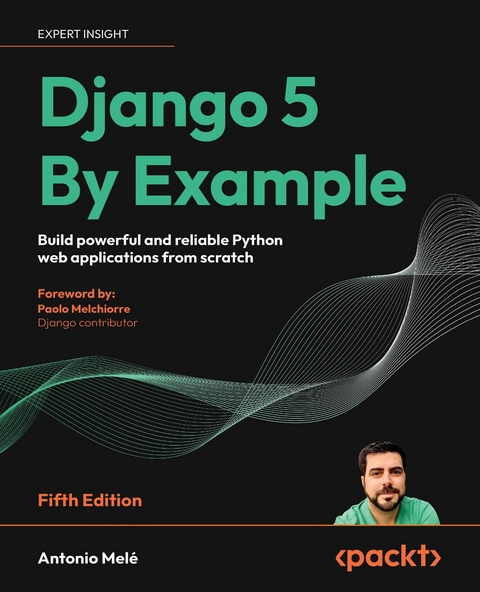
Django 5 By Example (eBook)
820 Seiten
Packt Publishing Limited (Verlag)
978-1-80512-234-0 (ISBN)
If you want to learn Django by doing, this book is for you.
Django 5 By Example is the fifth edition of the best-selling franchise that helps you build real-world web apps. This book will walk you through planning and creation, solving common problems, and implementing best practices using a step-by-step approach.
You'll cover a wide range of web application development topics through four different projects: a blog application, a social website, an e-commerce application, and an e-learning platform. Pick up what's new in Django 5 as you build end-to-end Python web apps, follow detailed project plans, and understand the hows and whys of Django.
This is a practical and approachable book that will have you creating web apps quickly.
2025 EDITION: Build four fully functional real-world Django applications with authentication, content management systems, payment processing, REST APIs, and more!Purchase of the print or Kindle book includes a free eBook in PDF format.Key FeaturesUpdated with the latest Django 5.2 features, detailed app planning, improved tooling, and GPT prompts for extending projectsLearn Django essentials, including models, ORM, views, templates, URLs, forms, authentication, signals, and middlewareIntegrate JavaScript, PostgreSQL, Redis, Celery, Docker, and Memcached into your applicationsBook DescriptionIf you want to learn Django by doing, this book is for you. This 2025 EDITION, fully updated to Django 5.2 LTS, is the fifth edition of the best-selling Django By Example franchise that helps you build real-world web apps. This book will walk you through planning and creation, solving common problems, and implementing best practices using a step-by-step approach. You ll cover a wide range of web application development topics through four different projects: a blog application, a social website, an e-commerce application, and an e-learning platform. Pick up what s new in Django 5 as you build end-to-end Python web apps, follow detailed project plans, and understand the hows and whys of Django. This is a practical and approachable book that will have you creating web apps quickly.What you will learnUse various Django modules to solve specific problems using the latest featuresIntegrate third-party Django applications into your projectBuild complex web applications using Redis, Postgres, Celery/RabbitMQ and MemcachedSet up a production environment for your project with Docker ComposeBuild a RESTful API with Django Rest Framework (DRF)Implement advanced functionalities, such as full-text search engines, user activity streams, payment gateways, and recommender enginesBuild real-time asynchronous (ASGI) apps with Django Channels and WebSocketsWho this book is forThis book is for readers with basic Python programming knowledge and programmers transitioning from other web frameworks who wish to learn Django by doing. If you already use Django, or have in the past, and want to learn best practices and integrate other technologies to scale your applications, then this book is for you too. This book will help you master the most relevant areas of the framework by building practical projects from scratch. Some previous knowledge of HTML and JavaScript is assumed.]]>
Preface
Django is an open-source Python web framework that encourages rapid development and clean, pragmatic design. It takes care of much of the hassle of web development and presents a relatively shallow learning curve for beginner programmers. Django follows Python’s “batteries included” philosophy, shipping with a rich and versatile set of modules that solve common web-development problems. The simplicity of Django, together with its powerful features, makes it attractive to both novice and expert programmers. Django has been designed for simplicity, flexibility, reliability, and scalability.
Nowadays, Django is used by countless start-ups and large organizations such as Instagram, Spotify, Pinterest, Udemy, Robinhood, and Coursera. It is not by coincidence that, over the last few years, Django has consistently been chosen by developers worldwide as one of the most loved web frameworks in Stack Overflow’s annual developer survey.
This book will guide you through the entire process of developing professional web applications with Django. The book focuses on explaining how the Django web framework works by building multiple projects from the ground up. This book not only covers the most relevant aspects of the framework but also explains how to apply Django to very diverse real-world situations.
This book not only teaches Django but also presents other popular technologies, such as PostgreSQL, Redis, Celery, RabbitMQ, and Memcached. You will learn how to integrate these technologies into your Django projects throughout the book to create advanced functionalities and build complex web applications.
Django 5 By Example will walk you through the creation of real-world applications, solving commonproblems, and implementing best practices, using a step-by-step approach that is easy to follow.
After reading this book, you will have a good understanding of how Django works and how to build full-fledged Python web applications.
This book now includes details of changes introduced in Django 5.1 and 5.2, with examples showing how you can utilize these changes in the applications built within the book. Further details are included in the Appendix, alongside links to the Django release notes, which you can access here: https://packt.link/1g7Af.
Who this book is for
This book should serve as a primer for programmers newly initiated to Django. The book is intended for developers with Python knowledge who wish to learn Django in a pragmatic manner. Perhaps you are completely new to Django, or you already know a little but you want to get the most out of it. This book will help you to master the most relevant areas of the framework by building practical projects from scratch. You need to have familiarity with programming concepts in order to read this book. In addition to basic Python knowledge, some previous knowledge of HTML and JavaScript is assumed.
What this book covers
This book encompasses a range of topics of web application development with Django. The book will guide you through building four different fully-featured web applications, that are built over the course of 17 chapters.
- A blog application (chapters 1 to 3)
- An image bookmarking website (chapters 4 to 7)
- An online shop (chapters 8 to 11)
- An e-learning platform (chapters 12 to 17)
Each chapter covers several Django features.
Chapter 1, Building a Blog Application, will introduce you to the framework through a blog application. You will create the basic blog models, views, templates, and URLs to display blog posts. You will learn how to build QuerySets with the Django object-relational mapper (ORM), and you will configure the Django administration site.
Chapter 2, Enhancing Your Blog with Advanced Features, will teach you how to add pagination to your blog, and how to implement Django class-based views. You will learn to send emails with Django, and handle forms and model forms. You will also implement a comment system for blog posts.
Chapter 3, Extending Your Blog Application, explores how to integrate third-party applications. This chapter will guide you through the process of creating a tagging system, and you will learn how to build complex QuerySets to recommed similar posts. The chapter will teach you how to create custom template tags and filters. You will also learn how to use the sitemap framework and create an RSS feed for your posts. You will complete your blog application by building a search engine using PostgreSQL’s full-text search capabilities.
Chapter 4, Building a Social Website, explains how to build a social website. You will learn how to implement user authentication views and learn to use the Django authentication framework. You will implement user registration and extend the user model with a custom profile model.
Chapter 5, Implementing Social Authentication, covers implementing social authentication and using the messages framework. You will create a custom authentication backend and you will integrate social authentication with Google, using OAuth 2. You will learn how to use django-extensions to run the development server through HTTPS and customize the social authentication pipeline to automate the user profile creation.
Chapter 6, Sharing Content on Your Website, will teach you how to transform your social application into an image bookmarking website. You will define many-to-many relationships for models, and you will create a JavaScript bookmarklet that integrates into your project. The chapter will show you how to generate image thumbnails. You will also learn how to implement asynchronous HTTP requests using JavaScript and Django and you will implement infinite scroll pagination.
Chapter 7, Tracking User Actions, will show you how to build a follower system for users. You will complete your image bookmarking website by creating a user activity stream application. You will learn how to create generic relations between models and optimize QuerySets.
You will work with signals and implement denormalization. You will use Django Debug Toolbar to obtain relevant debug information. Finally, you will integrate Redis into your project to count image views and you will create a ranking of the most viewed images with Redis.
Chapter 8, Building an Online Shop, explores how to create an online shop. You will build models for a product catalog, and you will create a shopping cart using Django sessions. You will build a context processor for the shopping cart and will learn how to manage customer orders. The chapter will teach you how to send asynchronous notifications using Celery and RabbitMQ. You will also learn to monitor Celery using Flower.
Chapter 9, Managing Payments and Orders, explains how to integrate a payment gateway into your shop. You will integrate Stripe Checkout and receive asynchronous payment notifications in your application. You will implement custom views in the administration site and you will also customize the administration site to export orders to CSV files. You will also learn how to generate PDF invoices dynamically.
Chapter 10, Extending Your Shop, will teach you how to create a coupon system to apply discounts to the shopping cart. You will update the Stripe Checkout integration to implement coupon discounts and you will apply coupons to orders. You will use Redis to store products that are usually bought together, and use this information to build a product recommendation engine.
Chapter 11, Adding Internationalization to Your Shop, will show you how to add internationalization to your project. You will learn how to generate and manage translation files and translate strings in Python code and Django templates. You will use Rosetta to manage translations and implement per-language URLs. You will learn how to translate model fields using django-parler and how to use translations with the ORM. Finally, you will create a localized form field using django-localflavor.
Chapter 12, Building an E-Learning Platform, will guide you through creating an e-learning platform. You will add fixtures to your project, and create initial models for the content management system. You will use model inheritance to create data models for polymorphic content. You will learn how to create custom model fields by building a field to order objects. You will also implement authentication views for the CMS.
Chapter 13, Creating a Content Management System, will teach you how to create a CMS using class-based views and mixins. You will use the Django groups and permissions system to restrict access to views and implement formsets to edit the content of courses. You will also create a drag-and-drop functionality to reorder course modules and their content using JavaScript and Django.
Chapter 14, Rendering and Caching Content, will show you how to implement the public views for the course catalog. You will create a student registration system and manage student enrollment on courses. You will create the functionality to render different types of content for the course modules. You will learn how to cache content using the Django cache framework and configure the Memcached and Redis cache backends for your project. Finally, you will learn how to monitor Redis using the administration site.
Chapter 15, Building an API, explores...
| Erscheint lt. Verlag | 30.4.2024 |
|---|---|
| Vorwort | Paolo Melchiorre |
| Sprache | englisch |
| Themenwelt | Mathematik / Informatik ► Informatik ► Programmiersprachen / -werkzeuge |
| Mathematik / Informatik ► Informatik ► Web / Internet | |
| ISBN-10 | 1-80512-234-7 / 1805122347 |
| ISBN-13 | 978-1-80512-234-0 / 9781805122340 |
| Informationen gemäß Produktsicherheitsverordnung (GPSR) | |
| Haben Sie eine Frage zum Produkt? |
 PDF (Wasserzeichen)
Größe: 28,2 MB
DRM: Digitales Wasserzeichen
Dieses eBook enthält ein digitales Wasserzeichen und ist damit für Sie personalisiert. Bei einer missbräuchlichen Weitergabe des eBooks an Dritte ist eine Rückverfolgung an die Quelle möglich.
Dateiformat: PDF (Portable Document Format)
Mit einem festen Seitenlayout eignet sich die PDF besonders für Fachbücher mit Spalten, Tabellen und Abbildungen. Eine PDF kann auf fast allen Geräten angezeigt werden, ist aber für kleine Displays (Smartphone, eReader) nur eingeschränkt geeignet.
Systemvoraussetzungen:
PC/Mac: Mit einem PC oder Mac können Sie dieses eBook lesen. Sie benötigen dafür einen PDF-Viewer - z.B. den Adobe Reader oder Adobe Digital Editions.
eReader: Dieses eBook kann mit (fast) allen eBook-Readern gelesen werden. Mit dem amazon-Kindle ist es aber nicht kompatibel.
Smartphone/Tablet: Egal ob Apple oder Android, dieses eBook können Sie lesen. Sie benötigen dafür einen PDF-Viewer - z.B. die kostenlose Adobe Digital Editions-App.
Buying eBooks from abroad
For tax law reasons we can sell eBooks just within Germany and Switzerland. Regrettably we cannot fulfill eBook-orders from other countries.
 EPUB (Ohne DRM)
Digital Rights Management: ohne DRM
Dieses eBook enthält kein DRM oder Kopierschutz. Eine Weitergabe an Dritte ist jedoch rechtlich nicht zulässig, weil Sie beim Kauf nur die Rechte an der persönlichen Nutzung erwerben.
Dateiformat: EPUB (Electronic Publication)
EPUB ist ein offener Standard für eBooks und eignet sich besonders zur Darstellung von Belletristik und Sachbüchern. Der Fließtext wird dynamisch an die Display- und Schriftgröße angepasst. Auch für mobile Lesegeräte ist EPUB daher gut geeignet.
Systemvoraussetzungen:
PC/Mac: Mit einem PC oder Mac können Sie dieses eBook lesen. Sie benötigen dafür die kostenlose Software Adobe Digital Editions.
eReader: Dieses eBook kann mit (fast) allen eBook-Readern gelesen werden. Mit dem amazon-Kindle ist es aber nicht kompatibel.
Smartphone/Tablet: Egal ob Apple oder Android, dieses eBook können Sie lesen. Sie benötigen dafür eine kostenlose App.
Geräteliste und zusätzliche Hinweise
Buying eBooks from abroad
For tax law reasons we can sell eBooks just within Germany and Switzerland. Regrettably we cannot fulfill eBook-orders from other countries.
aus dem Bereich