Zum Hauptinhalt springen
Nicht aus der Schweiz? Besuchen Sie lehmanns.de

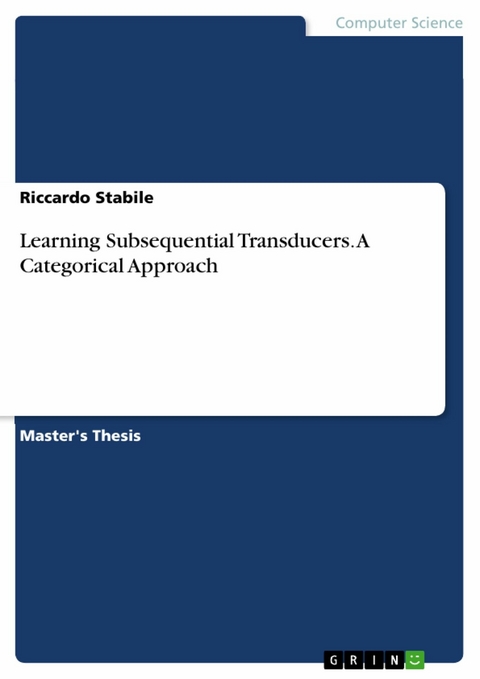
Learning Subsequential Transducers. A Categorical Approach (eBook)

eBook Download: PDF
2024 | 1. Auflage
88 Seiten
GRIN Verlag
978-3-389-01564-3 (ISBN)
Lese- und Medienproben

Learning Subsequential Transducers. A Categorical Approach -  Riccardo Stabile
Systemvoraussetzungen
36,99 inkl. MwSt
(CHF 36,10)
Der eBook-Verkauf erfolgt durch die Lehmanns Media GmbH (Berlin) zum Preis in Euro inkl. MwSt.
  • Download sofort lieferbar
  • Zahlungsarten anzeigen
Master's Thesis from the year 2024 in the subject Computer Sciences - Artificial Intelligence, Università degli Studi di Milano (Dipartimento di Matematica), course: Corso di Laurea Magistrale in Matematica, language: English, abstract: In this thesis, an algorithm for learning subsequential transducers is presented from two different perspectives: as an extension of Angluin's algorithm for learning deterministic finite automata and as an instantiation of a more generic categorical algorithm valid for a larger class of automata. The adopted categorical approach considers automata as functors from a category representing words to a certain output category. Some sufficient properties for yielding the existence of minimal automata are presented, together with some additional hypotheses relative to termination to ensure the correctness of the generic algorithm. Remarkably, the conditions required in Angluin's original algorithm and in its extended version for subsequential transducers naturally arise as the generic categorical algorithm is instantiated with the proper output categories. It is not uncommon to understand facts, processes and results better by looking at them from above: learning is not an exception. Learning is a crucial area in computer science, especially in artificial intelligence: knowing how to deal with communication, mistakes and experience plays an essential role to progress in learning. But even more important is learning what makes communication possible: a language. A language can be initially thought as a subset of a set of words over an alphabet, always supposed to be finite.The relation between languages and automata has become clearer and clearer in the last decades, since Noam Chomsky gave a mathematical model of a grammar in the second half of the last century. A deterministic finite automaton accepts a language, called regular, and for every regular language there exists a deterministic finite automaton being minimal, i.e. with a minimal number of states, that accepts it. An analogous thing happens for subsequential transducers, which are automata more complex than deterministic finite automata: in this case, some partial functions, called subsequential, from a set of words to another over possibly different alphabets are accepted;asubsequential transducer accepts a particular subsequential function and for every subsequential function there exists a minimal subsequential transducer accepting it. This is the reason why learning regular languages and subsequential functions may be pursued by learning the minimal automata accepting them.
Erscheint lt. Verlag 24.4.2024
Verlagsort München
Sprache englisch
Themenwelt Mathematik / Informatik Informatik Netzwerke
Informatik Theorie / Studium Künstliche Intelligenz / Robotik
Schlagworte Automata • category • functor • learning • subsequential • transducer
ISBN-10 3-389-01564-7 / 3389015647
ISBN-13 978-3-389-01564-3 / 9783389015643
Informationen gemäß Produktsicherheitsverordnung (GPSR)
Haben Sie eine Frage zum Produkt?
PDFPDF (Ohne DRM)

Digital Rights Management: ohne DRM
Dieses eBook enthält kein DRM oder Kopier­schutz. Eine Weiter­gabe an Dritte ist jedoch rechtlich nicht zulässig, weil Sie beim Kauf nur die Rechte an der persön­lichen Nutzung erwerben.

Dateiformat: PDF (Portable Document Format)
Mit einem festen Seiten­layout eignet sich die PDF besonders für Fach­bücher mit Spalten, Tabellen und Abbild­ungen. Eine PDF kann auf fast allen Geräten ange­zeigt werden, ist aber für kleine Displays (Smart­phone, eReader) nur einge­schränkt geeignet.

Systemvoraussetzungen:
PC/Mac: Mit einem PC oder Mac können Sie dieses eBook lesen. Sie benötigen dafür einen PDF-Viewer - z.B. den Adobe Reader oder Adobe Digital Editions.
eReader: Dieses eBook kann mit (fast) allen eBook-Readern gelesen werden. Mit dem amazon-Kindle ist es aber nicht kompatibel.
Smartphone/Tablet: Egal ob Apple oder Android, dieses eBook können Sie lesen. Sie benötigen dafür einen PDF-Viewer - z.B. die kostenlose Adobe Digital Editions-App.

Buying eBooks from abroad
For tax law reasons we can sell eBooks just within Germany and Switzerland. Regrettably we cannot fulfill eBook-orders from other countries.

Mehr entdecken
aus dem Bereich
Die Grundlage der Digitalisierung

von Knut Hildebrand; Michael Mielke; Marcus Gebauer

eBook Download (2025)
Springer Fachmedien Wiesbaden (Verlag)
CHF 29,30
Die materielle Wahrheit hinter den neuen Datenimperien

von Kate Crawford

eBook Download (2024)
C.H.Beck (Verlag)
CHF 17,55