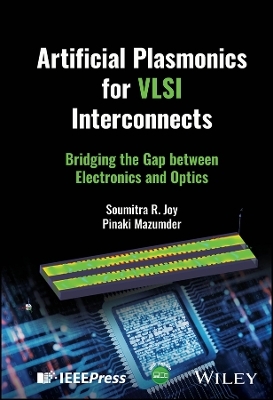
Artificial Plasmonics for VLSI Interconnects
Wiley-IEEE Press (Verlag)
978-1-394-28995-0 (ISBN)
Advancements in high-performance computing have continually demanded for progress in disruptive technological research and innovations. Moore’s Law has pushed the Very Large Scale Integration (VLSI) technology to pack MOS devices inside a chip at an exponential rate, thereby surpassing now eight billion transistors per cm2. This has concomitantly fueled the growth of multilayered on-chip interconnects comprising metallic and low dielectric materials.
Artificial Plasmonics for VLSI Interconnects introduces a new method for improving chip performance by harnessing the power of information transfer among chips at terahertz frequency. This revolutionary new electromagnetic wave engineering, called a spoof surface plasmon polariton, adapts the principles of VLSI and terahertz interconnect technology along with the artificial plasmonics to transfer huge quantities of data at vastly improved speeds. It constitutes a potentially decisive contribution to the pursuit of faster and more capacious VLSI chips.
In Artificial Plasmonics for VLSI Interconnects, readers will also find:
A cutting-edge new approach supported by pioneering research
Detailed discussion of essential components related to the development of THz interconnect technology, including theory, modeling, simulation, and validation
Roadmap to future technological development in the branch of artificial plasmonics
Artificial Plasmonics for VLSI Interconnects is ideal for engineers, researchers, and scientists working in electronics, electromagnetics, and optics.
Soumitra R. Joy is an Assistant Professor in the Department of Electrical and Computer Engineering at the University of North Carolina at Charlotte, USA. Before joining academia, he served as a device reliability engineer at Intel Corporation for four years. He earned his Ph.D. in Electrical Engineering from the University of Michigan, Ann Arbor, MI, USA, and is recognized for his research in artificial plasmonics and semiconductor devices. Pinaki Mazumder, PhD, is a Professor in the Department of Electrical Engineering and Computer Science at the University of Michigan, Ann Arbor, MI, USA. He is a Fellow of both the IEEE and AAAS and internationally recognized for his research in the diverse aspects of VLSI circuits and systems design.
Preface xiii
Acknowledgments xvii
About the Companion Website xix
1 Prospects and Pitfalls of Modern Interconnect Technologies 1
1.1 Overview and Motivation 1
1.1.1 Problem Specifics 2
1.2 Communications Challenges: Human-Level vs Machine-Level 4
1.3 Modes of Interconnects: A Technology Gap 5
1.4 Innovations in Interconnect Frontier 6
1.4.1 Interconnect Research at Material Level 6
1.4.2 Interconnect Research at the Network Level 8
1.4.3 Interconnect Research at Waveguide Level 10
1.4.4 Chip-scale Interconnect Technologies: Major Industrial Steppingstones 14
1.5 Scaling Issue of System Level Interconnect 16
1.5.1 Chip Package Signaling 18
1.5.2 Issue of Crosstalk 20
1.5.3 High Power Consumption in System-level Interconnect 22
1.6 Optical Interconnect: Evolution Toward Chip-scale Communication 23
1.6.1 Integrated Photonic Circuits on Silicon 24
1.6.2 Is Optical Interconnect Viable at Short Range? 27
1.6.3 Wireless Network on Chip 29
1.6.4 Carbon Nanotube Interconnect 32
1.7 Complexity and Dilemma in Data Transfer 33
1.7.1 The Last Centimeter Barrier: The Most Critical Distance in Data Transfer 34
1.7.2 Time Variation in Data Traffic: A Dilemma in Selecting Interconnect Technology 35
1.7.3 Do We Have Any Alternative Interconnect Technology in Hand? 35
1.7.4 Spoof Plasmon Interconnect: A New Paradigm in Communication Technology 36
1.8 Research on Spoof Plasmon Wave: Toward CMOS Compatibility 42
1.8.1 Leading Researchers on Spoof Surface Plasmon Technology 43
1.9 Summary of the Chapter 47
References 47
2 Spoof Plasmonics: Origin and State-of-the-Art Development 57
2.1 Slow Wave Structure: A Historical Perspective 57
2.1.1 Variants on Slow Wave Structures 59
2.2 Surface Plasmon Polariton in Metal 62
2.2.1 Extraordinary Transmission by Surface Plasmonics 64
2.3 Surface Plasmon Polariton: Explanation Through Drude’s Model 66
2.4 SSPP in Planar Geometry 69
2.4.1 1D Groove Pattern 69
2.5 SSPP-based THz Circuits: Research in Mazumder Laboratory 76
2.5.1 Electromagnetic Analysis of the SSPP Mode 78
2.5.2 THz SSPP Switch Design 79
2.5.3 THz SSPP Circuit Component Design 82
2.5.4 THz Biosensor Design 91
2.6 Particle-Motion Control by SSPP Waveguide 93
2.7 Recent Advances in Spoof Plasmonics 94
2.8 Conclusion 97
References 98
3 Fundamental Electrodynamics of Spoof Plasmonic Mode 103
3.1 Baleen Whales: What They Teach Us on Novel Communication 103
3.2 Plasmonics Aided High Speed VLSI Communication 104
3.2.1 Innovative Spice Simulation Tool Development for Plasmonics 106
3.3 A Universal Theoretical Framework for Spoof Plasmonics 109
3.3.1 Dispersion Law of SSPP Waveguides 111
3.4 Electrodynamics of Spoof Plasmon in Finite Structure 116
3.5 Modal Analysis of Spoof Plasmon 117
3.5.1 Dispersion Relation in Wide Structures 117
3.5.2 Impact of Dielectric Half-space on Dispersion 119
3.5.3 Dispersion Relation Correction in Structures of Finite Thickness 120
3.5.4 Effect of Substrate 123
3.5.5 Effective Refractive Index of a Planar SSPP 124
3.6 Thin-film of SSPP 124
3.6.1 The Concept of Effective Thickness 124
3.6.2 Capacitance Between Edges of Neighboring Conductor Plates 126
3.6.3 Effect of a Substrate on Thin SSPP 127
3.7 Properties of Confined Modes 129
3.7.1 Degree of Confinement 129
3.7.2 Bandwidth Modulation of Confined Mode 131
3.8 Summary of the Chapter 132
References 133
4 Information Capacity of Spoof Plasmonic Interconnect 137
4.1 The 1858 Transatlantic Telegraph: Lessons from a Failed Project 137
4.2 Data Transfer Through Noisy Channel: Condition the Signal, Don’t “Brute-Force” 138
4.3 Challenges in Millimeter-scale Communication: A Call for Innovation Beyond Shannon’s Paradigm 140
4.4 Millimeters-scale Communication: Its Growing Relevance in Data-driven World 141
4.5 A Growing Industry Investment in Millimeter-scale Chip Packaging 142
4.6 Quest for a Fundamentally Different Propagation Mode for Millimeterscale Packaging 144
4.7 Limitations of Standard Interconnect Technologies 145
4.8 Authors’ Contribution to the Field of Interconnect Design 145
4.9 Bandwidth in Crosstalk-mediated SSPP Channels 147
4.10 Traveling Length of SSPP Mode in Lossy Metal 152
4.11 Information Capacity in the Limit of Thermal Noise 154
4.12 SSPP Interconnect in Comparison with Others: The Benefit of Minimized Interference 157
4.12.1 Crosstalk in Optical Interconnect 158
4.12.2 Crosstalk in Electrical Interconnects 160
4.12.3 Crosstalk in Spoof Plasmon Interconnects 162
4.13 Dual Mode in Spoof Plasmon Waveguide 165
4.14 Summary 166
References 167
5 Augmented Bandwidth by Spoof Plasmonics 171
5.1 Introduction 171
5.2 Background Studies: Severity of Crosstalk 171
5.3 Conventional Strategies for Crosstalk Reduction 173
5.4 Authors’ Contribution: Dealing with Crosstalk in Data Bus 175
5.4.1 Advantages of Proposed Interconnect 175
5.4.2 Crosstalk Limited Bandwidth in Lossless Electrical Bus 177
5.4.3 Crosstalk Limited Bandwidth in Lossless SSPP Bus 179
5.5 Hybrid-SSPP Mode: Theory and Property Analysis 183
5.5.1 Coupling Between Two Channels of Hybrid-SSPP Mode 188
5.5.2 Coupling Among a Large Number of Parallel Hybrid-SSPP Channels 190
5.5.3 Design Technique of Hybrid-SSPP for High Frequency Modulated Data Transmission 192
5.6 Optimal Design Technique for Hybrid-SSPP Waveguide for Baseband Communication 193
5.7 Experimental Characterizations of SSPP Data Bus 194
5.7.1 Verification of Electronic-SSPP Mode 195
5.7.2 Verification of Optical-SSPP Mode 196
5.7.3 Microfabrication Process 198
5.8 Mechanism for Bandwidth Augmentation 198
5.8.1 Experimental Validation of Bandwidth Enhancement 208
5.9 How Spoof Plasmon Advances the Engineering of Interconnect 210
5.10 Summary 212
References 212
6 Signal Modulation by Spoof Plasmonics 215
6.1 Introduction 215
6.2 Background Studies: Design of Modulator 215
6.3 Authors’ Contribution in the Field of Controlling Spoof Plasmon 217
6.4 Transmission Spectra of Homogeneous and Heterogeneous Structures 218
6.5 SSPP Scattering in Heterogeneous Structures 221
6.6 Q-factor and Enhanced Radiation Rate 225
6.7 Dynamic Switching of SSPP Transmission Property 226
6.7.1 SSPP Dispersion in the Presence of Modulator:Theoretical Framework 227
6.7.2 Prediction of Dispersion-limited Modulation Speed 232
6.7.3 Analysis of Energy Efficiency 234
6.7.4 Numerical Analysis 235
6.7.5 Trade-off Between Modulation Speed and Energy-efficiency 237
6.7.6 Extension of the Theory for a Broad Class of SSPP Modulators 238
6.8 Experimental Considerations and Signal Modulation 240
6.8.1 Design Considerations 240
6.8.2 Transmission Characteristics 241
6.8.3 Modulation Characteristics 244
6.9 Summary 248
References 248
7 Process Variation Effect on Spoof Plasmonic Interconnect: Compensations 253
7.1 Introduction 253
7.2 Background Studies: Process Variation in Interconnects 253
7.3 Author’s Contribution in the Field of Spoof Plasmon Signal Restoration 254
7.4 Frequency Response of SSPP Channel 254
7.4.1 SSPP Channel with Ideal Pattern 254
7.4.2 SSPP with Pattern Irregularity 255
7.5 Performance Loss for Structural Imperfections 257
7.5.1 Bandwidth Degradations 257
7.5.2 Loss of Signal Integrity 258
7.6 Mitigation of Performance Degradation 260
7.6.1 Mathematical Functions to Compensate for Signal Loss 260
7.6.2 Nonlinear Circuit Design for Real-time Compensations 261
7.6.3 Dynamic Tunability of Compensation Circuit 262
7.7 Summary 263
References 264
8 Future Research Avenues for Spoof Plasmonic Interconnects 265
8.1 Introduction 265
8.2 New Research Frontiers for Spoof Plasmonic Interconnect 266
8.2.1 New Material Integration with Spoof Plasmonics 266
8.2.2 Spoof Plasmonics for Higher Device Integration 268
8.2.3 Nanoscale Realization of Spoof Plasmonic Interconnect 269
8.2.4 Development of Multi-level Computation Model for THz Surface Wave Network 270
8.3 Summary of the Chapter 273
Index 275
| Erscheinungsdatum | 25.11.2025 |
|---|---|
| Sprache | englisch |
| Themenwelt | Mathematik / Informatik ► Informatik ► Datenbanken |
| Informatik ► Software Entwicklung ► User Interfaces (HCI) | |
| Technik ► Bauwesen | |
| Technik ► Elektrotechnik / Energietechnik | |
| ISBN-10 | 1-394-28995-2 / 1394289952 |
| ISBN-13 | 978-1-394-28995-0 / 9781394289950 |
| Zustand | Neuware |
| Informationen gemäß Produktsicherheitsverordnung (GPSR) | |
| Haben Sie eine Frage zum Produkt? |
aus dem Bereich