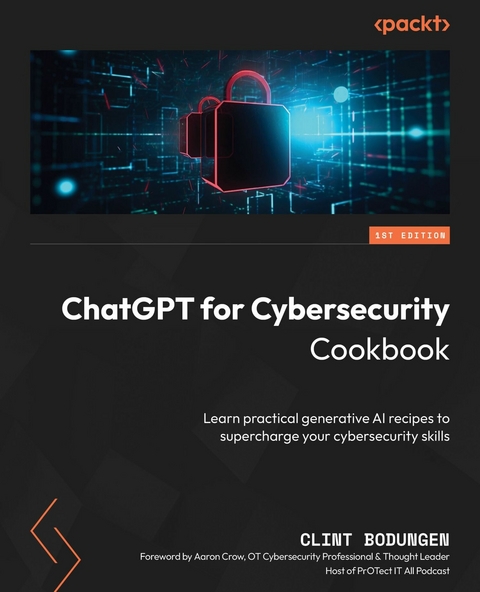
ChatGPT for Cybersecurity Cookbook (eBook)
372 Seiten
Packt Publishing Limited (Verlag)
978-1-80512-511-2 (ISBN)

No detailed description available for "e;ChatGPT for Cybersecurity Cookbook"e;.
Preface
In the ever-evolving domain of cybersecurity, the advent of generative AI and large language models (LLMs), epitomized by the introduction of ChatGPT by OpenAI, marks a significant leap forward. This book, dedicated to the exploration of ChatGPT’s applications within cybersecurity, embarks on a journey from the tool’s nascent stages as a basic chat interface to its current stature as an advanced platform reshaping cybersecurity methodologies.
Initially conceptualized to aid AI research through the analysis of user interactions, ChatGPT’s journey from its initial release in late 2022 to its current form illustrates a remarkable evolution in a span of just over a year. The integration of sophisticated features such as web browsing, document analysis, and image creation through DALL-E, combined with advancements in speech recognition and text-to-image understanding, has transformed ChatGPT into a multi-faceted tool. This transformation is not merely technical but extends into functional realms, potentially significantly impacting cybersecurity practices.
A key facet in ChatGPT’s evolution was the incorporation of code completion and debugging functionalities, which expanded its utility across technical domains, particularly in software development and secure coding. These advancements have significantly enhanced coding speed and efficiency and have effectively democratized programming skills and accessibility.
The Advanced Data Analysis feature (formerly known as Code Interpreter) has further opened new avenues in cybersecurity. It enables professionals to rapidly analyze and debug security-related code, automate the creation of secure coding guidelines, and develop custom security scripts. The capability to process and visualize data from diverse sources, including documents and images, and to generate detailed charts and graphs, transforms raw data into actionable cybersecurity insights.
ChatGPT’s web-browsing capabilities have greatly enhanced its role in cybersecurity intelligence gathering. By enabling professionals to extract real-time threat information from a broad spectrum of online sources, ChatGPT facilitates a rapid response to emerging threats and supports informed strategic decision-making. This synthesis of data into concise, actionable intelligence underscores ChatGPT’s value as a dynamic tool for cybersecurity experts navigating the rapidly evolving landscape of cyber threats.
Finally, this book extends beyond the confines of the ChatGPT web interface, venturing into the OpenAI API to unlock a world of possibilities, empowering you to not only utilize but also innovate with the OpenAI API. By delving into the creation of custom tools and expanding upon the inherent capabilities of the ChatGPT interface, you are equipped to tailor AI-powered solutions to their unique cybersecurity challenges.
This book serves as a quintessential guide for cybersecurity professionals looking to harness the power of ChatGPT in their projects and tasks by providing practical, step-by-step examples of how to employ ChatGPT in real-world scenarios.
Each chapter focuses on a unique facet of cybersecurity, from vulnerability assessment and code analysis to threat intelligence and incident response. Through these chapters, you are introduced to the innovative application of ChatGPT in creating vulnerability and threat assessment plans, analyzing and debugging security-related code, and even generating detailed threat reports. The book delves into using ChatGPT in conjunction with frameworks such as MITRE ATT&CK, automating the creation of secure coding guidelines, and crafting custom security scripts, thereby offering a comprehensive toolkit for enhancing cybersecurity infrastructure.
By integrating the advanced capabilities of ChatGPT, this book not only educates but also inspires professionals to explore new horizons in cybersecurity, making it an indispensable resource in the age of AI-driven security solutions.
Who this book is for
ChatGPT for Cybersecurity Cookbook is written for a diverse audience with a shared interest in the intersection of artificial intelligence and cybersecurity. Whether you are a seasoned cybersecurity professional aiming to incorporate the innovative capabilities of ChatGPT and the OpenAI API into your security practices, an IT professional eager to broaden your cybersecurity acumen with AI-powered tools, a student or emerging cybersecurity enthusiast keen on understanding and applying AI in security contexts, or a security researcher fascinated by the transformative potential of AI in cybersecurity, this book is tailored for you.
The content is structured to accommodate a spectrum of knowledge levels, initiating you with fundamental concepts before advancing to sophisticated applications. This inclusive approach ensures the book’s relevance and accessibility to individuals across various stages of their cybersecurity journey.
What this book covers
Chapter 1, Getting Started: ChatGPT, the OpenAI API, and Prompt Engineering, introduces ChatGPT and the OpenAI API, laying the foundation for leveraging generative AI in cybersecurity. It covers the basics of setting up an account, mastering prompt engineering, and utilizing ChatGPT for tasks including code writing and role simulation, setting the stage for more advanced applications in subsequent chapters.
Chapter 2, Vulnerability Assessment, focuses on enhancing vulnerability assessment tasks, guiding you through using ChatGPT to create assessment plans, automate processes with the OpenAI API, and integrate with frameworks including MITRE ATT&CK for comprehensive threat reporting and analysis.
Chapter 3, Code Analysis and Secure Development, delves into the secure software development lifecycle (SSDLC), showing how ChatGPT can streamline the process from planning to maintenance. It highlights the use of AI in crafting security requirements, identifying vulnerabilities, and generating documentation to improve software security and maintainability.
Chapter 4, Governance, Risk, and Compliance (GRC), offers insights into using ChatGPT for enhancing cybersecurity governance, risk management, and compliance efforts. It covers generating cybersecurity policies, deciphering complex standards, conducting cyber risk assessments, and creating risk reports to strengthen cybersecurity frameworks.
Chapter 5, Security Awareness and Training, focuses on leveraging ChatGPT in cybersecurity education and training. It explores creating engaging training materials, interactive assessments, phishing training tools, exam preparation aids, and employing gamification to enhance learning experiences in cybersecurity.
Chapter 6, Red Teaming and Penetration Testing, explores AI-enhanced techniques for red teaming and penetration testing. It includes generating realistic scenarios using the MITRE ATT&CK framework, conducting OSINT reconnaissance, automating asset discovery, and integrating AI with penetration testing tools for comprehensive security assessments.
Chapter 7, Threat Monitoring and Detection, addresses the use of ChatGPT in threat intelligence analysis, real-time log analysis, detecting advanced persistent threats (APTs), customizing threat detection rules, and using network traffic analysis to improve threat detection and response capabilities.
Chapter 8, Incident Response, focuses on utilizing ChatGPT to enhance incident response processes, including incident analysis, playbook generation, root cause analysis, and automating report creation to ensure efficient and effective responses to cybersecurity incidents.
Chapter 9, Using Local Models and Other Frameworks, investigates the use of local AI models and frameworks in cybersecurity, highlighting tools such as LMStudio and Hugging Face AutoTrain for privacy-enhanced threat hunting, penetration testing, and sensitive document review.
Chapter 10, The Latest OpenAI Features, provides an overview of the most recent OpenAI features and their applications in cybersecurity. It emphasizes leveraging ChatGPT’s advanced capabilities for cyber threat intelligence, security data analysis, and employing visualization techniques for a deeper understanding of vulnerabilities.
To get the most out of this book
To maximize the benefits derived from this book, you are encouraged to possess the following:
- A foundational grasp of cybersecurity principles, including prevalent terminology and best practices, to contextualize the applications of ChatGPT within the security landscape. (This book is not intended to be an introduction to cybersecurity.)
- An understanding of programming fundamentals, particularly in Python, as the book employs Python scripts extensively to demonstrate interactions with the OpenAI API.
- Proficiency with command-line interfaces and a rudimentary knowledge of...
| Erscheint lt. Verlag | 12.4.2024 |
|---|---|
| Vorwort | Aaron Crow |
| Sprache | englisch |
| Themenwelt | Informatik ► Netzwerke ► Sicherheit / Firewall |
| Informatik ► Theorie / Studium ► Künstliche Intelligenz / Robotik | |
| Mathematik / Informatik ► Informatik ► Web / Internet | |
| ISBN-10 | 1-80512-511-7 / 1805125117 |
| ISBN-13 | 978-1-80512-511-2 / 9781805125112 |
| Informationen gemäß Produktsicherheitsverordnung (GPSR) | |
| Haben Sie eine Frage zum Produkt? |
 EPUB (Adobe DRM)
Größe: 13,2 MB
Kopierschutz: Adobe-DRM
Adobe-DRM ist ein Kopierschutz, der das eBook vor Mißbrauch schützen soll. Dabei wird das eBook bereits beim Download auf Ihre persönliche Adobe-ID autorisiert. Lesen können Sie das eBook dann nur auf den Geräten, welche ebenfalls auf Ihre Adobe-ID registriert sind.
Details zum Adobe-DRM
Dateiformat: EPUB (Electronic Publication)
EPUB ist ein offener Standard für eBooks und eignet sich besonders zur Darstellung von Belletristik und Sachbüchern. Der Fließtext wird dynamisch an die Display- und Schriftgröße angepasst. Auch für mobile Lesegeräte ist EPUB daher gut geeignet.
Systemvoraussetzungen:
PC/Mac: Mit einem PC oder Mac können Sie dieses eBook lesen. Sie benötigen eine
eReader: Dieses eBook kann mit (fast) allen eBook-Readern gelesen werden. Mit dem amazon-Kindle ist es aber nicht kompatibel.
Smartphone/Tablet: Egal ob Apple oder Android, dieses eBook können Sie lesen. Sie benötigen eine
Geräteliste und zusätzliche Hinweise
Buying eBooks from abroad
For tax law reasons we can sell eBooks just within Germany and Switzerland. Regrettably we cannot fulfill eBook-orders from other countries.
 PDF (Wasserzeichen)
Größe: 11,7 MB
DRM: Digitales Wasserzeichen
Dieses eBook enthält ein digitales Wasserzeichen und ist damit für Sie personalisiert. Bei einer missbräuchlichen Weitergabe des eBooks an Dritte ist eine Rückverfolgung an die Quelle möglich.
Dateiformat: PDF (Portable Document Format)
Mit einem festen Seitenlayout eignet sich die PDF besonders für Fachbücher mit Spalten, Tabellen und Abbildungen. Eine PDF kann auf fast allen Geräten angezeigt werden, ist aber für kleine Displays (Smartphone, eReader) nur eingeschränkt geeignet.
Systemvoraussetzungen:
PC/Mac: Mit einem PC oder Mac können Sie dieses eBook lesen. Sie benötigen dafür einen PDF-Viewer - z.B. den Adobe Reader oder Adobe Digital Editions.
eReader: Dieses eBook kann mit (fast) allen eBook-Readern gelesen werden. Mit dem amazon-Kindle ist es aber nicht kompatibel.
Smartphone/Tablet: Egal ob Apple oder Android, dieses eBook können Sie lesen. Sie benötigen dafür einen PDF-Viewer - z.B. die kostenlose Adobe Digital Editions-App.
Buying eBooks from abroad
For tax law reasons we can sell eBooks just within Germany and Switzerland. Regrettably we cannot fulfill eBook-orders from other countries.
EPUB (Ohne DRM)Digital Rights Management: ohne DRM
Dieses eBook enthält kein DRM oder Kopierschutz. Eine Weitergabe an Dritte ist jedoch rechtlich nicht zulässig, weil Sie beim Kauf nur die Rechte an der persönlichen Nutzung erwerben.
Dateiformat: EPUB (Electronic Publication)
EPUB ist ein offener Standard für eBooks und eignet sich besonders zur Darstellung von Belletristik und Sachbüchern. Der Fließtext wird dynamisch an die Display- und Schriftgröße angepasst. Auch für mobile Lesegeräte ist EPUB daher gut geeignet.
Systemvoraussetzungen:
PC/Mac: Mit einem PC oder Mac können Sie dieses eBook lesen. Sie benötigen dafür die kostenlose Software Adobe Digital Editions.
eReader: Dieses eBook kann mit (fast) allen eBook-Readern gelesen werden. Mit dem amazon-Kindle ist es aber nicht kompatibel.
Smartphone/Tablet: Egal ob Apple oder Android, dieses eBook können Sie lesen. Sie benötigen dafür eine kostenlose App.
Geräteliste und zusätzliche Hinweise
Buying eBooks from abroad
For tax law reasons we can sell eBooks just within Germany and Switzerland. Regrettably we cannot fulfill eBook-orders from other countries.
aus dem Bereich