


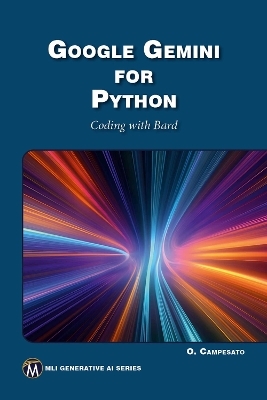
Google Gemini for Python
Coding with Bard
Seiten
2024
De Gruyter (Verlag)
978-1-5015-2274-1 (ISBN)
De Gruyter (Verlag)
978-1-5015-2274-1 (ISBN)
Provides a bridge between the worlds of Python 3 programming and Generative AI, equipping readers with the skills to navigate both domains with confidence. The book begins with an introduction to fundamental aspects of Python programming. Popular platforms and models are presented to give readers an understanding of the current AI landscape.
This book provides a bridge between the worlds of Python 3 programming and Generative AI, aiming to equip readers with the skills to navigate both domains with confidence. It begins with an introduction to fundamental aspects of Python programming, which include various data types, number formatting, Unicode and UTF-8 handling, and text manipulation techniques. In addition, you will learn about loops, functions, data structures, NumPy, Pandas, conditional logic, and reserved words in Python. Further chapters show how to handle user input, manage exceptions, and work with command-line arguments. The text then transitions to the realm of Generative AI, discussing its distinction from Conversational AI. Popular platforms and models, including Bard (now called “Gemini”) and its competitors, are presented to give readers an understanding of the current AI landscape. The book discusses the capabilities of Bard, its strengths, weaknesses, and potential applications. Finally, you will learn how to generate a variety of Python 3 code samples via Bard.
This book provides a bridge between the worlds of Python 3 programming and Generative AI, aiming to equip readers with the skills to navigate both domains with confidence. It begins with an introduction to fundamental aspects of Python programming, which include various data types, number formatting, Unicode and UTF-8 handling, and text manipulation techniques. In addition, you will learn about loops, functions, data structures, NumPy, Pandas, conditional logic, and reserved words in Python. Further chapters show how to handle user input, manage exceptions, and work with command-line arguments. The text then transitions to the realm of Generative AI, discussing its distinction from Conversational AI. Popular platforms and models, including Bard (now called “Gemini”) and its competitors, are presented to give readers an understanding of the current AI landscape. The book discusses the capabilities of Bard, its strengths, weaknesses, and potential applications. Finally, you will learn how to generate a variety of Python 3 code samples via Bard.
Oswald Campesato (San Francisco, CA) specializes in Deep Learning, Python, and GPT-4. He is the author/co-author of over forty books including Python 3 Data Visualization Using ChatGPT / GPT-4, NLP for Developers, and Artificial Intelligence, Machine Learning and Deep Learning (all Mercury Learning).
1:Introduction to Python 3
2: Conditional Logic, Loops, and Functions
3: PythonData Structures
4:Introduction to NumPy and Pandas
5: Generative AI, Bard, and Gemini
6: Bardand Python Code
Index
| Erscheinungsdatum | 04.04.2024 |
|---|---|
| Reihe/Serie | MLI Generative AI Series |
| Verlagsort | New York |
| Sprache | englisch |
| Gewicht | 292 g |
| Themenwelt | Mathematik / Informatik ► Informatik ► Office Programme |
| Informatik ► Programmiersprachen / -werkzeuge ► Assembler | |
| Informatik ► Theorie / Studium ► Künstliche Intelligenz / Robotik | |
| Technik | |
| ISBN-10 | 1-5015-2274-4 / 1501522744 |
| ISBN-13 | 978-1-5015-2274-1 / 9781501522741 |
| Zustand | Neuware |
| Informationen gemäß Produktsicherheitsverordnung (GPSR) | |
| Haben Sie eine Frage zum Produkt? |
Mehr entdecken
aus dem Bereich
aus dem Bereich
Buch | Softcover (2024)
dpunkt (Verlag)
CHF 51,65


