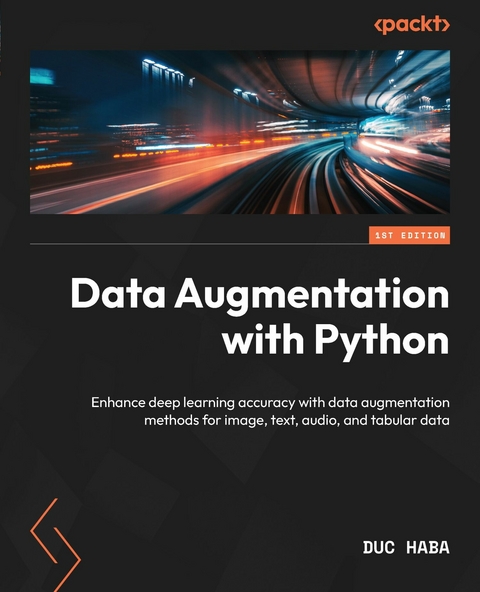
Data Augmentation with Python (eBook)
394 Seiten
Packt Publishing (Verlag)
978-1-80323-591-2 (ISBN)
Data is paramount in AI projects, especially for deep learning and generative AI, as forecasting accuracy relies on input datasets being robust. Acquiring additional data through traditional methods can be challenging, expensive, and impractical, and data augmentation offers an economical option to extend the dataset.
The book teaches you over 20 geometric, photometric, and random erasing augmentation methods using seven real-world datasets for image classification and segmentation. You'll also review eight image augmentation open source libraries, write object-oriented programming (OOP) wrapper functions in Python Notebooks, view color image augmentation effects, analyze safe levels and biases, as well as explore fun facts and take on fun challenges. As you advance, you'll discover over 20 character and word techniques for text augmentation using two real-world datasets and excerpts from four classic books. The chapter on advanced text augmentation uses machine learning to extend the text dataset, such as Transformer, Word2vec, BERT, GPT-2, and others. While chapters on audio and tabular data have real-world data, open source libraries, amazing custom plots, and Python Notebook, along with fun facts and challenges.
By the end of this book, you will be proficient in image, text, audio, and tabular data augmentation techniques.
Boost your AI and generative AI accuracy using real-world datasets with over 150 functional object-oriented methods and open source librariesPurchase of the print or Kindle book includes a free PDF eBookKey FeaturesExplore beautiful, customized charts and infographics in full colorWork with fully functional OO code using open source libraries in the Python Notebook for each chapterUnleash the potential of real-world datasets with practical data augmentation techniquesBook DescriptionData is paramount in AI projects, especially for deep learning and generative AI, as forecasting accuracy relies on input datasets being robust. Acquiring additional data through traditional methods can be challenging, expensive, and impractical, and data augmentation offers an economical option to extend the dataset. The book teaches you over 20 geometric, photometric, and random erasing augmentation methods using seven real-world datasets for image classification and segmentation. You ll also review eight image augmentation open source libraries, write object-oriented programming (OOP) wrapper functions in Python Notebooks, view color image augmentation effects, analyze safe levels and biases, as well as explore fun facts and take on fun challenges. As you advance, you ll discover over 20 character and word techniques for text augmentation using two real-world datasets and excerpts from four classic books. The chapter on advanced text augmentation uses machine learning to extend the text dataset, such as Transformer, Word2vec, BERT, GPT-2, and others. While chapters on audio and tabular data have real-world data, open source libraries, amazing custom plots, and Python Notebook, along with fun facts and challenges. By the end of this book, you will be proficient in image, text, audio, and tabular data augmentation techniques.What you will learnWrite OOP Python code for image, text, audio, and tabular dataAccess over 150,000 real-world datasets from the Kaggle websiteAnalyze biases and safe parameters for each augmentation methodVisualize data using standard and exotic plots in colorDiscover 32 advanced open source augmentation librariesExplore machine learning models, such as BERT and TransformerMeet Pluto, an imaginary digital coding companionExtend your learning with fun facts and fun challengesWho this book is forThis book is for data scientists and students interested in the AI discipline. Advanced AI or deep learning skills are not required; however, knowledge of Python programming and familiarity with Jupyter Notebooks are essential to understanding the topics covered in this book.]]>
| Erscheint lt. Verlag | 28.4.2023 |
|---|---|
| Sprache | englisch |
| Themenwelt | Mathematik / Informatik ► Informatik ► Netzwerke |
| Informatik ► Theorie / Studium ► Künstliche Intelligenz / Robotik | |
| ISBN-10 | 1-80323-591-8 / 1803235918 |
| ISBN-13 | 978-1-80323-591-2 / 9781803235912 |
| Informationen gemäß Produktsicherheitsverordnung (GPSR) | |
| Haben Sie eine Frage zum Produkt? |
 EPUB (Ohne DRM)
Digital Rights Management: ohne DRM
Dieses eBook enthält kein DRM oder Kopierschutz. Eine Weitergabe an Dritte ist jedoch rechtlich nicht zulässig, weil Sie beim Kauf nur die Rechte an der persönlichen Nutzung erwerben.
Dateiformat: EPUB (Electronic Publication)
EPUB ist ein offener Standard für eBooks und eignet sich besonders zur Darstellung von Belletristik und Sachbüchern. Der Fließtext wird dynamisch an die Display- und Schriftgröße angepasst. Auch für mobile Lesegeräte ist EPUB daher gut geeignet.
Systemvoraussetzungen:
PC/Mac: Mit einem PC oder Mac können Sie dieses eBook lesen. Sie benötigen dafür die kostenlose Software Adobe Digital Editions.
eReader: Dieses eBook kann mit (fast) allen eBook-Readern gelesen werden. Mit dem amazon-Kindle ist es aber nicht kompatibel.
Smartphone/Tablet: Egal ob Apple oder Android, dieses eBook können Sie lesen. Sie benötigen dafür eine kostenlose App.
Geräteliste und zusätzliche Hinweise
Buying eBooks from abroad
For tax law reasons we can sell eBooks just within Germany and Switzerland. Regrettably we cannot fulfill eBook-orders from other countries.
aus dem Bereich