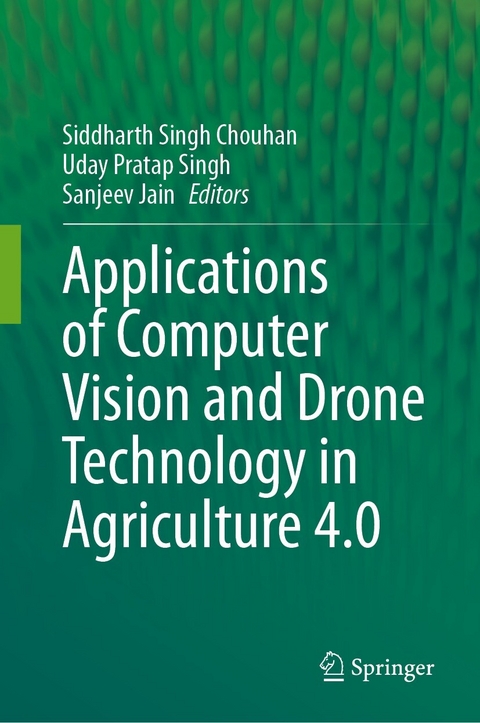
Applications of Computer Vision and Drone Technology in Agriculture 4.0 (eBook)
321 Seiten
Springer Nature Singapore (Verlag)
978-981-99-8684-2 (ISBN)
This edited book focus on two most emerging areas and covers the different aspects of computer vision and drone technology in the field of agriculture. It comprises various applications including segmentation/classification of plant diseases, monitoring of crops, grade/quality estimation of fruits/flowers/vegetables/crops, surveillance, soil deficiency estimation, crop/plant growth estimation, canopy measurement, water stress management, vegetation indices calculation, weed detection, and spraying, among other. It has 17 chapters contributed by experts in the field of computer vision, drone technology, deep learning, machine learning, artificial intelligence, image processing, agriculturist, and plant pathologists.
The recent development of high-end computing devices and the adaptation of unmanned aerial vehicles has provided a mechanism to automate traditional agriculture practices. The on-field or aerial images captured using cameras are processed with the help of intelligent algorithms, and an assessment is drawn for further recommendations. This practice is efficient in provisioning an accurate, timely, and economical decision-making system to overcome the problems of agricultural field experts and farmers. This process is advantageous in increasing the quality and quantity of crop yields.
This book serves as an excellent guide to students, researchers, scientists, and field experts in directing their work toward this domain and developing/designing models. Further, this book is useful for pathologists, biotechnologists, seed production specialists, breeders, market managers, and other stakeholders associated with underlying technology or market development from the public and private sectors.
This edited book focus on two most emerging areas and covers the different aspects of computer vision and drone technology in the field of agriculture. It comprises various applications including segmentation/classification of plant diseases, monitoring of crops, grade/quality estimation of fruits/flowers/vegetables/crops, surveillance, soil deficiency estimation, crop/plant growth estimation, canopy measurement, water stress management, vegetation indices calculation, weed detection, and spraying, among other. It has 17 chapters contributed by experts in the field of computer vision, drone technology, deep learning, machine learning, artificial intelligence, image processing, agriculturist, and plant pathologists.The recent development of high-end computing devices and the adaptation of unmanned aerial vehicles has provided a mechanism to automate traditional agriculture practices. The on-field or aerial images captured using cameras are processed with the help of intelligent algorithms, and an assessment is drawn for further recommendations. This practice is efficient in provisioning an accurate, timely, and economical decision-making system to overcome the problems of agricultural field experts and farmers. This process is advantageous in increasing the quality and quantity of crop yields.This book serves as an excellent guide to students, researchers, scientists, and field experts in directing their work toward this domain and developing/designing models. Further, this book is useful for pathologists, biotechnologists, seed production specialists, breeders, market managers, and other stakeholders associated with underlying technology or market development from the public and private sectors.
| Erscheint lt. Verlag | 18.3.2024 |
|---|---|
| Zusatzinfo | XXIII, 321 p. 1 illus. |
| Sprache | englisch |
| Themenwelt | Informatik ► Theorie / Studium ► Künstliche Intelligenz / Robotik |
| Naturwissenschaften ► Biologie ► Botanik | |
| Technik ► Umwelttechnik / Biotechnologie | |
| Weitere Fachgebiete ► Land- / Forstwirtschaft / Fischerei | |
| Schlagworte | Artificial Intelligence in Agriculture • Computer vision in agriculture • Deep Learning in agriculture • Machine Learning In Agriculture • remote sensing in agriculture • Unmanned Aerial Vehicle in agriculture |
| ISBN-10 | 981-99-8684-2 / 9819986842 |
| ISBN-13 | 978-981-99-8684-2 / 9789819986842 |
| Informationen gemäß Produktsicherheitsverordnung (GPSR) | |
| Haben Sie eine Frage zum Produkt? |
 PDF (Wasserzeichen)
DRM: Digitales Wasserzeichen
Dieses eBook enthält ein digitales Wasserzeichen und ist damit für Sie personalisiert. Bei einer missbräuchlichen Weitergabe des eBooks an Dritte ist eine Rückverfolgung an die Quelle möglich.
Dateiformat: PDF (Portable Document Format)
Mit einem festen Seitenlayout eignet sich die PDF besonders für Fachbücher mit Spalten, Tabellen und Abbildungen. Eine PDF kann auf fast allen Geräten angezeigt werden, ist aber für kleine Displays (Smartphone, eReader) nur eingeschränkt geeignet.
Systemvoraussetzungen:
PC/Mac: Mit einem PC oder Mac können Sie dieses eBook lesen. Sie benötigen dafür einen PDF-Viewer - z.B. den Adobe Reader oder Adobe Digital Editions.
eReader: Dieses eBook kann mit (fast) allen eBook-Readern gelesen werden. Mit dem amazon-Kindle ist es aber nicht kompatibel.
Smartphone/Tablet: Egal ob Apple oder Android, dieses eBook können Sie lesen. Sie benötigen dafür einen PDF-Viewer - z.B. die kostenlose Adobe Digital Editions-App.
Buying eBooks from abroad
For tax law reasons we can sell eBooks just within Germany and Switzerland. Regrettably we cannot fulfill eBook-orders from other countries.
aus dem Bereich