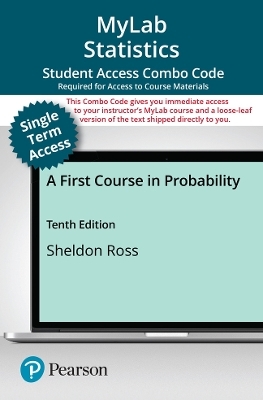
MyLab Statistics with Pearson eText (up to 18-weeks) + Print Combo Access Code for First Course in Probability, A
Pearson (Hersteller)
978-0-13-811064-2 (ISBN)
- Titel nicht im Sortiment
- Artikel merken
Personalize learning with MyLab Statistics with Pearson+ eTextbook This flexible digital platform combines unrivaled content, online assessments and customizable features to personalize learning and improve results.
Pearson+ eTextbook is an easy-to-use digital textbook available within MyLab® that lets you read, highlight and take notes, all in one place.
NOTE: This MyLab combo access pack includes a MyLab access code plus a loose-leaf print version (delivered by mail) to complement your MyLab experience. To register for and use MyLab, you will need either a course ID from your instructor or an invitation link that your instructor will send you directly.
Used books, rentals, and purchases made outside of Pearson If purchasing or renting from companies other than Pearson, the access codes for the [[MyLab / Mastering] platform may not be included, may be incorrect, or may be previously redeemed. Check with the seller before completing your purchase.
About our author Sheldon M. Ross is a professor in the Department of Industrial Engineering and Operations Research at the University of Southern California. He received his Ph.D. in statistics at Stanford University in 1968. He has published many technical articles and textbooks in the areas of statistics and applied probability. Among his texts are A First Course in Probability, Introduction to Probability Models, Stochastic Processes, and Introductory Statistics. Professor Ross is the founding and continuing editor of the journal Probability in the Engineering and Informational Sciences, the Advisory Editor for International Journal of Quality Technology and Quantitative Management, and an Editorial Board Member of the Journal of Bond Trading and Management. He is a Fellow of the Institute of Mathematical Statistics and a recipient of the Humboldt US Senior Scientist Award.
1. Combinatorial Analysis
1.1 Introduction
1.2 The Basic Principle of Counting
1.3 Permutations
1.4 Combinations
1.5 Multinomial Coefficients
1.6 The Number of Integer Solutions of Equations
Summary
Problems
Theoretical Exercises
Self-Test Problems and Exercises
2. Axioms of Probability
2.1 Introduction
2.2 Sample Space and Events
2.3 Axioms of Probability
2.4 Some Simple Propositions
2.5 Sample Spaces Having Equally Likely Outcomes
2.6 Probability as a Continuous Set Function
2.7 Probability as a Measure of Belief
Summary
Problems
Theoretical Exercises
Self-Test Problems and Exercises
3. Conditional Probability and Inference
3.1 Introduction
3.2 Conditional Probabilities
3.3 Bayes's Formula
3.4 Independent Events
3.5 P(·|F) Is a Probability
Summary
Problems
Theoretical Exercises
Self-Test Problems and Exercises
4. Random Variables
4.1 Random Variables
4.2 Discrete Random Variables
4.3 Expected Value
4.4 Expectation of a Function of a Random Variable
4.5 Variance
4.6 The Bernoulli and Binomial Random Variables
4.7 The Poisson Random Variable
4.8 Other Discrete Probability Distributions
4.9 Expected Value of Sums of Random Variables
4.10 Properties of the Cumulative Distribution Function
Summary
Problems
Theoretical Exercises
Self-Test Problems and Exercises
5. Continuous Random Variables
5.1 Introduction
5.2 Expectation and Variance of Continuous Random Variables
5.3 The Uniform Random Variable
5.4 Normal Random Variables
5.5 Exponential Random Variables
5.6 Other Continuous Distributions
5.7 The Distribution of a Function of a Random Variable
Summary
Problems
Theoretical Exercises
Self-Test Problems and Exercises
6. Jointly Distributed Random Variables
6.1 Joint Distribution Functions
6.2 Independent Random Variables
6.3 Sums of Independent Random Variables
6.4 Conditional Distributions: Discrete Case
6.5 Conditional Distributions: Continuous Case
6.6 Order Statistics
6.7 Joint Probability Distribution of Functions of Random Variables
6.8 Exchangeable Random Variables
Summary
Problems
Theoretical Exercises
Self-Test Problems and Exercises
7. Properties of Expectation
7.1 Introduction
7.2 Expectation of Sums of Random Variables
7.3 Moments of the Number of Events that Occur
7.4 Covariance, Variance of Sums, and Correlations
7.5 Conditional Expectation
7.6 Conditional Expectation and Prediction
7.7 Moment Generating Functions
7.8 Additional Properties of Normal Random Variables
7.9 General Definition of Expectation
Summary
Problems
Theoretical Exercises
Self-Test Problems and Exercises
8. Limit Theorems
8.1 Introduction
8.2 Chebyshev's Inequality and the Weak Law of Large Numbers
8.3 The Central Limit Theorem
8.4 The Strong Law of Large Numbers
8.5 Other Inequalities and a Poisson Limit Result
8.6 Bounding the Error Probability When Approximating a Sum of Independent Bernoulli Random Variables by a Poisson Random Variable
8.7 The Lorenz Curve
Summary
Problems
Theoretical Exercises
Self-Test Problems and Exercises
9. Additional Topics in Probability
9.1 The Poisson Process
9.2 Markov Chains
9.3 Surprise, Uncertainty, and Entropy
9.4 Coding Theory and Entropy
Summary
Problems and Theoretical Exercises
Self-Test Problems and Exercises
10. Simulation
10.1 Introduction
10.2 General Techniques for Simulating Continuous Random Variables
10.3 Simulating from Discrete Distributions
10.4 Variance Reduction Techniques
Summary
Problems
Self-Test Problems and Exercises
Answers to Selected Problems Solutions to Self-Test Problems and Exercises Index Common Discrete Distributions Common Continuous Distributions
| Erscheint lt. Verlag | 2.1.2023 |
|---|---|
| Sprache | englisch |
| Themenwelt | Mathematik / Informatik ► Mathematik ► Statistik |
| ISBN-10 | 0-13-811064-6 / 0138110646 |
| ISBN-13 | 978-0-13-811064-2 / 9780138110642 |
| Zustand | Neuware |
| Informationen gemäß Produktsicherheitsverordnung (GPSR) | |
| Haben Sie eine Frage zum Produkt? |
aus dem Bereich