


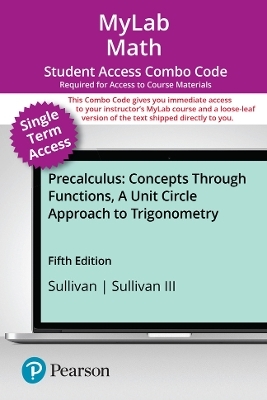
MyLab Math with Pearson eText (up to 18-weeks) + Print Combo Access Code for Precalculus
Pearson (Hersteller)
978-0-13-808012-9 (ISBN)
- Titel nicht im Sortiment
- Artikel merken
Personalize learning with MyLab Math with Pearson+ eTextbook This flexible digital platform combines unrivaled content, online assessments, and customizable features to personalize learning and improve results.
Pearson+ eTextbook is an easy-to-use digital textbook available within MyLab that lets you read, highlight, and take notes, all in one place.
NOTE: This MyLab combo access pack includes a MyLab access code plus a loose-leaf print version (delivered by mail) to complement your MyLab experience. To register for and use MyLab, you will need either a course ID from your instructor or an invitation link that your instructor will send you directly.
Used books, rentals, and purchases made outside of Pearson If purchasing or renting from companies other than Pearson, the access codes for the MyLab platform may not be included, may be incorrect, or may be previously redeemed. Check with the seller before completing your purchase.
About our authors After graduating from Saint Ignatius College Prep (Chicago), Michael Sullivan attended DePaul University as an undergraduate, completing a major in mathematics and a minor in physics in 3 years. He pursued his graduate studies at the Illinois Institute of Technology, receiving a master's degree in 1963 and a Doctor of Philosophy (PhD) in 1967, both in mathematics. Mike had a teaching career of over 30 years at Chicago State University as a Professor of Mathematics, where he honed an approach to teaching and writing that forms the foundation for his textbooks. He has authored more than 120 textbooks in mathematics and currently has 15 books in print. His textbooks are used in high schools and universities across the United States and have been translated into a variety of foreign languages. His books have been awarded both the Texty and McGuffey awards from the Textbook and Academic Authors Association (TAA), and in 2007 he received the TAA Lifetime Achievement Award. In 2023, Mike was awarded the Saint Ignatius College Prep Alumni Award for Excellence, in recognition of his outstanding commitment to his profession and to the Saint Ignatius community. Mike is a member of the American Mathematical Association of Two-Year Colleges, the American Mathematical Society, the Mathematical Association of America, and the Textbook and Academic Authors Association. He has 4 children, all of whom are involved with mathematics or publishing. His son, Michael Sullivan III, also teaches college mathematics and is his coauthor on 2 Pearson precalculus series. He divides his time between living in Naples, FL and Oak Lawn, IL. When not writing textbooks he enjoys tennis, travel and gardening. Michael Sullivan, III is an adjunct professor of Mathematics at Florida SouthWestern State College. He took this position after retiring from Joliet Junior College (the nation’s oldest public community college). He taught at Joliet Junior College for 25 years. Prior to teaching at Joliet Junior College, Michael taught high school mathematics. He holds graduate degrees from DePaul University in both mathematics and economics. Michael has been actively presenting at both national and regional conferences for over 25 years. He currently has a Statistics series in its 7th edition and a Developmental Mathematics series in its 4th edition. He also writes a Precalculus series with his father. Michael’s interests in the classroom lie in developing exciting and innovative techniques for delivering course content to help keep his students engaged. He strongly believes in developing students’ communication skills (both written and oral) and developing students' conceptual understanding of mathematics. His experience in course redesign, corequisites, and writing texts for the college-level math and statistics courses gives him a unique insight into what students need to be successful.
Applications Index
F. Foundations: A Prelude to Functions
F.1 The Distance and Midpoint Formulas
F.2 Graphs of Equations in Two Variables; Intercepts; Symmetry
F.3 Lines
F.4 Circles
Chapter Project
1. Functions and Their Graphs
1.1 Functions
1.2 The Graph of a Function
1.3 Properties of Functions
1.4 Library of Functions; Piecewise-defined Functions
1.5 Graphing Techniques: Transformations
1.6 Building Mathematical Models from Verbal Descriptions
1.7 Building Mathematical Models Using Variation
Chapter Review
Chapter Test
Chapter Projects
2. Linear and Quadratic Functions
2.1 Properties of Linear Functions and Linear Models
2.2 Building Linear Models from Data
2.3 Quadratic Functions and Their Zeros
2.4 Properties of Quadratic Functions
2.5 Inequalities Involving Quadratic Functions
2.6 Building Quadratic Models from Verbal Descriptions and from Data
2.7 Complex Zeros of a Quadratic Function
2.8 Equations and Inequalities Involving the Absolute Value Function
Chapter Review
Chapter Test
Cumulative Review
Chapter Projects
3. Polynomial and Rational Functions
3.1 Polynomial Functions
3.2 Graphing Polynomial Functions; Models
3.3 The Real Zeros of a Polynomial Function
3.4 Complex Zeros; Fundamental Theorem of Algebra
3.5 Properties of Rational Functions
3.6 The Graph of a Rational Function
3.7 Polynomial and Rational Inequalities
Chapter Review
Chapter Test
Cumulative Review
Chapter Projects
4. Exponential and Logarithmic Functions
4.1 Composite Functions
4.2 One-to-One Functions; Inverse Functions
4.3 Exponential Functions
4.4 Logarithmic Functions
4.5 Properties of Logarithms
4.6 Logarithmic and Exponential Equations
4.7 Financial Models
4.8 Exponential Growth and Decay Models; Newton's Law; Logistic Growth and Decay Models
4.9 Building Exponential, Logarithmic, and Logistic Models from Data
Chapter Review
Chapter Test
Cumulative Review
Chapter Projects
5. Trigonometric Functions
5.1 Angles, Arc Length, and Circular Motion
5.2 Trigonometric Functions: Unit Circle Approach
5.3 Properties of the Trigonometric Functions
5.4 Graphs of the Sine and Cosine Functions
5.5 Graphs of the Tangent, Cotangent, Cosecant, and Secant Functions
5.6 Phase Shift; Sinusoidal Curve Fitting
Chapter Review
Chapter Test
Cumulative Review
Chapter Projects
6. Analytic Trigonometry
6.1 The Inverse Sine, Cosine, and Tangent Functions
6.2 The Inverse Trigonometric Functions (Continued)
6.3 Trigonometric Equations
6.4 Trigonometric Identities
6.5 Sum and Difference Formulas
6.6 Double-angle and Half-angle Formulas
6.7 Product-to-Sum and Sum-to-Product Formulas
Chapter Review
Chapter Test
Cumulative Review
Chapter Projects
7. Applications of Trigonometric Functions
7.1 Right Triangle Trigonometry; Applications
7.2 The Law of Sines
7.3 The Law of Cosines
7.4 Area of a Triangle
7.5 Simple Harmonic Motion; Damped Motion; Combining Waves
Chapter Review
Chapter Test
Cumulative Review
Chapter Projects
8. Polar Coordinates; Vectors
8.1 Polar Coordinates
8.2 Polar Equations and Graphs
8.3 The Complex Plane; De Moivre's Theorem
8.4 Vectors
8.5 The Dot Product
8.6 Vectors in Space
8.7 The Cross Product
Chapter Review
Chapter Test
Cumulative Review
Chapter Projects
9. Analytic Geometry
9.1 Conics
9.2 The Parabola
9.3 The Ellipse
9.4 The Hyperbola
9.5 Rotation of Axes; General Form of a Conic
9.6 Polar Equations of Conics
9.7 Plane Curves and Parametric Equations
Chapter Review
Chapter Test
Cumulative Review
Chapter Projects
10. Systems of Equations and Inequalities
10.1 Systems of Linear Equations: Substitution and Elimination
10.2 Systems of Linear Equations: Matrices
10.3 Systems of Linear Equations: Determinants
10.4 Matrix Algebra
10.5 Partial Fraction Decomposition
10.6 Systems of Nonlinear Equations
10.7 Systems of Inequalities
10.8 Linear Programming
Chapter Review
Chapter Test
Cumulative Review
Chapter Projects
11. Sequences; Induction; the Binomial Theorem
11.1 Sequences
11.2 Arithmetic Sequences
11.3 Geometric Sequences; Geometric Series
11.4 Mathematical Induction
11.5 The Binomial Theorem
Chapter Review
Chapter Test
Cumulative Review
Chapter Projects
12. Counting and Probability
12.1 Counting
12.2 Permutations and Combinations
12.3 Probability
Chapter Review
Chapter Test
Cumulative Review
Chapter Projects
13. A Preview of Calculus: The Limit, Derivative, and Integral of a Function
13.1 Investigating Limits Using Tables and Graphs
13.2 Algebraic Techniques for Finding Limits
13.3 One-sided Limits; Continuity
13.4 The Tangent Problem; The Derivative
13.5 The Area Problem; The Integral
Chapter Review
Chapter Test
Chapter Projects
APPENDICES
A. Review
A.1 Algebra Essentials
A.2 Geometry Essentials
A.3 Polynomials
A.4 Factoring Polynomials
A.5 Synthetic Division
A.6 Rational Expressions
A.7 nth Roots; Rational Exponents
A.8 Solving Equations
A.9 Problem Solving: Interest, Mixture, Uniform Motion, Constant Rate Job Applications
A.10 Interval Notation; Solving Inequalities
A.11 Complex Numbers
B. Graphing Utilities
B.1 The Viewing Rectangle
B.2 Using a Graphing Utility to Graph Equations
B.3 Using a Graphing Utility to Locate Intercepts and Check for Symmetry
B.4 Using a Graphing Utility to Solve Equations
B.5 Square Screens
B.6 Using a Graphing Utility to Graph Inequalities
B.7 Using a Graphing Utility to Solve Systems of Linear Equations
B.8 Using a Graphing Utility to Graph a Polar Equation
B.9 Using a Graphing Utility to Graph Parametric Equations
| Erscheint lt. Verlag | 24.2.2023 |
|---|---|
| Sprache | englisch |
| Themenwelt | Mathematik / Informatik ► Mathematik |
| ISBN-10 | 0-13-808012-7 / 0138080127 |
| ISBN-13 | 978-0-13-808012-9 / 9780138080129 |
| Zustand | Neuware |
| Informationen gemäß Produktsicherheitsverordnung (GPSR) | |
| Haben Sie eine Frage zum Produkt? |


