


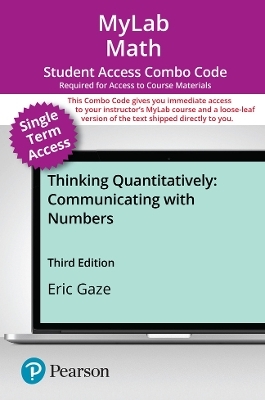
MyLab Math with Pearson eText (up to 18-weeks) + Print Combo Access Code for Thinking Quantitatively
Pearson (Hersteller)
978-0-13-807849-2 (ISBN)
- Titel nicht im Sortiment
- Artikel merken
Personalize learning with MyLab Math with Pearson+ eTextbook This flexible digital platform combines unrivaled content, online assessments and customizable features to personalize learning and improve results.
Pearson+ eTextbook is an easy-to-use digital textbook available within MyLab® that lets you read, highlight and take notes, all in one place.
NOTE: This MyLab combo access pack includes a MyLab access code plus a loose-leaf print version (delivered by mail) to complement your MyLab experience. To register for and use MyLab, you will need either a course ID from your instructor or an invitation link that your instructor will send you directly.
Used books, rentals, and purchases made outside of Pearson If purchasing or renting from companies other than Pearson, the access codes for the MyLab platform may not be included, may be incorrect, or may be previously redeemed. Check with the seller before completing your purchase.
About our author Eric Gaze is a well-known leader in the quantitative reasoning community. After experiences teaching a liberal arts math course and an Excel course early in his career, Eric began to think about giving students a truly meaningful experience in math. He also came to see that spreadsheets were a powerful way to engage in real-world problem solving while learning mathematical concepts. Excited to discover a group of like-minded educators talking about “Quantitative Reasoning,” he began seriously working out a framework for a new course based around both proportional reasoning and Excel. Eric directs the Quantitative Reasoning (QR) program at Bowdoin College, is past Chair of the Center for Learning and Teaching, and is a Senior Lecturer in the Mathematics Department. He served as President of the National Numeracy Network for 3 terms (NNN 2013-2019) and is a former chair of SIGMAA-QL (2010-12). He is an Associate Editor for the Numeracy journal, and writes a blog on using articles in QR courses. Eric gives talks and leads workshops on the topics of QR Across the Curriculum, Creating a QR Entry Point Course, Writing with Numbers, QR Assessment, and Running a QR Program; he continues to serve on review teams of QR programs and oversight boards for NSF-funded grant projects. He was the Principal Investigator for an NSF TUES Type I grant (2012-14), Quantitative Literacy and Reasoning Assessment (QLRA) DUE 1140562. This collaborative project builds on Bowdoin College's QR instrument, which is used for advising purposes and is available to interested schools. Prior to coming to Bowdoin, Eric led the development of a Masters in Numeracy program for K-12 teachers (the first of its kind in the country) at Alfred University as an Associate Professor of Mathematics and Education.
1: An Excel-lent Approach to Relationships
1.1: Functions
1.2: Analytic Representations: Equations
1.3: Numerical and Graphical Representations: Tables and Charts
1.4: Spotlight on Statistics
Chapter 1: Review
2: Ratios and Proportions
2.1: Ratios and Proportions
2.2: Proportionality
2.3: Financial Literacy
2.4: Spotlight on Statistics
Chapter 2: Review
3: Units, Conversions, Scales, and Rates
3.1: Units and Conversions
3.2: Scales
3.3: Rates
3.4: Dosages and Concentrations
3.5: Spotlight on Statistics
Chapter 3: Review
4: Percentages
4.1: Percentages
4.2: Part-to-Part Ratios
4.3: Percentage Change and Difference
4.4: Data Tables with Percentages
4.5: Spotlight on Statistics
5: Linear Functions
5.1: Proportionality
5.2: Slopes and y-Intercepts
5.3: Linear Equations
5.4: Spotlight on Statistics
6: Exponential Functions
6.1: Constant Percentage Change
6.2: Exponential Functions
6.3: Average Percentage Change
6.4: Spotlight on Statistics
7: Logical Arithmetic
7.1: Logarithms
7.2: Doubling Time and Half-Lives
7.3: Annual Percentage Yield and
Continuous Compounding
7.4: Spotlight on Statistics
End of Chapter Summary
8: Curve Fitting and Correlation
8.1: Correlation, Causation, and Confounding Factors
8.2: Best-Fit, Least-Squares, and Regression Lines
8.3: Correlation Coefficient and Coefficient of Linear Determination
8.4: Spotlight on Statistics
Chapter 8: Review
9: Financial Health
9.1: Retirement
9.2: Securities: Cash, Stocks, Mutual Funds, and Bonds
9.3: Built-In Financial Functions
9.4: Loans
Chapter 9: Review
10: Logically!
10.1: Logical Statements
10.2: Excel's IF Function
10.3: VLOOKUP
10.4: Random Simulations
Chapter 10: Review
11: Chance, Risk, and Likelihood
11.1: Risk and Decision-Making
11.2: Probability and Counting
11.3: Conditional Probabilities
11.4: Unions and Complements
11.5: Spotlight on Statistics
12: Statistically Speaking
12.1: Data Distributions: Frequency and Probability
12.2: Binomial and Normal Distributions
12.3: Sampling Distributions and Confidence Intervals
12.4: Hypothesis Testing
Chapter 12: Review
13: Modeling the Real World
13.1: Modeling Basics
13.2: Rate (Population) Models
13.3: Stochastic (Random) Models
13.4: Linear Programming (Optimization) Models
13.5: Spotlight on Statistics
Chapter 13: Review
R (Review)
R.1 Objective 1: Number Sense
R.1 Objective 2: Decimals and Percentages
R.1 Objective 3: Formulas and Order of Operations
R.2 Objective 1: Number Words
R.2 Objective 2: Fractions
R.2 Objective 3: Setting Up Proportions
R.2 Objective 4: Basic Equation Solving
R.3 Objective 1: Arithmetic with Units
R.3 Objective 2: Fraction Arithmetic
R.3 Objective 3: Scientific Notation
R.4 Objective 1: Percent Proportions
R.5 Objective 1: The Cartesian Coordinate
Appendix: Spreadsheet Basics
A.1: Introduction to Spreadsheets
A.1 Objective 1: Create a Spreadsheet Model or Template
A.1 Objective 2: Enter Formulas
A.1 Objective 3: Fill Formulas
Section A.2: Built-In Functions
A.2 Objective 1: Using Built-In Functions
Section A.3: Charts
A.3 Objective 1: Creating Charts
Glossary Index
| Erscheint lt. Verlag | 1.1.2023 |
|---|---|
| Sprache | englisch |
| Themenwelt | Mathematik / Informatik ► Mathematik |
| ISBN-10 | 0-13-807849-1 / 0138078491 |
| ISBN-13 | 978-0-13-807849-2 / 9780138078492 |
| Zustand | Neuware |
| Informationen gemäß Produktsicherheitsverordnung (GPSR) | |
| Haben Sie eine Frage zum Produkt? |


