


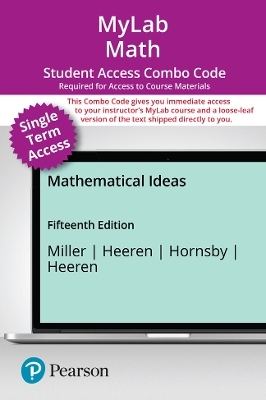
MyLab Math with Pearson eText (up to 18-weeks) + Print Combo Access Code for Mathematical Ideas
Pearson (Hersteller)
978-0-13-810975-2 (ISBN)
- Titel nicht im Sortiment
- Artikel merken
Personalize learning with MyLab Math with Pearson+ eTextbook This flexible digital platform combines unrivaled content, online assessments and customizable features to personalize learning and improve results.
Pearson+ eTextbook is an easy-to-use digital textbook available within MyLab® that lets you read, highlight and take notes, all in one place.
NOTE: This MyLab combo access pack includes a MyLab access code plus a loose-leaf print version (delivered by mail) to complement your MyLab experience. To register for and use MyLab, you will need either a course ID from your instructor or an invitation link that your instructor will send you directly.
Used books, rentals, and purchases made outside of Pearson If purchasing or renting from companies other than Pearson, the access codes for the MyLab platform may not be included, may be incorrect, or may be previously redeemed. Check with the seller before completing your purchase.
About our authors Vern Heeren grew up in the Sacramento Valley of California. After earning a Bachelor of Arts degree in mathematics with a minor in physics at Occidental College, and completing his Master of Arts degree in mathematics at the University of California - Davis, he began a 38-year teaching career at American River College teaching math and a little physics. He coauthored Mathematical Ideas in 1968 with office mate Charles Miller, and he has enjoyed researching and revising it over the years. It has been a joy for him to complete the 14th Edition along with long-time coauthor John Hornsby and with son Christopher. These days, besides pursuing his mathematical interests, Vern enjoys spending time with his wife Carole and their family, exploring the wonders of nature at and near their home in central Oregon. John Hornsby joined the author team of Margaret Lial, Charles Miller and Vern Heeren in 1988. In 1990, the 6th Edition of Mathematical Ideas became the first of nearly 150 titles he has coauthored for Scott Foresman, HarperCollins, Addison-Wesley and Pearson in the years that have followed. His books cover the areas of developmental and college algebra, precalculus, trigonometry, and mathematics for the liberal arts. He is a native and resident of New Roads, Louisiana. Christopher Heeren is a native of Sacramento, California. While studying engineering in college, he had an opportunity to teach a math class at a local high school, and this sparked both a passion for teaching and a change of major. He received a Bachelor of Arts degree and a Master of Arts degree, both in mathematics, from California State University - Sacramento. Chris has taught mathematics at the middle school, high school and college levels, and he currently teaches at American River College in Sacramento. He has a continuing interest in using technology to bring mathematics to life. When not writing, teaching or preparing to teach, Chris enjoys spending time with his lovely wife Heather and their 3 children.
1. The Art of Problem Solving
1.1 Solving Problems by Inductive Reasoning
1.2 An Application of Inductive Reasoning: Number Patterns
1.3 Strategies for Problem Solving
1.4 Numeracy in Today's World
Summary
Test
2. The Basic Concepts of Set Theory
2.1 Symbols and Terminology
2.2 Venn Diagrams and Subsets
2.3 Set Operations
2.4 Surveys and Cardinal Numbers
Summary
Test
3. Introduction to Logic
3.1 Statements and Quantifiers
3.2 Truth Tables and Equivalent Statements
3.3 The Conditional and Circuits
3.4 The Conditional and Related Statements
3.5 Analyzing Arguments with Euler Diagrams
3.6 Analyzing Arguments with Truth Tables
Summary
Test
4. Numeration Systems
4.1 Historical Numeration Systems
4.2 More Historical Numeration Systems
4.3 Arithmetic in the Hindu-Arabic System
4.4 Conversion Between Number Bases
4.5 Arithmetic in Other Bases
Summary
Test
5. Number Theory
5.1 Prime and Composite Numbers
5.2 Large Prime Numbers
5.3 Selected Topics from Number Theory
5.4 Greatest Common Factor and Least Common Multiple
5.5 The Fibonacci Sequence and the Golden Ratio
5.6 Magic Squares (online)*
Summary
Test
6. The Real Numbers and Their Representations
6.1 Real Numbers, Order, and Absolute Value
6.2 Operations, Properties, and Applications of Real Numbers
6.3 Rational Numbers and Decimal Representation
6.4 Irrational Numbers and Decimal Representation
6.5 Applications of Decimals and Percents
Summary
Test
7. The Basic Concepts of Algebra
7.1 Linear Equations
7.2 Applications of Linear Equations
7.3 Ratio, Proportion, and Variation
7.4 Linear Inequalities
7.5 Properties of Exponents and Scientific Notation
7.6 Polynomials and Factoring
7.7 Quadratic Equations and Applications
Summary
Test
8. Graphs, Functions, and Systems of Equations and Inequalities
8.1 The Rectangular Coordinate Systems and Circles
8.2 Lines, Slope, and Average Rate of Change
8.3 Equations of Lines
8.4 Linear Functions, Graphs, and Models
8.5 Quadratic Functions, Graphs, and Models
8.6 Exponential and Logarithmic Functions, Graphs, and Models
8.7 Systems of Linear Equations
8.8 Applications of Linear Systems
8.9 Linear Inequalities, Systems, and Linear Programming
Summary
Test
9. Geometry
9.1 Points, Lines, Planes, and Angles
9.2 Curves, Polygons, Circles, and Geometric Constructions
9.3 The Geometry of Triangles: Congruence, Similarity, and the Pythagorean Theorem
9.4 Perimeter, Area, and Circumference
9.5 Volume and Surface Area
9.6 Transformational Geometry
9.7 Non-Euclidian Geometry and Topology
9.8 Chaos and Fractal Geometry
Summary
Test
10. Counting Methods
10.1 Counting by Systematic Listing
10.2 Using the Fundamental Counting Principle
10.3 Using Permutations and Combinations
10.4 Using Pascal's Triangle
10.5 Counting Problems Involving “Not” and “Or”
Summary
Test
11. Probability
11.1 Basic Concepts
11.2 Events Involving “Not” and “Or”
11.3 Conditional Probability and Events Involving “And”
11.4 Binomial Probability
11.5 Expected Value and Simulation
Summary
Test
12. Statistics
12.1 Visual Displays of Data
12.2 Measures of Central Tendency
12.3 Measures of Dispersion
12.4 Measures of Position
12.5 The Normal Distribution
Summary
Test
13. Personal Financial Management
13.1 The Time Value of Money
13.2 Consumer Credit
13.3 Truth in Lending
13.4 The Costs and Advantages of Home Ownership
13.5 Financial Investments
13.6 Income Tax Liability
Summary
14. Graph Theory
14.1 Basic Concepts
14.2 Euler Circuits and Route Planning
14.3 Hamilton Circuits and Algorithms
14.4 Trees and Minimum Spanning Trees
Summary
Test
15. Voting and Apportionment
15.1 The Possibilities of Voting
15.2 The Impossibilities of Voting
15.3 The Possibilities of Apportionment
15.4 The Impossibilities of Apportionment
Summary
Test
Answers to Selected Exercises
Credits
Index of Applications
Index
| Erscheint lt. Verlag | 24.2.2023 |
|---|---|
| Sprache | englisch |
| Themenwelt | Mathematik / Informatik ► Mathematik |
| ISBN-10 | 0-13-810975-3 / 0138109753 |
| ISBN-13 | 978-0-13-810975-2 / 9780138109752 |
| Zustand | Neuware |
| Informationen gemäß Produktsicherheitsverordnung (GPSR) | |
| Haben Sie eine Frage zum Produkt? |


