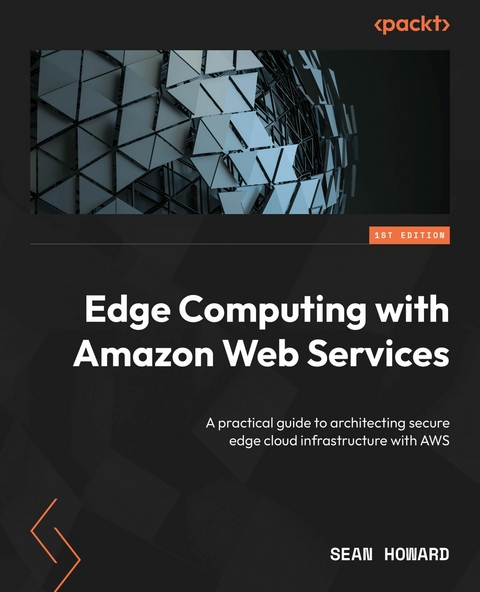
Edge Computing with Amazon Web Services (eBook)
378 Seiten
Packt Publishing Limited (Verlag)
978-1-83508-524-0 (ISBN)
No detailed description available for "e;Edge Computing with Amazon Web Services"e;.
Preface
During the last few decades, computing models have fluctuated between drives toward centralization and distribution. At first, all compute horsepower was centralized on a mainframe, user terminals had no ability to operate independently, and networking was very simple. Then, client-server architectures took over, and corporate data centers were filled with racks full of servers that weren’t much different than the clients they served. Next, those servers were virtualized to improve utilization and manageability. Finally, the bulk of those VMs were centralized in the cloud for similar reasons. Now, we are facing demand for a new hybrid model of cloud operation – distributed edge computing, sometimes known as Industry 4.0 or hybrid edge.
This shift is driven by the incredible growth in the number of networked devices, the amount of data they produce, and advances in our ability to process this data. A new hybrid edge computing model has emerged. This book aims to demystify this emerging computing model, particularly through the lens of architecting distributed edge applications in the Amazon Web Services (AWS) cloud.
Distributed edge computing allows us to process data and make decisions closer to its source. This approach reduces response time, lowers cost, and supports new use cases. AWS, with its world-class cloud and history of innovation, is uniquely positioned to help you capitalize on the strengths of centralization and distribution.
AWS services facilitate the deployment, management, and hosting of application components wherever they are needed. The AWS strategy is about reimagining what computing can look like when it is not constrained by physical location.
Throughout this book, we will explore offerings such as AWS Outposts, AWS Snow Family, AWS Wavelength, AWS Local Zones, AWS IoT Greengrass, and Amazon CloudFront. Whether it’s processing data on a remote oil rig, processing and distributing live video, supporting the latency requirements of augmented reality, or running a full-scale data center in a disconnected environment, AWS has a solution.
After covering the what and why of distributed edge computing, this book explains the how – with hands-on exercises and an example of Infrastructure-as-Code (IaC) that you can use as a starting point for your own applications.
Who this book is for
This book is for cloud architects, cloud engineers, solution architects, and enterprise architects who are already familiar with the AWS cloud. It is particularly useful for those facing requirements to move compute, storage, database, and/or machine learning resources closer to the sources of data – but who aren’t sure how to do so in a scalable, secure, and cost-effective manner.
What this book covers
Chapter 1, Getting Started with Edge Computing on AWS, introduces the concept of edge computing and its integration with cloud computing with a focus on AWS’s strategy and tools for edge computing solutions.
Chapter 2, Understanding Network and Security for Near Edge Computing, dives into the challenges and solutions for networking and security specific to near edge computing, including private WANs, GSLB, IP Anycast, and new protocols such as HTTP/3 and QUIC.
Chapter 3, Understanding Network and Security for Far Edge Computing, covers the networking and security aspects of far edge computing, including RF communications, cellular networks, Wi-Fi connectivity, Low-powered networks such as LoRaWAN, and integration with satellite communication systems (SATCOM).
Chapter 4, Addressing Disconnected Scenarios with AWS Snow Family, introduces AWS’s Snow Family products (Snowball Edge and Snowcone) and how they address the needs of disconnected or remote computing scenarios.
Chapter 5, Incorporating AWS Outposts into Your On-Premise Data Center, introduces AWS Outposts, offering insights into how it integrates with on-premise data centers and the various deployment options such as Outposts Rack and Server.
Chapter 6, Lowering First-Hop Latency with AWS Local Zones, introduces AWS Local Zones, explaining how they reduce latency by connecting on-premise networks to local AWS resources and routing internet traffic effectively into region-based applications.
Chapter 7, Using AWS Wavelength Zones on Public 5G Networks, introduces AWS Wavelength Zones, exploring their role in 5G networks, VPC extension, and integration with other AWS services.
Chapter 8, Utilizing the Capabilities of the AWS Global Network at the Near Edge, provides an overview of the AWS Global Network, its role in edge computing, and specific services offered at its edge such as Amazon CloudFront and AWS Global Accelerator.
Chapter 9, Architecting for Disconnected Edge Computing Scenarios, focuses on designing solutions for environments with limited connectivity, discussing AWS IoT services, tactical edge scenarios, and private 5G networks.
Chapter 10, Utilizing Public 5G Networks for Multi-Access Edge (MEC)Architectures, covers the architecture of 5G-based MEC solutions, comparing Wi-Fi and 5G in terms of observability, security, and capacity, and discusses applications such as V2X and software-defined video production.
Chapter 11, Addressing the Requirements of Immersive Experiences with AWS, discusses creating immersive experiences using AWS, including applications in online gaming, connected workers, and augmented/virtual reality.
Chapter 12, Configuring an AWS Snowcone Device to Be an IoT Gateway, details the process of setting up an AWS Snowcone as an IoT gateway, from ordering and configuring the device to deploying backend services and IoT Greengrass with AWS CloudFormation.
Chapter 13, Deploying a Distributed Edge Computing Application, details the process of quickly pushing a containerized application that runs on AWS Elastic Kubernetes Service, which has elements in a core Region, AWS Local Zones, and AWS Wavelength.
Chapter 14, Preparing for the Future of Edge Computing with AWS, concludes the book by discussing the future trends in edge computing, including business drivers, foundational strategies, and emerging patterns and anti-patterns in this field.
To get the most out of this book
It is assumed that you have a basic familiarity with general IT concepts such as IP networking, virtual machines, servers, and data centers, as well as an understanding of common AWS services equivalent to the AWS Certified Solution Architect – Associate level.
| Software/hardware covered in the book | Operating system requirements |
| AWS Command-Line Interface (CLI) >= 2.13.9 | Windows, macOS, or Linux |
| AWS Snowball Edge Client >= 1.2 | Windows, macOS, or Linux |
| AWS OpsHub >= 1.15 | Windows, macOS, or Linux |
| HashiCorp Terraform >=1.6 | Windows, macOS, or Linux |
| Kubectl >= 1.28 | Windows, macOS, or Linux |
If your workstation is Windows-based, it is strongly recommended that you install Windows Subsystem for Linux (WSL), specifically the Ubuntu LTS 22(x) environment available from the Windows Store. This will allow you to directly use the example commands given with no modification.
If you are using the digital version of this book, we advise you to type the code yourself or access the code from the book’s GitHub repository (a link is available in the next section). Doing so will help you avoid any potential errors related to the copying and pasting of code.
Download the example code files
You can download the example code files for this book from GitHub at https://github.com/PacktPublishing/Edge-Computing-with-Amazon-Web-Services. If there’s an update to the code, it will be updated in the GitHub...
| Erscheint lt. Verlag | 14.3.2024 |
|---|---|
| Sprache | englisch |
| Themenwelt | Mathematik / Informatik ► Informatik ► Datenbanken |
| Mathematik / Informatik ► Informatik ► Netzwerke | |
| Informatik ► Software Entwicklung ► SOA / Web Services | |
| Mathematik / Informatik ► Informatik ► Web / Internet | |
| ISBN-10 | 1-83508-524-5 / 1835085245 |
| ISBN-13 | 978-1-83508-524-0 / 9781835085240 |
| Informationen gemäß Produktsicherheitsverordnung (GPSR) | |
| Haben Sie eine Frage zum Produkt? |
 PDF (Wasserzeichen)
Größe: 29,4 MB
DRM: Digitales Wasserzeichen
Dieses eBook enthält ein digitales Wasserzeichen und ist damit für Sie personalisiert. Bei einer missbräuchlichen Weitergabe des eBooks an Dritte ist eine Rückverfolgung an die Quelle möglich.
Dateiformat: PDF (Portable Document Format)
Mit einem festen Seitenlayout eignet sich die PDF besonders für Fachbücher mit Spalten, Tabellen und Abbildungen. Eine PDF kann auf fast allen Geräten angezeigt werden, ist aber für kleine Displays (Smartphone, eReader) nur eingeschränkt geeignet.
Systemvoraussetzungen:
PC/Mac: Mit einem PC oder Mac können Sie dieses eBook lesen. Sie benötigen dafür einen PDF-Viewer - z.B. den Adobe Reader oder Adobe Digital Editions.
eReader: Dieses eBook kann mit (fast) allen eBook-Readern gelesen werden. Mit dem amazon-Kindle ist es aber nicht kompatibel.
Smartphone/Tablet: Egal ob Apple oder Android, dieses eBook können Sie lesen. Sie benötigen dafür einen PDF-Viewer - z.B. die kostenlose Adobe Digital Editions-App.
Buying eBooks from abroad
For tax law reasons we can sell eBooks just within Germany and Switzerland. Regrettably we cannot fulfill eBook-orders from other countries.
 EPUB (Ohne DRM)
Digital Rights Management: ohne DRM
Dieses eBook enthält kein DRM oder Kopierschutz. Eine Weitergabe an Dritte ist jedoch rechtlich nicht zulässig, weil Sie beim Kauf nur die Rechte an der persönlichen Nutzung erwerben.
Dateiformat: EPUB (Electronic Publication)
EPUB ist ein offener Standard für eBooks und eignet sich besonders zur Darstellung von Belletristik und Sachbüchern. Der Fließtext wird dynamisch an die Display- und Schriftgröße angepasst. Auch für mobile Lesegeräte ist EPUB daher gut geeignet.
Systemvoraussetzungen:
PC/Mac: Mit einem PC oder Mac können Sie dieses eBook lesen. Sie benötigen dafür die kostenlose Software Adobe Digital Editions.
eReader: Dieses eBook kann mit (fast) allen eBook-Readern gelesen werden. Mit dem amazon-Kindle ist es aber nicht kompatibel.
Smartphone/Tablet: Egal ob Apple oder Android, dieses eBook können Sie lesen. Sie benötigen dafür eine kostenlose App.
Geräteliste und zusätzliche Hinweise
Buying eBooks from abroad
For tax law reasons we can sell eBooks just within Germany and Switzerland. Regrettably we cannot fulfill eBook-orders from other countries.
aus dem Bereich